Why Is My Radiator Not Heating Up? 9 Common Causes and What to Check
You turn the heating on. Most of the house starts warming up. But one radiator remains stubbornly cold. Or perhaps the top gets warm while the bottom stays cold...
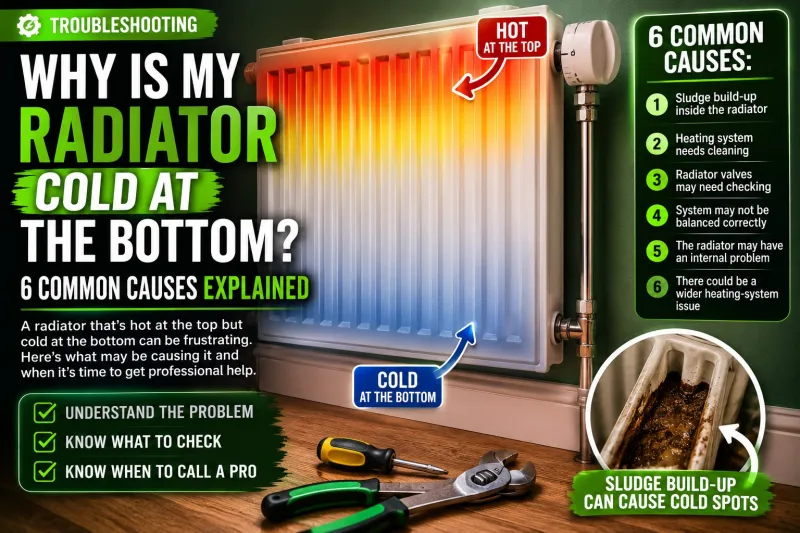
Or perhaps the top gets warm while the bottom stays cold.
Maybe it heats eventually, but never gets as hot as the others.
A radiator that isn't working properly can be frustrating, particularly once temperatures start dropping. But the way the radiator is behaving can also provide useful clues about what might be happening.
Before assuming you need a new radiator — or a new boiler — it helps to understand some of the common possibilities.1. The Radiator Is Cold at the Top
If the bottom of the radiator gets warm but the top remains noticeably colder, trapped air is one possible explanation.
Air can collect towards the top of a radiator and prevent hot water from filling it properly.
Bleeding the radiator releases that trapped air.
You may hear a hissing sound as it escapes, followed eventually by water reaching the bleed point.
However, don't repeatedly bleed radiators without paying attention to the rest of the heating system.
On a sealed system, bleeding can reduce system pressure. Check the boiler manufacturer's instructions and make sure the pressure remains within the appropriate range afterwards.
If radiators continually fill with air again, there may be an underlying issue worth investigating rather than simply bleeding them repeatedly.2. The Radiator Is Warm at the Top but Cold at the Bottom
This is a different pattern.
If the top heats normally while the lower section remains cold, one possible cause is a build-up of sludge or debris inside the radiator or heating system.
Over time, corrosion products and other material can accumulate within a central-heating system.
That can interfere with water circulation.
A small cold area doesn't automatically prove that sludge is responsible, but significant or recurring cold spots at the bottom are worth investigating.
Depending on the condition of the system, the solution might involve cleaning individual components or treating/flushing the wider heating system.
Simply bleeding the radiator is unlikely to solve a blockage at the bottom.3. The Entire Radiator Is Cold
If one radiator is completely cold while the others are working normally, start with the obvious controls.
Is the thermostatic radiator valve turned on?
Has the other valve accidentally been closed?
If both appear open, a valve may not actually be operating correctly.
One common problem involves the small pin inside some thermostatic radiator valves becoming stuck, particularly after the heating has been unused for a long period.
The control may appear to be open while the valve underneath isn't allowing water through properly.
That doesn't mean you should immediately start dismantling it.
First establish whether the valve itself is likely to be the problem.4. The Thermostatic Radiator Valve May Be Stuck
Thermostatic radiator valves — commonly called TRVs — regulate the flow of water through individual radiators in response to room temperature.
They're particularly noticeable at the beginning of the heating season.
A valve that hasn't moved for months may not behave exactly as expected when the heating comes back on.
If changing the TRV setting makes no difference while other radiators are working, the valve may need checking.
Sometimes the issue is relatively straightforward.
Other times the valve may be damaged or require replacement.
If you're uncertain about removing components or there's a risk of causing a leak, this is a sensible point to call someone who knows what they're looking at.5. The Heating System May Need Balancing
Imagine the radiators closest to the boiler become extremely hot very quickly.
Meanwhile, radiators further away take much longer to warm up.
That can indicate a balancing issue.
Balancing a heating system involves adjusting the flow through individual radiators so hot water is distributed appropriately around the system.
Without the correct balance, some radiators can receive more flow than they need while others struggle.
This is particularly worth considering if:
Some radiators heat much faster than others
Problems appeared after radiators were replaced
The heating system has recently been altered
Radiators further from the boiler consistently underperform
Balancing isn't the same thing as bleeding.
Bleeding removes trapped air.
Balancing adjusts water flow.
The two solve different problems.6. The Boiler Pressure Could Be Too Low
If several radiators aren't heating properly rather than just one, look at the wider heating system.
On many sealed central-heating systems, insufficient pressure can affect circulation.
The appropriate pressure varies by system, so check the boiler manufacturer's instructions rather than relying on a universal number.
If the pressure is low, the system may need repressurising according to those instructions.
But there's an important distinction between:
The pressure has dropped once
and:
The pressure keeps dropping.
Repeated pressure loss can indicate another problem — such as a leak or component fault — that needs investigation.
Continually topping the system up without finding out why the pressure disappears isn't a long-term solution.7. There Could Be a Circulation Problem
Your boiler can heat water perfectly well, but that heat still needs to travel around the system.
If hot water isn't circulating correctly, radiators may warm slowly, unevenly or not at all.
Possible circulation problems can involve several components and causes, including the pump, valves, restrictions within the system or its configuration.
This becomes more likely to require professional diagnosis because the symptom alone may not identify the faulty component.
If several radiators are affected and basic checks don't explain why, the problem may exist elsewhere in the system.8. The Radiator or Pipework Could Be Restricted
Heating systems don't remain perfectly clean forever.
Debris, corrosion products or restrictions can reduce the amount of water moving through part of the system.
Sometimes this affects one radiator.
Sometimes several.
And sometimes homeowners repeatedly bleed or adjust a problematic radiator without improving anything because air was never the problem.
A heating professional can assess temperatures and flow around the system to help determine whether circulation is being restricted.
The appropriate solution depends on what is actually found.9. The Problem Might Not Be the Radiator at All
This is an important one.
A cold radiator is a symptom.
It doesn't automatically mean the radiator itself has failed.
The underlying issue could involve:
The valve.
Pipework.
System pressure.
Balancing.
Controls.
Circulation.
The boiler.
Or the wider heating system.
Replacing the radiator without establishing the cause could therefore leave you with a brand-new radiator that still doesn't heat properly.What Does the Pattern Tell You?
Before changing anything, observe exactly what is happening.
Cold at the top?
Trapped air may be worth investigating.
Cold at the bottom?
Think about circulation, deposits or restrictions.
Completely cold while others are hot?
Check the individual radiator's controls and valves.
Several radiators struggling?
Start thinking about the wider heating system.
Some radiators hot and others consistently cooler?
Balancing or circulation may be relevant.
These aren't definitive diagnoses.
They're clues that can help narrow down the problem.Check the Simple Things First
Before assuming something expensive has failed, check:
Is the heating actually on?
Is the room thermostat calling for heat?
Is the radiator valve open?
Is the TRV turned up?
Are other radiators heating normally?
Is the boiler displaying a fault?
Is system pressure appropriate for your boiler?
Is the radiator cold everywhere or only in certain areas?
Those observations can be surprisingly useful if you later need to explain the problem to a heating engineer.
Instead of:
“The heating isn't working.”
you can say:
“Every radiator downstairs heats normally, but the bedroom radiator stays completely cold even with the TRV fully open.”
That's much more useful information.Don't Assume Every Radiator Should Feel Identical
Radiators won't necessarily all reach the same temperature at exactly the same time.
Their size, location, valve settings, system design and the temperature of individual rooms can all affect how they behave.
A TRV may also deliberately reduce flow once its room reaches the selected temperature.
The question isn't simply:
“Is this radiator as hot as that one?”
It's whether the heating system is warming the property as intended.When Might You Need a Heating Engineer?
Professional investigation becomes sensible when:
The same problem keeps returning.
Several radiators aren't heating.
You suspect sludge or poor circulation.
A valve is leaking or defective.
System pressure repeatedly drops.
The boiler displays a fault.
You're unsure how the heating system is configured.
Or basic checks haven't identified the cause.
If work involves the gas appliance itself, use an appropriately registered Gas Safe engineer.
Checking the pressure display or using normal homeowner controls is very different from opening a boiler and attempting repairs internally.
Don't remove the boiler casing or interfere with gas-related components yourself.
The radiator may be where you're noticing the problem, but if diagnosis leads back to the boiler, that's where DIY troubleshooting should stop.Fix the Cause, Not Just the Cold Radiator
A cold radiator can be something simple.
Sometimes it just needs bleeding.
Sometimes a valve isn't opening correctly.
Sometimes the system needs balancing.
But it can also be the first visible symptom of a wider circulation or heating-system problem.
That's why the pattern matters.
Look at where the radiator is cold.
Compare it with the others.
Check the controls.
Pay attention to boiler pressure and any fault messages.
And if the same problem keeps returning, investigate why rather than repeating the same temporary fix.
A radiator that isn't heating properly is giving you information — the key is working out what the rest of the heating system is telling you too.
0 Comments
No comments yet — be the first to share your thoughts.