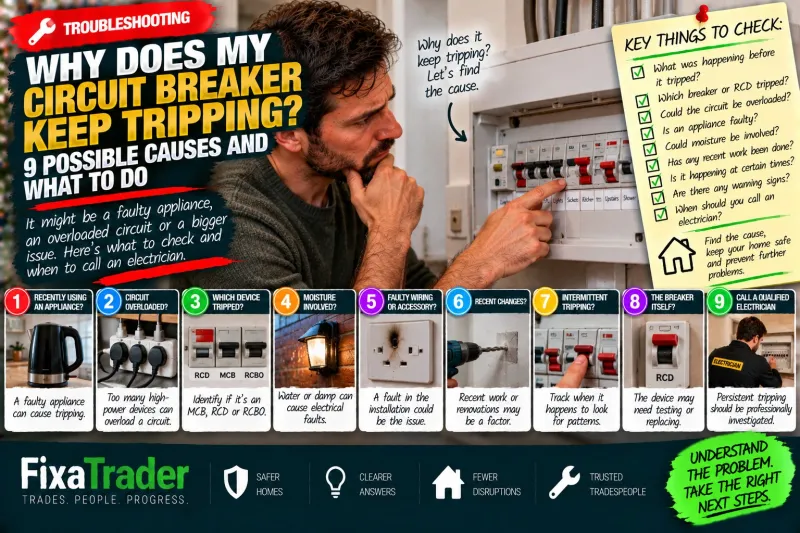
Why Does My Circuit Breaker Keep Tripping? 9 Possible Causes and What to Do
Everything suddenly goes off. The television. The kettle. The lights. Maybe an entire section of the house. You go to the consumer unit, find that something has...
You go to the consumer unit, find that something has tripped and reset it.
Everything comes back.
Problem solved?
Maybe.
Then it happens again.
A circuit breaker or other protective device operating isn't necessarily evidence that the device itself is faulty. Its purpose is to disconnect the electrical supply under certain abnormal conditions.
The important question is:
Why did it operate?
Sometimes the cause is relatively straightforward, such as a faulty appliance.
Other times, repeated tripping can indicate a problem with the electrical installation that needs investigation.
And unlike some household troubleshooting, this isn't an area where homeowners should start removing covers and experimenting with wiring.
You can gather useful information without taking the electrical system apart.1. Start With What Happened Immediately Before It Tripped
Before touching anything, think backwards.
What had just happened?
Did you switch the kettle on?
Start the washing machine?
Turn on the shower?
Plug in a heater?
Switch on an outside light?
Did several appliances start operating simultaneously?
Was there heavy rain?
Has any electrical work recently been completed?
Patterns are extremely useful when diagnosing electrical faults.
If the power trips every time one particular appliance is switched on, that's very different from seemingly random tripping across several circuits.
Make a note of what was happening.2. Identify What Has Actually Tripped
Modern consumer units can contain different types of protective devices, and understanding which device has operated can help narrow down what is happening.
Depending on the installation, you may encounter devices such as:
MCBs — miniature circuit breakers, commonly providing protection against overcurrent on individual circuits.
RCDs — residual current devices, designed to disconnect the supply when certain leakage or imbalance conditions are detected.
RCBOs — devices combining overcurrent and residual-current protection for individual circuits.
Your consumer unit may look different depending on its age and design.
You don't need to dismantle anything.
Simply noting which labelled switch or device has moved can provide useful information for an electrician.3. A Circuit May Be Overloaded
One possible reason for a breaker operating is excessive current.
Imagine a circuit supplying several high-demand appliances.
Individually, each appliance may be perfectly functional.
But the combined demand under particular circumstances may exceed what the circuit and protective device are designed to carry.
Portable electric heaters are a common example of appliances with relatively substantial power requirements.
This doesn't mean you should solve repeated tripping by replacing the breaker with one that has a higher rating.
Absolutely don't do that.
Protective devices are selected in relation to the circuit and installation.
Changing protection without properly assessing the circuit can create a serious safety issue.
If overloading is suspected, an electrician can determine whether that's actually what is occurring and what solution is appropriate.4. One Appliance Could Be Faulty
Sometimes the electrical installation isn't the source of the problem at all.
An appliance may have developed a fault.
Possible suspects can include almost anything connected to the electrical supply:
Kettles.
Toasters.
Washing machines.
Dishwashers.
Tumble dryers.
Heaters.
Fridges.
Freezers.
Power tools.
Outdoor equipment.
And countless other devices.
If tripping consistently occurs when a particular appliance is used, stop using that appliance until the cause is understood.
Don't repeatedly reset the protection and keep trying the appliance to see whether it “works this time”.
The protective device is giving you information.
Pay attention to it.5. Moisture Could Be Involved
Electricity and moisture don't make a good combination.
If tripping appears after:
Heavy rain.
A leak.
Flooding.
Condensation.
Outdoor electrical equipment getting wet.
Or water entering somewhere near electrical equipment...
...that timing matters.
External lights, garden equipment, outbuildings and outdoor connections are naturally exposed to harsher conditions than equipment inside the home.
Likewise, a plumbing leak can unexpectedly become an electrical problem if water reaches wiring, sockets, lights or other electrical components.
Don't start handling wet electrical equipment in an attempt to diagnose it.
If water has reached the electrical installation or there is any doubt about safety, get professional help.6. A Circuit or Accessory Could Have a Fault
Repeated tripping may originate within the fixed electrical installation.
Possible faults can occur in:
Cables.
Sockets.
Switches.
Lighting equipment.
Connections.
Accessories.
Junctions.
Or other parts of the circuit.
These aren't things a homeowner can reliably diagnose by looking at the front of a socket.
The fact that everything appears normal externally doesn't establish that the wiring behind it is fault-free.
Electrical testing is used to establish what is actually happening.
That's the point where appropriate test equipment and competence matter.7. A Recent Change May Be Relevant
Ask whether anything changed shortly before the problem began.
Has somebody:
Installed a new appliance?
Changed a light fitting?
Put screws into a wall?
Completed renovation work?
Worked on the electrical system?
Installed outdoor equipment?
Moved something?
Had a leak repaired?
Or carried out unrelated building work nearby?
Correlation doesn't automatically prove the cause.
But it's useful information.
A screw or fixing can potentially damage concealed services.
Work elsewhere may disturb existing wiring.
A newly connected appliance may reveal a problem.
Tell the electrician about recent changes rather than assuming they're irrelevant.8. The Problem Could Be Intermittent
Some faults don't occur continuously.
That's what makes them frustrating.
Everything works perfectly when somebody comes to inspect it.
Then two days later:
Click.
Power goes off again.
Try to record the circumstances each time it happens.
Note:
The date and time.
Which device tripped.
What appliances were running.
Which lights were on.
Whether it was raining.
Whether heating or hot-water equipment was operating.
And anything unusual you noticed.
A pattern that seems invisible after one event can become obvious after five.9. The Protective Device Itself May Need Investigation
It's possible for protective equipment itself to develop a problem.
But don't jump immediately to:
“The breaker must be faulty.”
Especially if replacing or resetting it would be more convenient than investigating why it keeps operating.
The device may be doing exactly what it's supposed to do.
An electrician can test the circuit and relevant protective equipment to determine whether the device is operating appropriately or whether another fault exists.
Diagnosis comes before replacement.Is It Safe to Reset a Tripped Breaker?
That depends on what has happened.
A device operating once doesn't necessarily mean there's an immediate catastrophe.
But you should first consider whether there are obvious warning signs.
If you can smell burning, see smoke, notice scorching, hear unusual electrical noises, know that water has reached electrical equipment or have another reason to suspect immediate danger, don't simply keep resetting the supply.
Likewise, if the device immediately trips again, repeated resetting isn't troubleshooting.
Something is causing it to operate.
Get the cause investigated.Can You Unplug Appliances to Find the Problem?
There are circumstances where identifying connected appliances can provide useful diagnostic information without opening the electrical installation.
For example, if a socket circuit is affected and there are no immediate danger signs, noting which appliances were connected or recently used can help identify a pattern.
But there are limits.
Don't unplug or handle equipment that's wet, damaged, overheating or otherwise unsafe to approach.
And don't assume that because unplugging one appliance appears to stop the tripping you've completed a full diagnosis of the electrical installation.
You've found a useful clue.
That's different.What If It Trips Only When Two Things Are Used Together?
That's valuable information.
Perhaps one appliance works.
Another appliance works.
But operating both under certain conditions causes the breaker to trip.
That could point toward the combined electrical demand or another issue that only appears under those operating conditions.
Again, don't solve this by changing the protective device yourself.
Tell the electrician exactly what combination produces the problem.
Reproducible faults are often much easier to investigate than:
“It goes off sometimes.”What If the RCD Won't Reset?
Don't force it.
If a protective device refuses to remain reset, there may still be a fault present.
An electrician can systematically investigate the affected circuits and equipment.
The answer isn't to repeatedly push the switch harder.
Likewise, never attempt to mechanically hold a protective device in the ON position.
If it won't stay on, treat that as information that needs investigating.What If the Whole House Loses Power?
First establish whether the problem is actually inside your property.
Look appropriately and safely for clues.
Are neighbouring properties affected?
Are street lights out?
Has the entire consumer unit lost supply rather than one protective device operating?
A wider electricity-network interruption is different from a fault on an individual household circuit.
If there appears to be a local power cut affecting the network, in Great Britain you can contact 105, the free power-cut number, which connects callers to their local electricity network operator.
If the issue appears confined to your property, the cause may require further investigation.Don't Remove the Consumer Unit Cover
This is an important boundary.
Looking at the switches and labels on the front of your consumer unit is one thing.
Removing covers to investigate wiring is another.
Don't start exposing internal electrical components because you're trying to find the tripping fault yourself.
Likewise, don't dismantle sockets, switches or fixed electrical equipment unless you're competent and legally able to undertake the work involved.
There is plenty of useful information you can gather without exposing live parts.Burning Smells, Heat and Scorching Need Attention
Some warning signs should move the problem beyond casual troubleshooting.
Pay attention to:
Burning or unusual electrical smells.
Discolouration.
Scorch marks.
Crackling or buzzing that isn't normal for the equipment.
Sockets or accessories becoming unusually hot.
Smoke.
Visible damage.
Or evidence that water has reached electrical components.
Stop using affected equipment and seek appropriate professional help.
Where there is fire, smoke or immediate danger to people, treat it as an emergency.Don't Ignore a Breaker Because It Eventually Stays On
Suppose the circuit trips.
You reset it.
It trips again.
You reset it.
It trips again.
You unplug a few things.
Eventually it stays on.
It's tempting to think:
“Great. Fixed.”
But what did you actually fix?
Unless you've identified a clear cause, all you know is that the conditions that caused the device to operate aren't present at this moment.
Repeated tripping deserves investigation.
Particularly if it is becoming more frequent.When Should You Call an Electrician?
Professional investigation is sensible when:
A breaker or RCD repeatedly trips.
The device immediately trips after being reset.
You can't identify any obvious appliance-related pattern.
Several circuits appear affected.
You notice burning smells, heat or discolouration.
Water may have reached electrical equipment.
The problem began after electrical or building work.
The consumer unit or accessories appear damaged.
The fault keeps returning unpredictably.
Or you simply aren't confident the electrical installation is safe.
For electrical work where registration or notification requirements apply, make sure the person undertaking the work is appropriately competent for what they're doing.Give the Electrician Useful Information
Instead of reporting:
“The electrics keep tripping.”
you might be able to say:
“The kitchen socket RCBO has tripped three times this week. Twice it happened when the dishwasher was running, and once overnight. It resets afterwards, but yesterday it tripped again after about twenty minutes.”
That's much more useful.
You haven't diagnosed the fault.
You've documented its behaviour.
If possible, note which protective device operated and photograph the consumer-unit labels without removing any covers.
Good information can make intermittent faults easier to investigate.The Breaker Isn't the Problem Just Because It's the Thing That Moves
When a protective device trips, it's highly visible.
The switch moves.
The power disappears.
So it's natural to blame the device.
But think of it differently.
A smoke alarm making noise isn't necessarily the problem in a smoky room.
Likewise, an electrical protective device operating may be responding to conditions it was specifically installed to detect.
Sometimes the device itself will require attention.
But first establish why it operated.
If a circuit breaker keeps tripping, don't make your goal “how do I stop it tripping?” Make your goal “what is causing the protection to operate?”—because finding that answer is what makes the electrical system safer.
0 Comments
No comments yet — be the first to share your thoughts.