Why Has My Door Started Sticking? 9 Possible Causes and What to Check
The door used to close perfectly. Now you have to push it. Or lift the handle slightly. Maybe the top corner catches the frame. Perhaps it closes in summer but...
Perhaps it closes in summer but becomes difficult every winter.
A sticking door is easy to dismiss as one of those little annoyances you eventually learn to live with.
Sometimes that's exactly what it is: a relatively straightforward adjustment.
But doors can also act as surprisingly useful indicators of what's happening around them.
Timber can respond to moisture. Hinges can loosen. New flooring can reduce clearance. Frames can move. And, less commonly, changes elsewhere in the building can alter the shape of the opening.
The important thing is not to jump immediately to the most serious explanation.
Start with where the door is catching and what changed before it started happening.
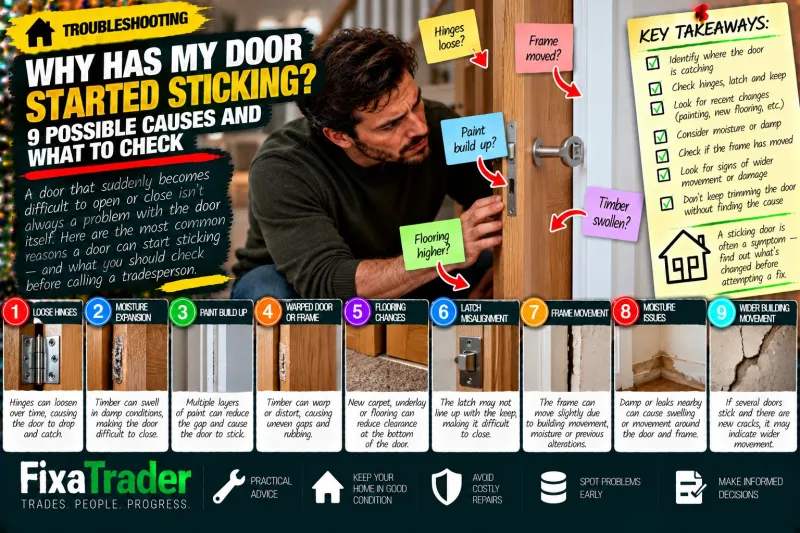
Here are nine possibilities.1. The Hinges Have Become Loose
Start with one of the simplest causes.
Doors place continuous load on their hinges, and fixings can loosen over time.
If that happens, the door may drop slightly.
Even a relatively small change can be enough for:
The top corner to catch.
The latch to stop lining up properly.
The bottom of the door to scrape.
Or the gap around the frame to become uneven.
Open the door and look at the hinges.
Do they appear secure?
Can you see movement between the hinge and the door or frame?
Does the door visibly drop when its weight comes onto the hinges?
Loose fixings don't automatically mean simply driving a screw harder into the same hole will solve everything. If the fixing has lost its hold, the underlying problem may need an appropriate repair.
But checking the hinges is a sensible first step before assuming the door itself needs cutting down.2. Timber Has Expanded With Moisture
Timber responds to its environment.
Changes in moisture can cause wooden doors and frames to expand or contract.
That means a door that operated perfectly during a dry period may begin catching when conditions become damper.
You might notice a seasonal pattern:
Fine in summer.
Sticks during wetter months.
External timber doors can be particularly exposed to changing conditions, but internal timber can also be affected by the environment inside the property.
The key question is whether the movement appears modest and seasonal or whether there's evidence of an underlying moisture problem.
If a door has suddenly swollen alongside visible dampness, staining or deterioration nearby, don't simply trim the door and ignore why it changed.3. Paint Has Reduced the Clearance
Several layers of decoration can gradually make a surprisingly tight gap even tighter.
A door is painted.
Then painted again a few years later.
The frame receives another coat too.
Eventually, an edge that once cleared comfortably begins rubbing.
This is particularly noticeable where the original gaps were already small.
Look at the area that's catching.
You may see:
Scuffing.
Shiny patches.
Scraped paint.
Or a visible build-up of coatings.
If the problem appeared shortly after decorating, paint thickness becomes an obvious possibility.
Allow new coatings to cure properly too. A surface that feels dry isn't necessarily fully hardened, and two freshly painted surfaces pressing together can sometimes stick.4. The Door or Frame Has Warped
Not all movement happens evenly.
A door can change shape rather than simply becoming slightly larger.
Timber may bow, twist or distort, while frames can also move.
Stand back and look at the door when it's nearly closed.
Are the gaps reasonably consistent?
Does one part touch while another has a noticeably larger gap?
Does the door appear flat relative to the frame?
A warped door may behave differently from one that has simply dropped on its hinges.
This is where repeatedly shaving material from whichever point currently catches can become a poor solution.
You might make the door close today while creating excessive gaps elsewhere.
The cause and extent of the distortion need to be understood first.5. The Floor Has Changed
Sometimes the door hasn't changed at all.
The floor has.
Perhaps you've installed:
New carpet.
Thicker underlay.
Laminate.
Engineered flooring.
Tiles.
A threshold.
Or another floor covering.
A door that previously had adequate clearance may now rub along the bottom.
This often becomes obvious because the problem begins immediately after flooring work.
Check whether the door catches throughout its swing or only at one point.
If new flooring has been installed, the door may need an appropriate adjustment.
But don't automatically start cutting the bottom off.
Consider how much material can safely be removed from that particular door and whether doing so could affect its construction or performance.
Certain specialist doors require particular care.6. The Latch and Keep Are No Longer Lining Up
Sometimes the door itself swings freely.
The difficulty appears only during the final part of closing.
You push the door and the latch hits the frame rather than entering the keep smoothly.
That can feel like the door is sticking even though the actual problem is alignment.
Look for marks around the keep showing where the latch is making contact.
Misalignment can result from:
Loose hinges.
A dropped door.
Movement in the frame.
Loose hardware.
Or previous adjustments.
Don't immediately enlarge holes until you understand why the alignment changed.
If the door has visibly dropped, correcting the cause may restore the latch position without modifying the frame unnecessarily.7. The Frame Has Moved Slightly
Door frames aren't completely independent of the building around them.
Movement in adjacent materials can alter the opening.
This doesn't automatically mean there's a structural problem.
Changes can occur because of:
Normal movement.
Alterations.
Moisture.
Poor previous installation.
Movement in surrounding finishes.
Or issues with the frame itself.
Look at the gaps around the closed door.
A reasonably even gap that has suddenly become narrow in one location can help show where the relationship between the door and frame has changed.
Also look around the surrounding wall.
Are there new cracks?
Has the architrave moved?
Are joints opening?
Is anything else nearby behaving differently?
One sticking door in an otherwise unchanged property is very different from several doors suddenly becoming difficult at the same time.8. Moisture May Be Affecting the Area
This deserves separating from ordinary seasonal timber movement.
Suppose a door beside a bathroom begins swelling.
There's staining around the frame.
Paint is bubbling.
The skirting feels damp.
Or the area has developed a musty smell.
Now you may have a moisture problem rather than simply a door problem.
Possible sources vary enormously.
There could be:
A plumbing leak.
Water entering externally.
Persistent condensation.
A failed seal elsewhere.
Or another source of moisture.
The sticking door is only the symptom.
If you simply trim it until it closes, the underlying moisture can continue affecting the surrounding materials.
Look beyond the edge that's rubbing.9. Movement Elsewhere in the Building May Need Investigation
This is the possibility people often jump to immediately:
“Does a sticking door mean subsidence?”
Not by itself.
Doors stick for many much more ordinary reasons.
Loose hinges, moisture, paint and minor alignment changes are common explanations.
However, a sticking door can become more significant when it appears alongside other changes.
For example:
Several doors or windows becoming difficult around the same period.
New or changing cracks around openings.
Noticeably distorted frames.
Cracks extending through masonry.
Or other visible movement in the building.
The pattern matters.
One bedroom door that's rubbed slightly every damp winter for five years isn't the same situation as several previously normal openings suddenly changing alongside new cracking.
If you're seeing a wider pattern of movement, appropriate professional assessment may be sensible.Work Out Exactly Where the Door Is Catching
Before adjusting anything, locate the contact point.
Close the door slowly.
Where does resistance begin?
Look for rubbing marks around:
The top edge.
Hinge side.
Latch side.
Bottom edge.
Corners.
You can often learn a lot from the location.
A top corner catching may point you towards alignment or hinge issues.
The entire bottom edge rubbing immediately after new carpet was installed points somewhere else.
A latch striking the keep while the door otherwise moves freely suggests another issue again.
Diagnosis before adjustment can prevent unnecessary work.Has Anything Changed Recently?
This is one of the most useful questions in home troubleshooting.
Think backwards.
Has the door recently been:
Painted?
Removed and rehung?
Fitted with new hardware?
Exposed to a leak?
Surrounded by new flooring?
Affected by renovation work?
Has the weather become significantly wetter?
Has another problem appeared nearby?
The timing can narrow down the possibilities considerably.
If the door began sticking the day after new carpet was fitted, you probably don't need to begin your investigation with structural movement.Be Careful With Fire Doors
Not every door should be treated as an ordinary internal door.
Fire doors and fire-resisting doorsets are designed to provide particular performance as part of a fire-safety arrangement.
Their clearances, hardware, seals, construction and installation can matter.
Randomly trimming substantial material, removing seals or altering components could compromise that performance.
If you suspect the sticking door is a fire door — particularly in flats, HMOs, communal areas or other situations where fire doors are important — avoid casual modifications.
Use someone competent to assess and adjust it appropriately.Don't Keep Planing the Door Every Time It Sticks
This is the door equivalent of repeatedly covering a crack without asking why it keeps returning.
The door catches.
You remove material.
Six months later it catches again.
You remove more.
Eventually the gap is enormous when conditions change back.
If the same problem repeatedly returns, establish the cause.
Perhaps the hinges are failing.
Perhaps moisture levels are changing significantly.
Perhaps the frame is moving.
Perhaps the door itself is distorted.
Removing material treats the contact point.
It doesn't necessarily treat the reason the contact exists.When Is It Probably a Straightforward Adjustment?
A relatively simple door issue is more likely where:
The cause is obvious.
The hinges are slightly loose.
The problem began immediately after decoration or flooring work.
There are no signs of damp.
There are no concerning cracks or wider movement.
Only one door is affected.
And the problem has remained minor and stable.
Even then, the appropriate repair depends on the door.
A carpenter, joiner or other suitable tradesperson can usually determine whether adjustment, repair or replacement makes most sense.When Should You Look Further?
Don't treat the door in isolation if you notice:
New cracking around the opening.
Significant distortion.
Several doors or windows changing together.
Persistent moisture.
Rotten or softened timber.
A frame becoming visibly loose.
Rapidly worsening alignment.
Or repeated adjustments failing to solve the problem.
Those clues suggest the sticking may be part of something else.
The correct professional depends on what is found.
A joiner might deal with the door and frame itself.
A plumber may be needed for a leak.
A roofer could be relevant if water is entering from above.
And suspected building movement may require assessment by an appropriately qualified professional.
The goal is matching the investigation to the evidence rather than assuming the most dramatic cause.Your Door Is Giving You a Clue
A sticking door is usually telling you that something has changed.
The change might be tiny.
A hinge has loosened.
Paint has built up.
The timber has responded to moisture.
New flooring has reduced the gap.
Or the latch has moved slightly out of alignment.
Sometimes the change is elsewhere, and the door is simply where you first notice it.
So before reaching for a plane, screwdriver or replacement door, take a minute to inspect what's actually happening.
Find the contact point.
Look at the gaps.
Check the hinges.
Think about recent changes.
Look for moisture.
And pay attention to what's happening elsewhere around the opening.
Most sticking doors won't indicate a serious building problem.
But understanding why the door has started sticking is much more useful than simply forcing it closed every day.
A sticking door is a symptom, not a diagnosis — find out what moved, swelled, loosened or changed before deciding what needs fixing.
0 Comments
No comments yet — be the first to share your thoughts.