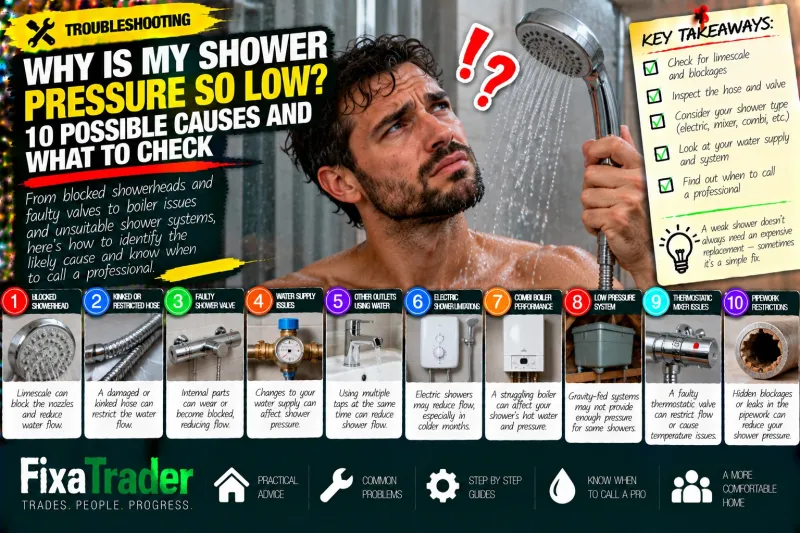
Why Is My Shower Pressure So Low? 10 Possible Causes and What to Check
You turn on the shower expecting a steady stream of hot water. Instead, you're greeted by a disappointing trickle. Perhaps the pressure has gradually become wea...
You turn on the shower expecting a steady stream of hot water.
Instead, you're greeted by a disappointing trickle.
Perhaps the pressure has gradually become weaker over several months.
Maybe it happened overnight.
Or the shower works perfectly until someone turns on a tap elsewhere in the house.
Low shower pressure is a frustrating problem, particularly when the rest of your plumbing appears to be working normally.
But there's an important distinction between low water pressure and poor water flow.
A shower can feel weak because the available pressure is insufficient, because something is restricting the flow or because the shower system itself has limitations.
The cause may be as simple as a blocked showerhead.
Or it could involve the shower valve, pipework, water supply or heating system.
Before replacing anything, it's worth understanding how your shower works and what the symptoms might indicate.
Here are ten possible causes.1. Your Showerhead Is Blocked With Limescale
One of the simplest explanations for a weak shower is a partially blocked showerhead.
Over time, mineral deposits can accumulate around the small openings where water exits.
This is particularly common in hard-water areas.
As the openings become restricted, the spray pattern may become uneven or noticeably weaker.
You might notice:
Water spraying sideways.
Some nozzles producing little or no water.
A reduction in flow over time.
Visible white deposits around the showerhead.
What to check:
Inspect the showerhead for visible deposits and follow the manufacturer's cleaning instructions.
Some showerheads have flexible rubber nozzles designed to make limescale removal easier.
Others can be dismantled for cleaning.
Avoid using aggressive chemicals or cleaning methods that could damage the finish or internal components.
If cleaning restores normal performance, the problem may have been limited to the showerhead.2. The Shower Hose Is Kinked or Restricted
If your shower uses a flexible hose, inspect its condition.
A hose can become twisted, kinked or damaged internally.
This may restrict water flow even when the showerhead itself is clean.
Check whether the hose bends sharply behind the shower fitting or becomes trapped when the showerhead is placed in its holder.
Also look for visible deterioration.
Some hoses contain an internal lining that can become damaged or collapse.
If the hose is defective, replacement with a compatible product may resolve the problem.
However, don't dismantle concealed plumbing or electrical shower components to investigate.
A simple external inspection is usually enough to identify obvious hose damage.3. The Shower Valve May Be Restricting Water Flow
Mixer showers use valves to control the amount and temperature of water delivered.
Over time, internal components can become affected by wear, debris or mineral deposits.
This may reduce flow or cause inconsistent temperature control.
Symptoms can include:
Weak flow from both hot and cold settings.
Difficulty adjusting the temperature.
A shower that performs differently from other outlets.
Flow that has gradually deteriorated.
Some valves contain filters or cartridges that can be serviced or replaced.
However, the correct approach depends on the shower model.
If the valve is concealed within the wall, professional investigation may be necessary.
Don't assume the entire shower needs replacing before establishing whether a serviceable component is responsible.4. Your Home's Water Supply Has Changed
Sometimes the shower isn't the source of the problem.
The water entering your property may have changed.
Possible reasons include temporary network work, a supply interruption, a partially closed valve or an issue with the incoming service pipe.
Check whether other cold-water outlets are affected.
For example, compare the flow from a cold kitchen tap with what you normally experience.
If several outlets have become noticeably weaker at the same time, the issue may be broader than the shower.
You can also check whether your water supplier has reported any local interruptions.
In England and Wales, your water company's website is usually the best starting point for supply-related updates.
If the problem appears to involve the property's internal plumbing, a plumber may need to investigate.5. Someone Else Is Using Water at the Same Time
Does your shower become weaker when the washing machine runs?
Or when someone turns on the kitchen tap?
This can happen when several outlets compete for the available water flow.
The effect depends on the property's plumbing layout, incoming supply and shower type.
Some systems are more sensitive to simultaneous demand than others.
You might notice that the shower performs normally when no other water is being used.
But the flow or temperature changes as soon as another outlet opens.
Try observing whether the problem only occurs during periods of high water demand.
If so, a plumber can assess whether the supply and plumbing arrangement are adequate for the household's needs.6. Your Electric Shower Has a Flow Limitation
Electric showers operate differently from showers supplied with hot water from a boiler or cylinder.
They heat incoming cold water as it passes through the unit.
The amount of water they can heat depends partly on the shower's electrical power rating and the temperature rise required.
During colder months, incoming water may be significantly cooler.
The shower may therefore need to reduce the flow to achieve the selected temperature.
This can make the shower feel weaker in winter.
A higher-powered electric shower may provide better performance under suitable conditions, but replacing one isn't simply a matter of choosing a more powerful model.
The electrical circuit, protective devices, cable sizing and water supply must all be suitable.
Electric shower installation or replacement should be assessed and carried out by appropriately competent professionals.
Never open an electric shower casing to investigate a fault yourself.7. Your Combi Boiler May Be Struggling to Supply Hot Water
If you have a combi boiler and a mixer shower, the boiler's hot-water performance can affect your shower.
Combi boilers heat domestic hot water on demand.
Their ability to deliver hot water depends on factors including boiler capacity, incoming water conditions and the flow being requested.
If the shower becomes weak or struggles to maintain temperature when another hot tap is opened, the system may be reaching its available capacity.
Other possible problems include faults affecting hot-water production or flow through the boiler.
Check whether the same issue affects other hot-water taps.
If hot-water performance has deteriorated throughout the property, arrange an assessment by a Gas Safe registered engineer where gas boiler work is involved.
Don't attempt to remove boiler covers or work on internal gas appliance components yourself.8. Your Gravity-Fed System May Not Provide Enough Pressure
Some older properties use gravity-fed hot-water systems.
These typically rely on the height difference between a cold-water storage cistern and the shower outlet to create pressure.
If the available height difference is limited, shower performance may be disappointing.
This can be particularly noticeable in upstairs bathrooms.
Certain shower systems are designed specifically for low-pressure installations.
Others may require a suitable pump or changes to the plumbing arrangement.
However, fitting a pump isn't automatically the correct solution.
The existing water system must be assessed for compatibility, and the installation needs to comply with applicable requirements.
A plumber can establish whether the problem is caused by the system design or a fault that has developed.9. A Faulty Thermostatic Mixer May Be Affecting Performance
Thermostatic mixer showers are designed to help maintain a consistent outlet temperature.
They adjust the balance of hot and cold water as supply conditions change.
But internal components can wear or become restricted.
This may cause reduced flow, temperature fluctuations or unexpected changes in performance.
A thermostatic shower may also respond to inadequate or unbalanced hot and cold supplies.
Before replacing the valve, it's important to establish whether the problem lies within the shower or elsewhere in the plumbing.
If the temperature suddenly becomes dangerously hot or unpredictable, stop using the shower until the issue has been assessed.
Temperature-control faults deserve attention because they can create a scalding risk.10. There May Be a Restriction or Leak in the Pipework
Sometimes the problem is hidden.
Pipework can become restricted by debris, corrosion or other defects.
A valve may not be fully open.
Or a leak may be affecting the supply.
The likelihood depends on the age, materials and condition of the plumbing system.
Possible warning signs include:
Reduced flow at several outlets.
Unexplained damp patches.
Water staining near plumbing routes.
Unexpected sounds when water is running.
A noticeable change following plumbing work.
Don't assume a concealed leak exists simply because the shower feels weak.
But if you notice signs of water damage, investigate promptly.
A plumber may need to test the supply and inspect accessible components to identify the cause.How to Work Out Whether the Problem Is Pressure or Flow
Homeowners often use the word pressure to describe how powerful a shower feels.
But pressure and flow are different measurements.
Water pressure describes the force available within the system.
Water flow describes the volume of water delivered over time.
A restriction can reduce flow even when the supply pressure is otherwise adequate.
This distinction helps explain why replacing a showerhead or valve can sometimes restore performance without changing the incoming water pressure.
A professional can measure pressure and flow where necessary.
For homeowners, the most useful starting point is comparing how different outlets behave.A Simple Shower Troubleshooting Checklist
Before calling a tradesperson, make a few safe observations.
Check the showerhead. Look for visible limescale or blocked spray openings.
Inspect the hose. Check for kinks, twists or obvious damage.
Compare other taps. Establish whether the problem affects only the shower.
Test at different times. Notice whether performance changes when other water outlets are used.
Check hot and cold performance. Where your shower allows it, observe whether one supply appears more affected.
Consider when the problem started. Was it gradual, sudden or following plumbing work?
Check for leaks. Look for visible signs of water damage.
Identify your shower type. Electric, mixer, power and gravity-fed systems can have different limitations.
These observations can help a professional narrow down the problem.
They don't require you to dismantle plumbing or electrical equipment.Should You Install a Shower Pump?
A shower pump can improve performance in some suitable low-pressure systems.
But it isn't a universal solution.
The correct pump depends on the plumbing arrangement, available water supply and manufacturer's requirements.
In particular, pumps must not be installed in ways that breach water supply regulations or create unsuitable conditions.
A pump that works with one system may be inappropriate for another.
Before purchasing one, ask a competent plumber to assess the installation.
Sometimes the real problem is a restriction or faulty component rather than insufficient pressure.Will a New Showerhead Improve Pressure?
Some showerheads are designed to provide a more concentrated or satisfying spray at relatively low flow rates.
This can improve the sensation of the shower.
However, a showerhead cannot create unlimited pressure or compensate for every supply problem.
Certain products may also be unsuitable for particular shower systems.
If the existing showerhead is heavily blocked or poorly matched to the installation, replacement could help.
But if the underlying problem involves the boiler, pipework or supply, changing the showerhead alone may achieve very little.What If the Shower Pressure Suddenly Drops?
A sudden change deserves more attention than a minor difference you've always experienced.
Consider whether there has been:
Recent plumbing work.
A local water supply interruption.
A new leak.
A boiler fault.
A change in how other taps perform.
An electrical shower warning or malfunction.
If you suspect a significant leak, take appropriate steps to limit damage and arrange assistance.
If an electric shower is malfunctioning, stop using it and seek professional advice.
If a gas boiler is involved, leave internal repairs to a Gas Safe registered engineer.When Should You Call a Plumber?
Professional investigation is sensible when:
Cleaning the showerhead doesn't help.
Flow remains weak despite no other outlets being used.
Hot-water performance has deteriorated.
The shower temperature fluctuates unexpectedly.
You suspect a hidden leak.
Several outlets are affected.
The shower valve or internal plumbing may be faulty.
Explain what you've observed.
Tell the tradesperson what type of shower you have, when the problem started and whether other taps are affected.
That information can make diagnosis more efficient.Don't Replace the Shower Before Finding the Cause
When shower performance becomes disappointing, replacing the entire unit can seem like the obvious solution.
But that may not solve the problem.
A new shower connected to an inadequate supply or restricted pipework could perform just as poorly.
Equally, an expensive pump may be unnecessary if the issue is simply a blocked component.
The sensible approach is to identify the cause first.
Start with straightforward external checks.
Compare the performance of other outlets.
Understand the type of system installed.
And seek professional help when the issue involves concealed plumbing, electrical equipment or heating appliances.
A weak shower doesn't always need an expensive upgrade — sometimes restoring proper performance starts with finding the restriction, fault or system limitation that's causing it.
0 Comments
No comments yet — be the first to share your thoughts.