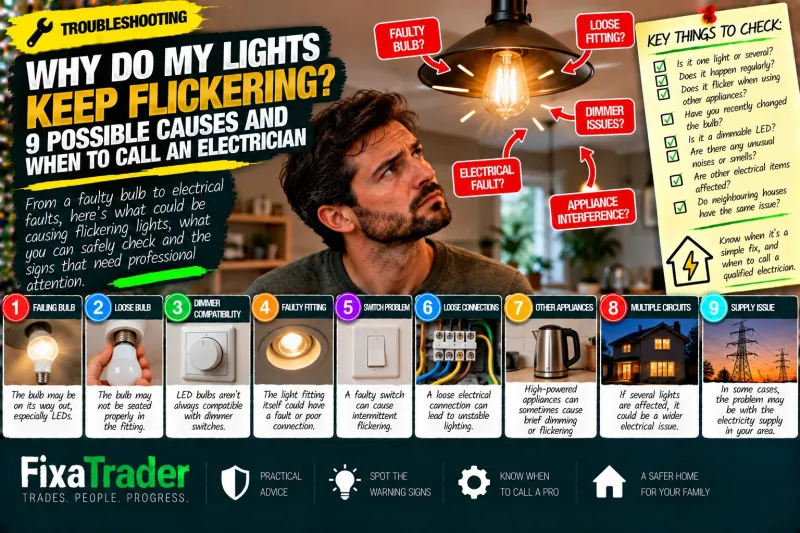
Why Do My Lights Keep Flickering? 9 Possible Causes and When to Call an Electrician
You're sitting in the living room and the light flickers. Once. Then again. Perhaps it stops. The next evening it happens again. At first, it's easy to dismiss....
You're sitting in the living room and the light flickers.
Once.
Then again.
Perhaps it stops.
The next evening it happens again.
At first, it's easy to dismiss.
Maybe the bulb is on its way out.
Maybe somebody switched on an appliance.
Maybe you imagined it.
But repeated flickering can become difficult to ignore, particularly when you don't know whether you're looking at a minor lighting problem or something electrical that needs investigating.
The useful question isn't simply:
“Why is my light flickering?”
It's:
“What else is happening when it flickers?”
One lamp behaving strangely is very different from several rooms dimming simultaneously.
Here are nine possible causes and the clues that can help you decide what to do next.1. The Bulb May Be Failing
Start with the simplest possibility.
If only one light is flickering and everything else in the home appears normal, the bulb itself could be responsible.
LED lamps don't necessarily fail by simply going dark.
You might notice:
Flickering.
Intermittent operation.
Reduced brightness.
Delayed startup.
Colour changes.
Or the light repeatedly switching between normal and abnormal operation.
If it's a normal user-replaceable bulb and you're comfortable doing so, switching the light off and replacing it with a suitable compatible lamp is a reasonable first check.
If the problem disappears, you've probably found the cause.
If the replacement behaves exactly the same way, look further.2. The Bulb May Not Be Seated Properly
A replaceable lamp needs to make proper contact with its fitting.
If it has become loose, intermittent contact may cause unstable operation.
Turn the light off before touching it and allow the lamp to cool if necessary.
Check that it is fitted correctly according to the type of lamp holder.
Don't overtighten it.
And don't continue using a fitting that appears:
Damaged.
Burnt.
Cracked.
Loose.
Or discoloured.
At that point, the issue may be with the fitting rather than the bulb.3. The LED Lamp and Dimmer May Not Be Compatible
This is an extremely common source of lighting problems.
A homeowner replaces older lamps with LEDs.
The lights work.
But when dimmed, they:
Flicker.
Buzz.
Jump between brightness levels.
Fail to dim smoothly.
Or refuse to operate properly at the lowest setting.
The problem may be compatibility between the LED lamps and the dimmer.
Not every LED is designed to be dimmed.
And not every dimmer is suitable for every LED load.
If flickering only occurs when the lights are dimmed—or started after changing the bulbs—compatibility is worth considering.
Check the lamp and dimmer manufacturer's information.
Don't start removing switches or altering wiring yourself simply to investigate it.4. The Light Fitting Could Have a Fault
If changing the bulb doesn't solve the problem, the fitting itself may need attention.
A connection or component within the fitting could be deteriorating.
You may notice:
Intermittent flickering.
A light that responds when the fitting is disturbed.
Buzzing.
Unusual heat.
Visible discolouration.
Or a burning smell.
Don't repeatedly manipulate a fitting to see whether you can make the fault happen.
If there are signs of overheating or damage, stop using it and have it inspected.
A flickering light accompanied by heat, burning smells or scorching should be treated very differently from an ordinary failing bulb.5. The Switch Could Be Involved
Sometimes the behaviour appears linked to the wall switch.
Perhaps the light flickers when switched on.
Maybe the switch feels different from normal.
You could notice:
Crackling.
Buzzing.
Unusual warmth.
Intermittent operation.
Or the light cutting in and out.
A normal light switch shouldn't feel excessively hot or make concerning electrical noises.
If it does, don't remove the faceplate and investigate the wiring yourself.
Have the switch and circuit checked by a suitably competent electrician.6. A Loose Electrical Connection Could Be Responsible
This is one of the reasons persistent flickering shouldn't automatically be dismissed as:
“Probably just the bulb.”
Electrical connections can deteriorate or become loose in different parts of an installation.
The symptoms depend on where the issue occurs.
You might experience:
One affected fitting.
Several lights on the same circuit.
Intermittent behaviour.
Changes when particular equipment operates.
Or other electrical symptoms elsewhere in the property.
Loose electrical connections can potentially create heat, making proper investigation important.
The connection may be somewhere completely inaccessible to the homeowner.
This isn't something to diagnose by opening electrical accessories and experimenting.7. A High-Powered Appliance May Coincide With the Flicker
Pay attention to when the lights change.
Does it happen when:
The kettle is switched on?
A shower operates?
A large appliance starts?
Heating equipment activates?
Another electrical load is used?
A very brief change in brightness when equipment starts isn't automatically evidence of a dangerous fault.
But repeated or pronounced dimming and flickering associated with other electrical loads can justify investigation.
Especially if the behaviour is new.
The pattern is useful information for an electrician.
Instead of simply saying:
“The lights flicker sometimes,”
you can say:
“The kitchen and hallway lights dim whenever this appliance starts.”
That is much more diagnostically useful.8. The Problem May Affect More Than One Circuit
This is where paying attention to the extent of the problem becomes particularly important.
Ask:
Is it one bulb?
One fitting?
One room?
Every light on one circuit?
Several unrelated rooms?
The entire property?
If multiple circuits appear affected simultaneously, the problem may not be isolated to a single light fitting.
That doesn't tell you what the fault is.
But it does tell you the investigation needs to look beyond the individual lamp.
Make a note of which areas are affected and whether other electrical equipment behaves unusually at the same time.9. The Issue Could Be With the Electricity Supply
Not every electrical problem originates inside your home.
In some circumstances, changes in the electricity supply can affect lighting.
A useful clue is whether neighbouring properties are experiencing the same thing.
If several nearby homes have lights flickering simultaneously, the issue may lie outside your individual installation.
In Great Britain, your local electricity network operator is responsible for the distribution network in your area.
For power cuts and electricity-network emergencies, 105 can be used to reach the appropriate network operator.
However, don't assume a supply problem simply because several lights in your own property are affected.
An electrician may need to establish whether the issue is internal or external.Start by Identifying the Pattern
Before doing anything else, observe what is happening.
You don't need electrical test equipment.
Just answer a few questions.
Is it one light or several?
One light points you towards a more localised issue.
Multiple lights broaden the possibilities.
Does it happen constantly or occasionally?
A continuous flicker is different from something that happens once every few days.
Does anything trigger it?
Watch for appliances, switches or other events occurring at the same time.
Did anything recently change?
For example:
New bulbs.
A new dimmer.
A replacement fitting.
Electrical work.
A new appliance.
Building work.
Or a recent fault elsewhere.
Changes can provide valuable clues.Try Another Suitable Bulb—But Know Where DIY Stops
For a normal user-replaceable lamp, substituting a known suitable bulb is one of the few simple checks most homeowners can reasonably make.
If the problem follows the bulb, that's useful.
If the problem remains with the fitting, that is also useful.
But once investigation requires you to:
Remove switches.
Open electrical fittings.
Access fixed wiring.
Remove consumer-unit covers.
Or test live electrical components,
you've moved into a different category of work.
Don't keep dismantling things until you find the fault.What If an LED Bulb Flickers Even When It's Switched Off?
Some homeowners notice LED lamps giving occasional flashes or a faint glow even when the light is supposedly off.
LEDs require very little energy to produce visible light, and certain electrical arrangements or controls can allow tiny currents that weren't noticeable with older lamp technologies to become visible.
There can be several explanations.
Rather than assuming the bulb is faulty, check whether the lamp is appropriate for the installation and controls.
If the behaviour persists or you're uncertain about the cause, an electrician can investigate the circuit and switching arrangement.What If Every Light in the House Flickers?
Treat this differently from one failing bedside lamp.
If lighting throughout the property suddenly begins:
Flickering.
Dimming significantly.
Becoming unusually bright.
Or changing brightness unpredictably,
there may be a wider electrical or supply issue.
Particularly concerning symptoms include:
Burning smells.
Buzzing or crackling.
Visible sparking.
Overheating.
Smoke.
Electrical equipment behaving abnormally.
Or signs of damage around the consumer unit or electrical accessories.
But “loose wiring” is often used online as a catch-all explanation for almost any electrical symptom.
The important thing is not to diagnose the installation from a symptom alone.
Flickering could relate to:
The lamp.
Driver electronics.
Dimmer compatibility.
A fitting.
A switch.
A connection.
The circuit.
Or the wider supply.
Proper testing may be required to determine which.
Could It Be the Consumer Unit?
Potentially, electrical problems elsewhere in the installation can produce symptoms that appear at the lights.
But a flickering lamp does not automatically mean:
“There's something wrong with the fuse box.”
The consumer unit is also not something homeowners should open up to investigate internally.
If an electrician suspects a wider installation issue, they'll determine what testing is appropriate.Should You Keep Using a Flickering Light?
It depends on what you're observing.
An old LED lamp occasionally flickering shortly before failing is very different from a fitting that is:
Crackling.
Overheating.
Smelling burnt.
Or visibly damaged.
If there are signs suggesting overheating or an electrical fault, stop using the affected equipment where it is safe to do so and arrange appropriate professional advice.
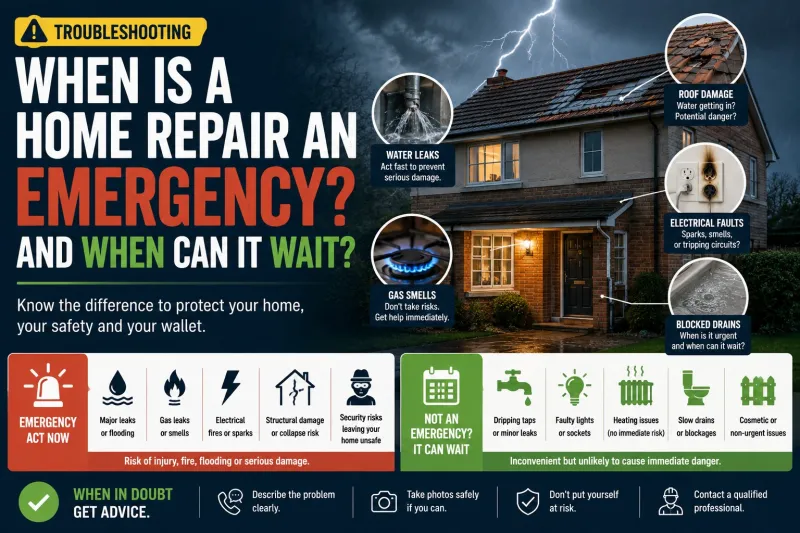
Don't continue operating something obviously abnormal simply to see whether it gets worse.When Should You Call an Electrician?
Consider having the problem investigated if:
The flickering continues after replacing a suitable bulb.
Several lights are affected.
The issue is becoming more frequent.
Lights dim substantially when other equipment operates.
A switch or fitting behaves abnormally.
There is buzzing or crackling.
A fitting or switch becomes unusually hot.
You can see scorching or discolouration.
There's a burning smell.
Circuit breakers or RCDs are also operating.
Or you simply cannot identify a harmless explanation.
Repeated unexplained behaviour is itself a reason to investigate.When Is It More Urgent?
Seek urgent help if the flickering is accompanied by signs such as:
Smoke.
Sparking.
A strong burning smell.
Obvious overheating.
Visible electrical damage.
Or another indication of immediate electrical danger.
If there's a fire or immediate danger to life, call 999.
For an electricity-network emergency or power cut in Great Britain, 105 connects you to the relevant network operator.
Don't touch damaged electrical equipment or exposed conductors.Give the Electrician Useful Information
You can make diagnosis easier without touching any wiring.
Tell them:
Which lights are affected.
How often it happens.
When it started.
Whether bulbs have been replaced.
Whether the lights are dimmable.
Whether anything triggers the flickering.
Whether any recent electrical work has taken place.
Whether breakers or RCDs have operated.
And whether there are other symptoms.
If the problem is intermittent, a short video can sometimes be useful if you can record it safely.
An intermittent fault that behaves perfectly during the electrician's visit can otherwise be difficult to demonstrate.Don't Ignore a Problem Just Because It Disappears
Intermittent electrical faults can be frustrating.
The light flickers for three evenings.
You finally decide to arrange an electrician.
Then it stops.
A week later, it returns.
The fact that a symptom disappears doesn't necessarily tell you the underlying cause has disappeared.
If the behaviour was significant, repeated or accompanied by other warning signs, mention the history even if everything happens to be working normally at that moment.One Flickering Bulb and a Flickering House Are Two Very Different Problems
That's the most useful distinction to remember.
If one replaceable bulb starts flickering, checking the lamp itself is a sensible place to begin.
But as the number of affected lights increases—or additional symptoms appear—the likelihood that you're dealing with something beyond a simple failed bulb also increases.
Don't jump straight to the worst conclusion.
But don't repeatedly dismiss unexplained electrical behaviour either.
Observe the pattern.
Check the simple things that can be checked safely.
And know when the investigation needs to move from the homeowner to someone competent to test the electrical installation properly.
A flickering light is a symptom, not a diagnosis—the number of lights affected, when it happens and what happens alongside it can tell you far more than the flicker alone.
0 Comments
No comments yet — be the first to share your thoughts.