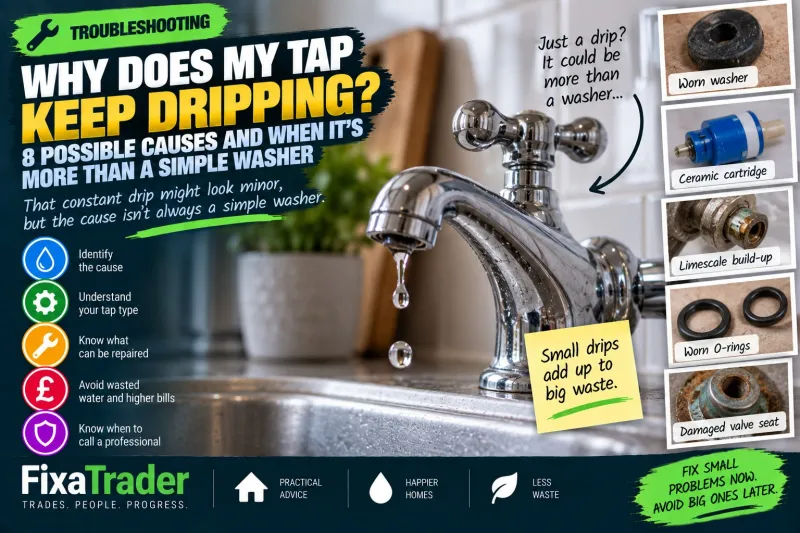
Why Does My Tap Keep Dripping? 8 Possible Causes and When It’s More Than a Simple Washer
Drip. Drip. Drip. During the day, you barely notice it. Then the house goes quiet at night and suddenly the kitchen tap sounds like it's trying to drive you mad...
Then the house goes quiet at night and suddenly the kitchen tap sounds like it's trying to drive you mad.
The traditional advice is simple:
“It probably needs a new washer.”
And sometimes it does.
But modern taps come in many different designs, and plenty don't rely on the traditional rubber washer people have in mind.
A persistent drip can result from worn internal components, damaged sealing surfaces, excessive movement or even a problem somewhere other than the spout itself.
Here are eight possibilities worth understanding.1. A Traditional Washer Has Worn Out
Let's start with the familiar one.
Some traditional compression taps control the flow of water by pressing a washer against a valve seat.
Over time, that washer can wear, harden or become damaged.
It may no longer create a reliable seal when the tap is closed.
The result?
Water continues to pass through.
This is where the classic:
“It just needs a washer.”
comes from.
For the right type of tap, that diagnosis may be perfectly reasonable.
The problem is assuming every tap works this way.2. The Tap Uses a Ceramic Cartridge Instead
Many modern taps use ceramic-disc cartridges rather than traditional compression washers.
Turn the handle and ceramic components inside control the flow.
These taps often require much less rotation between off and fully on.
When a cartridge becomes worn, damaged or contaminated, the tap may begin dripping or become difficult to operate properly.
Replacing a rubber washer won't solve that problem because there may not be a conventional washer controlling the flow in the first place.
The correct replacement cartridge also needs to match the tap.
That's one reason identifying the tap or cartridge can be important before dismantling everything.3. An O-Ring or Internal Seal Has Deteriorated
Not every leak appears from the end of the spout.
Sometimes water appears:
Around the handle.
Near the base of the spout.
Around a moving joint.
Or underneath part of the tap body.
Taps contain various seals depending on their design.
Over time, those components can deteriorate, become damaged or stop sealing effectively.
Where the water appears can therefore provide a useful clue.
A tap dripping from its spout and a tap leaking around its base aren't necessarily experiencing the same fault.4. The Valve Seat Could Be Damaged
Replacing a worn washer won't necessarily solve a leak if the surface it seals against is damaged.
In a traditional tap, the washer needs an appropriate surface to close against.
If that area has become worn, corroded or damaged, a new washer may still struggle to create a proper seal.
This can explain the frustrating situation where somebody replaces the washer only to discover:
The tap still drips.
Repeatedly replacing the same component without investigating why it keeps failing can waste both time and parts.5. Limescale or Debris May Be Interfering With the Mechanism
Hard-water areas can be particularly familiar with limescale.
Deposits and debris can affect moving components and sealing surfaces inside plumbing fittings.
Depending on the tap design, this can contribute to poor operation or prevent components from sealing as intended.
You may also notice:
Stiff operation.
Reduced flow.
Uneven water flow.
Or visible scale around the outlet.
That doesn't mean every dripping tap in a hard-water area is caused by limescale.
But it's another reason the fault may be more complicated than simply tightening the handle harder.6. You're Closing the Tap Too Hard
When a tap drips, the instinct can be:
Turn it tighter.
Then tighter again.
That might temporarily stop the water.
But repeatedly forcing a traditional tap closed can place additional stress on its internal components.
A functioning tap shouldn't require a wrestling match every time you use it.
If it only stops dripping when excessive force is applied, something may need repairing.
Continuing to overtighten it isn't necessarily the repair.7. The Tap Itself May Be Reaching the End of Its Useful Life
Not every old tap is worth rebuilding indefinitely.
Perhaps the finish is deteriorating.
Several components are worn.
Replacement parts are difficult to identify.
It has already been repaired repeatedly.
Or the tap body itself is in poor condition.
At some point, replacing the complete tap may make more sense than continuing to repair individual parts.
But age alone isn't enough reason to throw something away.
A good-quality tap with a readily available replacement cartridge may be perfectly economical to repair.
The decision depends on the condition, fault, parts availability and cost of the alternative.8. The Water May Not Actually Be Coming From the Tap Mechanism
This is particularly important when you notice water underneath a sink.
The immediate assumption might be:
“The tap is leaking.”
But water can potentially originate from several nearby places.
Supply connections.
Flexible hoses.
Waste pipework.
Sink seals.
Appliance connections.
Or water spilled around the sink itself.
Water also travels.
The place where you see a droplet isn't always the place where the leak started.
Before replacing the tap, establish where the water is actually coming from.
How Much Water Can a Dripping Tap Waste?
The amount varies enormously depending on how quickly the tap is dripping.
A slow occasional drip and a continuous small stream aren't comparable.
But any water passing through a closed tap is water you're not intending to use.
If it's hot water, there may also have been energy used to heat it.
Rather than becoming obsessed with calculating exactly how many litres each individual drip represents, the practical point is simpler:
A tap that won't shut off properly is worth fixing.
It usually isn't going to repair itself.Can You Repair a Dripping Tap Yourself?
Some tap repairs can be relatively straightforward for somebody competent and comfortable with basic plumbing.
But don't begin dismantling the tap until you know how the water supply will be safely isolated.
Also remember that different taps contain different components.
Before starting, establish:
What type of tap you have.
How it is isolated.
Whether replacement parts are available.
And whether you have the tools and ability to reassemble everything correctly.
A ten-minute repair can quickly become:
“Why can't I turn the water back on?”
if something doesn't go to plan.What If You Can't Find the Correct Cartridge?
This can be one of the most frustrating parts of repairing modern taps.
Cartridges come in numerous designs and sizes.
Two taps that look almost identical externally may not necessarily use the same internal component.
If you know the manufacturer and model, start there.
Documentation, supplier information or the manufacturer may help identify the appropriate replacement.
Avoid forcing a component that merely looks approximately right.
If the correct part can't be identified or sourced economically, replacing the tap may eventually become the more practical option.Don't Ignore Water Under the Sink
A dripping spout is annoying.
A leak underneath the sink can be considerably more damaging.
Water can affect:
Cabinetry.
Flooring.
Decoration.
Nearby materials.
And potentially the room below depending on the location.
If you find moisture underneath, investigate it rather than assuming it's harmless condensation or an occasional splash.
A slow leak can cause damage precisely because it can remain unnoticed for a long time.When Should You Call a Plumber?
Consider professional help if:
You can't confidently isolate the water.
The source of the leak isn't obvious.
The tap continues leaking after an attempted repair.
Pipework or connections underneath are leaking.
The fitting is badly corroded or damaged.
You can't identify the correct replacement components.
Or what looked like a simple tap problem appears to involve something more substantial.
There's nothing wrong with attempting appropriate minor maintenance when you know what you're doing.
There's also nothing wrong with deciding that dismantling an unfamiliar fitting isn't how you want to spend Saturday afternoon.Start by Identifying the Leak
Before buying washers, cartridges or an entirely new tap, answer one question:
Where exactly is the water coming from?
From the spout?
Around the handle?
Around the base?
From a connection underneath?
Only when you know that can you start narrowing down the likely cause.
Because the familiar advice that “a dripping tap just needs a new washer” comes from a time when many taps worked in broadly the same way.
Modern plumbing isn't always that simple.
A dripping tap is usually telling you that something is no longer sealing properly — the important part is finding out what before you start replacing it.
0 Comments
No comments yet — be the first to share your thoughts.