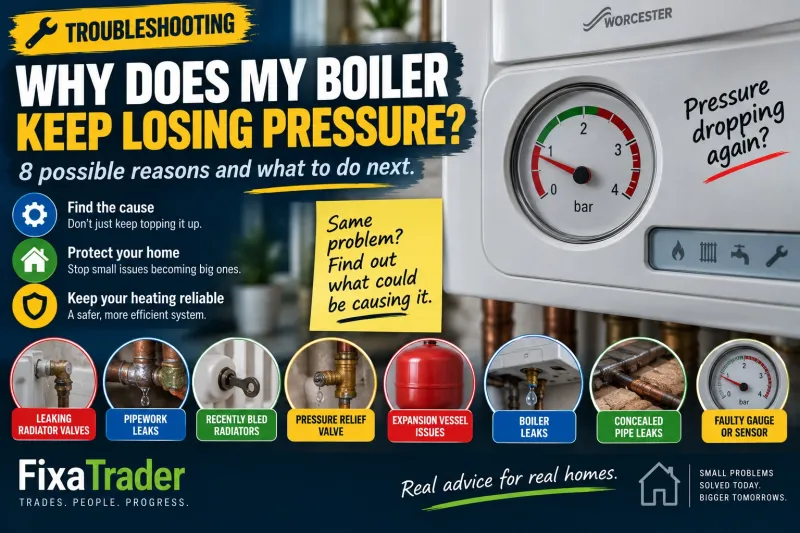
Why Does My Boiler Keep Losing Pressure? 8 Possible Reasons and What to Do Next
You look at your boiler and notice the pressure has dropped. You repressurise it. Everything starts working normally again. Then a few days later, the pressure...
You look at your boiler and notice the pressure has dropped.
You repressurise it.
Everything starts working normally again.
Then a few days later, the pressure is low again.
So you top it up once more.
Problem solved?
Not necessarily.
A heating system can occasionally need attention to its pressure, but repeatedly losing pressure usually means it's worth finding out why.
There are several possible causes, ranging from relatively straightforward issues to faults that need a heating professional to investigate.
The important thing is not to assume that continually topping up the system is the repair.
It's usually treating the symptom.First: What Does Boiler Pressure Actually Mean?
In many sealed central-heating systems, water circulates through a closed system containing the boiler, pipework and radiators.
The system needs to operate within an appropriate pressure range.
Your boiler normally has a pressure gauge or digital pressure reading that allows you to see what's happening.
The correct pressure varies by system and manufacturer, so the boiler's instructions should always take priority over a generic number found online.
For many domestic systems, however, you'll commonly see something around 1 to 1.5 bar when the system is cold.
Pressure will normally increase somewhat as the heating warms up.
The interesting part isn't necessarily one particular reading.
It's how the pressure behaves over time.1. There Could Be a Small Leak Somewhere
One of the more obvious explanations for pressure repeatedly falling is that water is escaping from the heating system.
But don't expect every leak to create a puddle in the middle of the floor.
Some can be extremely small.
Check accessible areas around:
Radiators
Radiator valves
Visible pipework
The boiler
Towel radiators
Exposed heating connections
Look for moisture, staining, corrosion or areas that repeatedly feel damp.
A tiny leak can lose relatively little water at any one moment while still causing system pressure to gradually decrease.
And some leaks may be concealed beneath floors or inside walls, making them much harder to identify.2. Check Around Your Radiator Valves
Radiator valves and their connections are worth inspecting carefully.
A very small leak might evaporate before creating an obvious pool of water.
Instead, you may notice:
Discolouration.
Rust.
A greenish or white deposit around a fitting.
A slightly damp connection.
Or staining beneath the valve.
You don't need to start tightening fittings yourself simply because something looks suspicious.
Overtightening or disturbing an old fitting can potentially make matters worse.
If you've identified what appears to be a leak, show it to the person investigating the pressure loss.3. Have You Recently Bled the Radiators?
Bleeding a radiator releases trapped air.
Some system pressure can also be lost during the process.
So if the boiler pressure has fallen shortly after you've bled several radiators, the two things may be connected.
The system may need to be returned to its appropriate cold pressure afterwards in accordance with the boiler manufacturer's instructions.
But there is an important distinction.
Pressure falling after you've deliberately released air is one thing.
Pressure continually falling afterwards is another.
If you're repeatedly bleeding radiators because air keeps returning and regularly topping up the boiler, there may be an underlying issue worth investigating.4. The Pressure Relief Valve Could Be Involved
Heating systems incorporate safety devices, including a pressure relief valve.
If excessive pressure occurs, the valve can allow water to discharge from the system.
Depending on the installation, that water may leave through a discharge pipe terminating outside the property.
This creates an interesting situation for homeowners.
You can be losing water from the heating system without seeing any water inside the house.
If you can safely view the relevant external discharge pipe from ground level, persistent dripping or evidence that water has been discharging may be useful information for a heating engineer.
Don't dismantle the boiler or safety components to investigate it yourself.5. There Could Be an Expansion Vessel Problem
A sealed heating system needs somewhere to accommodate the expansion of water as it heats.
That's one of the functions of the expansion vessel.
If there is a problem with the expansion vessel or its charge, the system pressure can behave abnormally.
One pattern you might notice is:
The pressure looks reasonable while the system is cold.
The heating comes on.
The pressure rises significantly.
Later, when everything cools down, the pressure falls very low.
That behaviour can provide a useful clue.
It doesn't mean you should diagnose or repair the expansion vessel yourself.
But telling an engineer how the pressure changes between cold and hot can help them investigate.6. The Boiler Itself Could Have a Leak
Not every leak occurs somewhere around a radiator.
Water can potentially escape from components within or around the boiler itself.
You may notice moisture beneath the boiler or evidence of leaking around accessible areas.
However, the internal components of a boiler aren't something homeowners should dismantle to investigate.
This is particularly important with gas boilers.
If you suspect the problem is inside the appliance, have it assessed by an appropriately qualified professional.
For gas-boiler work in the UK, that means checking that the engineer is appropriately registered with the Gas Safe Register for the work being undertaken.7. A Concealed Pipe Could Be Leaking
This is the frustrating possibility.
You inspect every radiator.
Everything is dry.
There's nothing underneath the boiler.
No obvious leaking valves.
But the pressure still falls.
Heating pipes can run:
Under floors.
Inside walls.
Behind kitchen units.
Through boxed-in sections.
Under screed.
And through other concealed areas.
A hidden leak therefore isn't always immediately visible.
That doesn't mean the first response should be tearing floors apart looking for water.
A heating professional can assess the system and determine what further investigation is appropriate.
The rate at which pressure is being lost can also be useful information.8. The Pressure Gauge or Sensor Could Be Misleading You
Sometimes the problem may relate to the way pressure is being measured or displayed rather than simply water disappearing from the system.
Depending on the boiler, pressure may be shown by a mechanical gauge or electronic sensor.
A fault affecting the reading could potentially create confusing behaviour.
This is another reason not to diagnose the entire heating system from the pressure display alone.
An engineer can assess whether the reading reflects what is actually happening within the system.How Quickly Is the Pressure Dropping?
This is one of the most useful things you can observe.
Does it fall from its normal cold pressure to very low:
Within hours?
Overnight?
Over several days?
Over several weeks?
Those are very different patterns.
Also note whether the pressure behaves differently when the heating is operating.
For example:
Cold: 1.2 bar
Heating running: 2.7 bar
Cold again the following morning: 0.5 bar
Those observations can be much more useful to an engineer than simply saying:
“The pressure keeps going down.”
You don't need to interpret the numbers yourself.
Record what happens.Should You Just Keep Topping It Up?
Repeatedly repressurising the system can become a habit.
Pressure drops.
Top it up.
Pressure drops.
Top it up again.
The heating continues working, so the problem feels solved.
But if pressure is repeatedly being lost, water is either potentially leaving the system or something else requires investigation.
Continually introducing fresh water into a heating system isn't a substitute for finding the cause.
Follow the manufacturer's instructions if the system genuinely needs repressurising, but don't turn frequent topping-up into the permanent solution.Be Careful Not to Overpressurise the System
More pressure isn't better.
If you're repressurising a boiler, follow the manufacturer's instructions and stop at the appropriate pressure.
Don't keep adding water because you think a higher reading will prevent it falling again.
An overpressurised system can create other problems and may cause the pressure relief valve to operate.
If you aren't confident about the correct procedure for your boiler, check its manual or ask a competent heating professional.What Information Should You Give an Engineer?
Before arranging a visit, a little observation can help.
Tell them:
How frequently you're topping up the pressure.
What the pressure is when the system is cold.
How high it rises when the heating is running.
How quickly it falls afterwards.
Whether you've recently bled any radiators.
Whether you've found visible leaks.
Whether you've noticed water from an external discharge pipe.
Whether the boiler displays any fault codes.
And when the problem first started.
Photographs of the pressure reading at different times can be useful too.
You're not trying to diagnose the system for them.
You're giving them evidence.When Should You Get Professional Help?
If the boiler repeatedly loses pressure despite being correctly repressurised, it's sensible to have the cause investigated.
Professional attention becomes particularly important if you notice:
Visible leaking.
Rapid pressure loss.
Large pressure changes as the heating warms and cools.
Water around the boiler.
Repeated fault codes.
Persistent discharge outside.
Or a system that continually needs topping up.
If you smell gas or suspect a gas leak, that's different from an ordinary boiler-pressure fault and should be treated according to current gas-emergency guidance.Don't Remove the Boiler Casing to Find the Problem
It's understandable to want to see where the water is going.
But boiler internals aren't an appropriate place for DIY investigation.
There are plenty of useful observations you can make without opening the appliance.
Inspect visible radiators and pipework.
Record the pressure.
Look for obvious external leaks.
Note when the pressure changes.
Then leave appliance investigation and safety-critical work to someone appropriately competent.The Pressure Gauge Is Giving You Information
A boiler losing pressure isn't a diagnosis.
It's a symptom.
The cause could potentially be a leaking radiator valve.
A hidden pipe leak.
A pressure relief issue.
An expansion-vessel problem.
Something within the boiler.
Or another system fault.
That's why repeatedly moving the gauge back to the “right” number doesn't necessarily solve anything.
If you have to keep topping up your boiler, don't just ask how to restore the pressure.
Ask why the pressure keeps disappearing in the first place.
0 Comments
No comments yet — be the first to share your thoughts.