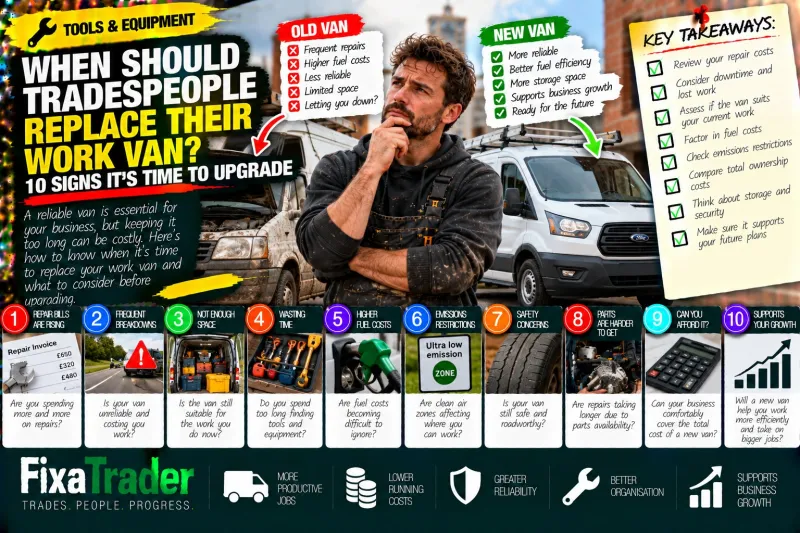
When Should Tradespeople Replace Their Work Van? 10 Signs It's Time to Upgrade
Your work van starts every morning, carries your tools and gets you from one job to the next. It's easy to take it for granted. Until something goes wrong. Perh...
Your work van starts every morning, carries your tools and gets you from one job to the next.
It's easy to take it for granted.
Until something goes wrong.
Perhaps you've spent more on repairs this year than you expected.
Maybe the van is constantly full, making it difficult to find equipment.
Or you're beginning to worry whether it will make it through another busy winter.
Eventually, almost every tradesperson faces the same question.
Is it time to replace the van, or would keeping it for another year be the smarter financial decision?
It's not always straightforward.
A newer van might offer better reliability, lower running costs and more suitable storage.
But it can also introduce finance payments, higher insurance premiums and significant depreciation.
Meanwhile, an older van that has been properly maintained may still provide excellent value.
The right time to replace a work van isn't necessarily when it reaches a particular age or mileage. It's when the cost, reliability and suitability of the vehicle no longer make sense for your business.
Here are ten signs worth considering.1. Repair Bills Are Becoming a Regular Expense
Every vehicle needs maintenance.
Tyres wear out, brakes need replacing and components eventually fail.
A repair bill doesn't automatically mean the van should be replaced.
However, repeated expensive repairs can change the financial calculation.
Look at what you've spent over the previous twelve months.
Separate routine servicing and consumables from unexpected mechanical failures.
Then consider what repairs may be approaching.
For example, a van that has recently needed major suspension work and is now facing significant engine or transmission repairs may warrant closer scrutiny.
But don't compare one repair bill with the full purchase price of a replacement.
Compare the expected future cost of keeping the existing van with the total cost of replacing it.
A £1,500 repair could still be financially sensible if it provides several more years of reliable use.2. Breakdowns Are Costing You Work
The direct cost of a breakdown is only part of the problem.
If your van fails on the way to a job, you may also lose productive working time.
Customers may need to rearrange appointments.
Materials might arrive without anyone available to install them.
And an important project could be delayed.
Consider the wider cost of unreliable transport.
For example, a breakdown might involve:
Recovery charges.
Replacement transport.
Lost chargeable hours.
Rearranged appointments.
Additional travel.
Customer inconvenience.
Delays affecting other trades.
One unexpected breakdown doesn't necessarily justify replacing a vehicle.
But repeated failures can become a serious operational risk.
If you're regularly questioning whether the van will get you to work, reliability deserves a place in the financial calculation.3. The Van Is No Longer Suitable for Your Work
Your business may have changed considerably since you purchased your current vehicle.
Perhaps you originally carried a small collection of hand tools.
Now you transport larger equipment, more materials or specialist machinery.
A van that suited your business three years ago might be limiting what you can do today.
Consider whether you're regularly making additional journeys because everything won't fit.
Or whether you struggle to transport long materials safely.
You might also need additional passenger capacity if you've started employing someone.
However, bigger isn't automatically better.
A larger van can mean higher running costs, more difficult parking and potentially greater restrictions in certain locations.
Choose a vehicle around the work you actually complete, not simply the largest model you can afford.4. You're Spending Too Much Time Searching for Equipment
An unsuitable van layout can quietly reduce productivity.
Imagine spending ten minutes looking for tools at the start of several jobs each day.
That time adds up.
Poor organisation can also increase the risk of damaged equipment and unnecessary purchases when items appear to be missing.
Before replacing the van, consider whether better storage could solve the problem.
Shelving, drawers, secure tool storage and improved stock organisation may make the existing vehicle significantly more practical.
But there are limits.
If the available space simply isn't sufficient, a better-organised layout may not solve everything.
Sometimes the problem is the vehicle's size. Other times, it's how the available space is being used.5. Fuel Costs Are Becoming Difficult to Ignore
Fuel can represent a substantial expense for tradespeople who travel between jobs.
Older vehicles may use more fuel than newer alternatives, although actual consumption depends on the model, condition, load and driving patterns.
Before upgrading, calculate your current annual fuel spending.
Then compare it with realistic figures for a potential replacement.
Avoid relying entirely on advertised fuel economy.
A heavily loaded van travelling through urban traffic may perform very differently from official test conditions.
Also remember that fuel savings need to offset the additional cost of replacing the vehicle.
For example, saving £500 annually on fuel wouldn't automatically justify taking on thousands of pounds in additional yearly costs.
Fuel efficiency matters, but it should be considered alongside the complete ownership cost.6. Emissions Restrictions Are Affecting Where You Can Work
For some tradespeople, local vehicle emissions rules can influence the replacement decision.
If you regularly work in London, for example, the Ultra Low Emission Zone can affect vehicles that don't meet the applicable emissions standards.
Other UK cities also operate clean air schemes with different requirements.
A vehicle that attracts regular charges may become less economical for certain service areas.
However, don't assume that every older van is non-compliant.
Compliance depends on the relevant standards and the individual vehicle.
Check the official vehicle checker for the areas where you work.
If charges are affecting your business, calculate the actual annual cost before deciding to replace the van.
A compliant replacement may make sense, but the financial benefit depends on how frequently you enter the charging area.7. Your Van Is Becoming a Safety Concern
A vehicle used for work needs to be roadworthy.
Warning signs such as persistent braking problems, serious corrosion or recurring steering faults should never be ignored.
Equally, carrying excessive loads or securing equipment poorly can create significant risks.
Check the vehicle's permitted weight limits and consider how tools, materials, passengers and fuel contribute to the total load.
A larger van may be appropriate if your existing vehicle cannot safely carry what the business requires.
But replacing the vehicle isn't a substitute for proper maintenance and safe loading.
If a fault affects roadworthiness, arrange appropriate repairs and avoid using the vehicle until it is safe.
A van that isn't safe or legally suitable for the work should not remain in service simply because replacing it would be expensive.8. You Can No Longer Depend on Its Availability
Some vehicles become increasingly difficult to maintain because of parts availability or lengthy repair times.
Even when a repair is technically possible, waiting several weeks for a component can disrupt a business.
This may be particularly relevant for older or less common models.
Ask your garage about the availability of likely replacement parts and the vehicle's general condition.
Also consider whether suitable temporary transport is available if the van needs to remain off the road.
A vehicle that can be repaired quickly and economically may still be worth keeping.
But repeated extended downtime can change the calculation.9. Your Business Can Afford a Replacement Without Creating Pressure
Being able to obtain finance doesn't automatically mean a replacement is affordable.
Before committing, consider the full monthly and annual cost.
Depending on the arrangement, this may include:
Finance or lease payments.
Insurance.
Vehicle tax.
Servicing and maintenance.
Tyres.
Breakdown cover.
Fuel or charging.
Storage modifications.
Security equipment.
Any deposit or initial payment.
Also consider how the commitment affects quieter months.
A vehicle that looks affordable during a busy period may feel very different when enquiries slow down.
The right replacement should support your business financially, not force you to take unsuitable jobs simply to cover its payments.10. A Different Vehicle Would Improve How You Operate
Sometimes replacing a van isn't primarily about avoiding repairs.
It may be about making the business more efficient.
A suitable vehicle could reduce unnecessary journeys, improve equipment security or allow you to carry the materials needed for more jobs.
It might also provide better access to tools and safer loading arrangements.
However, these improvements should be realistic and measurable.
Ask what the new vehicle would allow you to do that the current one cannot.
Would it genuinely save time?
Would it reduce costs?
Could it help you complete more profitable work?
Or would the main benefit simply be owning something newer?
There's nothing wrong with valuing comfort and convenience.
But when making a business investment, it's worth separating practical benefits from personal preference.Repair or Replace: How Do You Make the Financial Comparison?
One useful approach is to compare the expected cost of keeping your current van for another year with the cost of replacing it.
For your existing van, consider:
Expected repairs and servicing.
Insurance and vehicle tax.
Fuel.
Potential downtime.
Current resale value.
Expected value after another year.
For a replacement, consider:
Purchase price or finance commitments.
Deposit and fees.
Insurance.
Fuel or charging.
Maintenance.
Storage and security modifications.
Expected depreciation.
Any resale value or end-of-agreement obligations.
Be careful not to treat the entire purchase price as a one-year expense when comparing ownership costs.
Likewise, finance payments alone don't necessarily represent the full economic cost of a vehicle.
The aim is to compare realistic costs over the same period.
A newer van can be cheaper to operate while still being more expensive overall.Should You Buy a New Van or a Used Van?
Both options have advantages.
Buying new
A new van may offer manufacturer warranty cover, modern safety features and the opportunity to choose a suitable specification.
However, the purchase price is generally higher, and depreciation can be substantial.
Buying used
A used van may cost significantly less upfront and could provide good value if its condition and history are sound.
But you need to consider mileage, previous use, maintenance history and potential repair costs.
A used commercial vehicle may have experienced demanding working conditions.
Arrange appropriate inspections and check the vehicle's history before committing.
The best choice is the vehicle that meets your operational needs at a sustainable total cost, not necessarily the newest one.What About Leasing or Financing a Van?
Leasing, hire purchase and other finance arrangements can help businesses obtain vehicles without paying the entire purchase price upfront.
But they work differently.
Some arrangements may lead to ownership.
Others involve returning the vehicle at the end of the agreement.
Restrictions on mileage, condition and modifications may apply.
Before signing, establish:
The total amount payable.
Whether you will own the vehicle.
Any mileage limits.
Early termination costs.
Maintenance responsibilities.
End-of-agreement charges.
Whether shelving or other modifications are permitted.
Don't compare arrangements using the monthly payment alone.
A lower payment may come with different obligations or a substantial final payment.Is an Electric Van Worth Considering?
Electric vans may be suitable for businesses with predictable daily routes and reliable access to charging.
They can offer different running-cost characteristics from diesel vehicles.
However, suitability depends on the work.
Consider the vehicle's real-world range, payload, charging arrangements and daily mileage.
Cold weather, load and driving conditions can affect energy consumption and range.
If you regularly travel long distances or carry heavy equipment, carefully assess whether a particular model meets your needs.
Charging costs also vary depending on where and when the vehicle is charged.
An electric van shouldn't be ruled out automatically.
But neither should it be chosen solely because its advertised running costs appear lower.
The decision should be based on your actual working patterns.Don't Forget Tool Security When Choosing a Replacement
For many tradespeople, the equipment inside the van is worth a substantial amount.
When comparing vehicles, consider the security of the load area.
Look at the suitability of door locks, alarm systems, internal storage and secure parking arrangements.
Additional security measures may be worthwhile depending on the risks.
Check insurance requirements and whether modifications need to be declared.
Also consider how easily tools can be removed from view when the vehicle is parked.
A replacement van should ideally improve both the organisation and protection of your equipment.Five Questions to Ask Before Replacing Your Work Van
Before making a final decision, ask yourself:
Is the current van genuinely unreliable? Or has it simply needed normal maintenance?
What will keeping it cost over the next year? Include realistic repairs, downtime and depreciation.
What would a replacement actually improve? Consider capacity, safety, reliability and productivity.
Can the business comfortably afford the change? Include the full cost, not just the monthly payment.
Have you considered alternatives? Repairs, better storage or a different used vehicle may provide better value.
If you can't clearly explain why replacing the van benefits your business, it may be worth reviewing the decision.The Bottom Line: Replace the Van When the Numbers and Practical Benefits Make Sense
A work van is one of the most important assets in many trade businesses.
Without reliable transport, even a full diary can become difficult to manage.
But replacing a vehicle simply because it's getting older isn't always the right decision.
A well-maintained older van may still be economical.
Equally, a vehicle that regularly breaks down, limits your work or creates safety concerns can become expensive to keep.
Review the actual costs.
Consider how the vehicle supports your day-to-day work.
Compare realistic alternatives.
And make sure any replacement fits the business you have, rather than the business you hope to have someday.
The best work van isn't necessarily the newest, biggest or most expensive. It's the one that reliably supports your work without taking an unreasonable share of what your business earns.
0 Comments
No comments yet — be the first to share your thoughts.