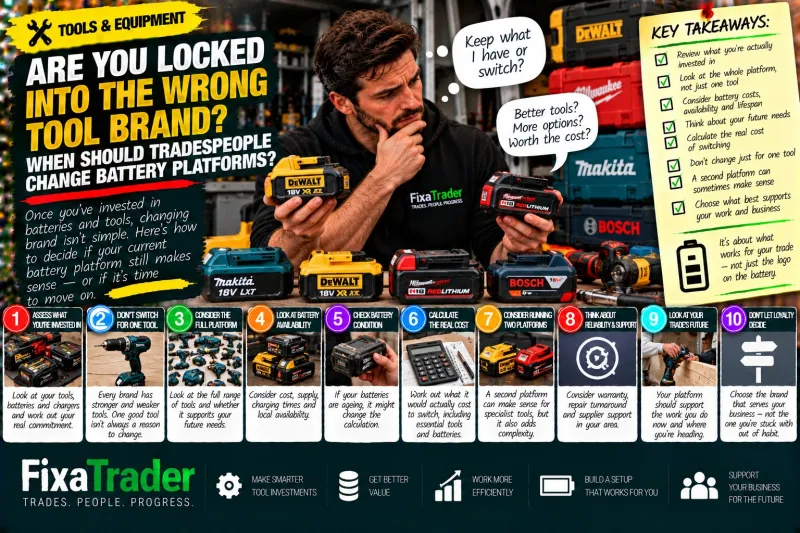
Are You Locked Into the Wrong Tool Brand? When Should Tradespeople Change Battery Platforms?
It often starts with one tool. You buy a cordless drill. Then an impact driver that uses the same batteries makes sense. Then comes the grinder. Circular saw. M...
Then an impact driver that uses the same batteries makes sense.
Then comes the grinder.
Circular saw.
Multitool.
Work light.
Vacuum.
Before long, you haven't just bought a collection of tools.
You've bought into an ecosystem.
That can be one of the biggest advantages of modern cordless equipment. A handful of batteries can power dozens of different tools, chargers can stay in the van or workshop and buying a bare tool becomes considerably cheaper than purchasing another complete kit.
But it also creates a problem.
What happens when another manufacturer releases a tool you prefer?
Or your existing batteries are getting tired?
Or the platform doesn't have the specialist equipment your work now requires?
Changing brands isn't as simple when you've already spent thousands building around one battery system.
So when does staying loyal make financial sense — and when are you simply staying because switching feels too expensive?1. Work Out What You're Actually Invested In
Tradespeople sometimes think:
“I've got ten tools on this platform, so I can't change now.”
But the number of tools doesn't tell the whole story.
Look at everything you own.
How many batteries do you have?
What capacities are they?
How many chargers?
How many tools are genuinely used every week?
Which tools are approaching replacement?
Which rarely leave the van?
You might discover that although you technically own twelve compatible tools, only five form the core of your working setup.
Alternatively, you may have eight batteries distributed across a large collection of heavily used equipment.
Those are very different levels of commitment.
Your real investment is the equipment you would actually need to replace if you changed.2. Don't Change Because Another Brand Has One Better Tool
Every major platform will have stronger and weaker products.
One manufacturer may make a drill you prefer.
Another may have a particularly good saw.
Someone else may produce a specialist tool your current brand doesn't offer.
That doesn't automatically justify moving your entire setup.
Ask whether the difference matters enough in your actual work.
A tradesperson using a circular saw every day might reasonably care about relatively small differences in performance, ergonomics and runtime.
Someone who uses one twice a month probably shouldn't rebuild their entire cordless setup because another saw won a comparison online.
Buy equipment around the work you perform, not around specifications you rarely benefit from.3. Look at the Platform, Not Just the Tool
If you are considering changing brands, don't compare:
Drill A vs Drill B.
Compare:
Platform A vs Platform B.
What else will you need over the next few years?
Consider the manufacturer's range of:
Drills and drivers.
Saws.
Grinders.
Nailers.
Dust extraction.
Lighting.
Outdoor equipment.
Plumbing or electrical tools.
Storage systems.
And specialist equipment relevant to your trade.
A brilliant starter kit isn't necessarily the best ecosystem for where your business is heading.
Think several purchases ahead.4. Battery Availability Matters More Than People Realise
A cordless tool is only useful when you can keep it powered.
Consider:
How many batteries you need during a normal day.
How quickly they charge.
Whether different capacities are readily available.
How expensive replacements are.
Whether your local suppliers stock them.
Whether the batteries suit both lighter and high-demand equipment.
A platform with excellent tools but expensive or difficult-to-source batteries can become frustrating when one fails on a busy week.
For working tradespeople, availability has value.
Being able to replace a failed battery locally that morning may matter more than saving £20 by ordering one online and waiting several days.5. Consider the Age of Your Existing Batteries
There is a natural point when changing platforms becomes easier.
Batteries don't last forever.
Over time you may notice:
Reduced runtime.
More frequent charging.
Poor performance under heavier loads.
Individual batteries failing.
Or older capacities no longer being suitable for newer equipment.
If you already need to replace several expensive batteries, the cost of remaining on your existing platform may suddenly be closer to the cost of beginning another.
That doesn't mean ageing batteries automatically justify switching.
It means the calculation has changed.
Instead of comparing:
£0 to stay vs £1,000 to switch
you might actually be comparing:
£500 to refresh the current platform vs £1,000 to begin another.
That's a more useful comparison.6. Ergonomics Matter When You Use Something Every Day
Tool comparisons often focus heavily on power.
For professionals, comfort can be just as important.
A tool might be technically excellent but feel:
Too heavy.
Poorly balanced.
Awkward with the battery attached.
Uncomfortable in your hand.
Difficult to operate while wearing gloves.
Or unnecessarily bulky for the spaces you normally work in.
Using something for ten minutes in a shop is different from holding it repeatedly throughout an eight-hour working day.
If you're considering another platform, try the equipment where possible.
The best specification sheet can't tell you exactly how a tool will feel after several hours of use.7. Your Trade May Have Outgrown Your Original Platform
The platform you chose as an apprentice or when you first became self-employed might have been perfectly sensible at the time.
Your work may now be different.
Perhaps you've moved towards:
Larger installations.
Maintenance.
Renewables.
Commercial work.
Joinery.
Landscaping.
Specialist diagnostics.
Or another niche requiring equipment you didn't previously use.
If you're constantly buying corded alternatives or equipment from other brands because your main platform doesn't serve the work you now perform, that's worth noticing.
Your tools should support the direction of your business.
You don't have to remain loyal to a purchasing decision you made ten years ago.8. Running Two Platforms Isn't Necessarily a Bad Thing
Changing brands doesn't have to mean selling everything tomorrow.
Many tradespeople operate more than one battery system.
That can make sense.
Perhaps your everyday tools remain on your established platform while another manufacturer supplies two specialist tools that are significantly better suited to your work.
Now you have:
A primary platform.
And a smaller secondary platform.
The downside is obvious.
More chargers.
More batteries.
More things to remember.
More stock to replace.
And batteries that can't be shared between everything.
But if the second platform solves a genuine problem, those disadvantages may be worthwhile.
The objective doesn't need to be owning equipment from only one manufacturer.
It's avoiding unnecessary complexity.9. Calculate the Switching Cost Properly
If you're seriously considering changing, put some numbers against it.
List the equipment that would need replacing.
For example:
Drill.
Impact driver.
Grinder.
Multitool.
Circular saw.
Four batteries.
Two chargers.
Work light.
Then separate essential replacements from things that can remain until they eventually fail.
You probably don't need to replace everything simultaneously.
Your old cordless light doesn't become useless because you've bought a drill from another manufacturer.
A gradual transition can spread the cost over months or years.
That can make switching much more realistic.10. Don't Ignore Downtime and Reliability
Purchase price isn't the only cost of a tool.
A cheaper system that repeatedly causes downtime may be more expensive in practice.
For working equipment, consider:
Reliability.
Warranty arrangements.
Repair turnaround.
Availability of replacements.
Local servicing.
Supplier support.
And whether you have backup equipment.
Imagine your main drill fails on Monday morning.
One manufacturer offers a straightforward repair or replacement process through a supplier you already use.
Another requires the tool to be sent away for an uncertain period.
That difference has business value.
A professional tool isn't just something you own.
It's equipment your income may depend on.Don't Replace Good Tools Just to Have Matching Colours
Once someone decides to switch platforms, there's a temptation to do everything at once.
New drill.
New grinder.
New saw.
New light.
New vacuum.
New everything.
It looks tidy.
It may not make financial sense.
If an existing tool still works well and the batteries to operate it are still healthy, there may be little reason to replace it immediately.
Let the transition happen naturally.
As equipment reaches the end of its useful life, replace it on the platform you intend to use going forward.
Over time, the balance shifts.
Eventually, the old charger and final battery may disappear from the van without you ever having funded one enormous replacement bill.Be Careful With Battery Adaptors
The existence of battery adaptors can make running different brands appear simple.
But compatibility isn't only about whether electricity can physically reach the tool.
Battery systems can involve communication, protection and charging arrangements designed around particular equipment.
Using unofficial adaptors may affect safety, performance or warranty arrangements depending on the products involved.
Don't assume an adaptor makes two ecosystems officially compatible.
Follow the relevant manufacturer instructions and use equipment as intended.Think About Your Van and Workshop Too
Battery platforms affect organisation.
If every cordless tool uses one system, you can create a straightforward routine:
Charged batteries in one location.
Flat batteries somewhere else.
Chargers mounted or stored consistently.
Known spares.
Easy stock checks.
Introduce three or four incompatible systems and that routine becomes harder.
You might arrive on site with the correct tool and the wrong battery.
Or have six batteries in the van but none suitable for the equipment you need.
For a sole trader with a small toolkit, that's manageable.
For a team sharing equipment across several vehicles, standardisation can become much more valuable.What About the Team?
If several people use company equipment, think beyond your personal preference.
Standardising a platform can make it easier to:
Share batteries.
Move tools between vans.
Maintain chargers.
Carry spares.
Replace equipment.
And train people around the same systems.
If every worker buys whatever they prefer, you can quickly end up with a workshop full of incompatible batteries.
There isn't necessarily a wrong approach, particularly where workers own their own tools.
But once equipment is shared, platform decisions become operational decisions rather than just purchasing decisions.Don't Let Brand Loyalty Become the Decision
Tradespeople can become surprisingly loyal to tool brands.
Sometimes that loyalty is deserved.
You've used the equipment for years, it has been reliable and the platform contains everything you need.
There's no reason to change simply because something newer exists.
But loyalty should work in one direction.
The manufacturer needs to keep earning your business.
You don't owe a tool company another £2,000 because your existing batteries have its logo printed on them.
Equally, constantly jumping to whatever brand is receiving attention online can become extremely expensive.
Ignore the badge for a moment and ask:
Does this platform still suit the work I actually do?
That's the important question.When Does Switching Make Sense?
There isn't a universal point.
But changing or beginning a gradual transition becomes easier to justify when several factors appear together.
Your batteries are approaching replacement.
Important tools are wearing out.
Your current platform lacks equipment you increasingly need.
Another ecosystem better suits your trade.
Reliability or support has become a recurring problem.
The cost difference is manageable.
And you expect the alternative platform to support your business for years rather than one purchase.
If your existing equipment is reliable, paid for and does everything you need, staying where you are may still be the best financial decision.
Newer isn't automatically better.Build Your Tool System Around Your Work
The biggest mistake is treating a battery platform as a lifelong commitment.
It isn't.
It's infrastructure for your tools.
And like any business infrastructure, it should continue earning its place.
Review what you actually use.
Consider where your trade is heading.
Look beyond individual headline products.
Calculate the real switching cost.
And don't assume the choice has to be all or nothing.
Sometimes the smartest move is staying exactly where you are.
Sometimes it's introducing a second platform.
And sometimes the batteries, tools and work have all reached a point where starting again genuinely makes sense.
Choose the battery platform that serves your work — not the one you're afraid to leave because you've already spent money on it.
0 Comments
No comments yet — be the first to share your thoughts.