How to Make Your Trade Tools Last Longer: 10 Habits That Save Money
For a tradesperson, tools aren't just equipment. They're part of the business. A good set of tools can represent thousands of pounds of investment, and many of...
A good set of tools can represent thousands of pounds of investment, and many of them are used almost every day.
So when something breaks, wears out or disappears from the bottom of a toolbox, the cost isn't necessarily limited to replacing the item.
There can also be lost time.
A job may take longer.
A specialist tool might need to be hired.
A customer appointment could be delayed.
And gradually replacing equipment that should have lasted years can become a significant business expense.
The good news is that extending the life of your tools doesn't necessarily require anything complicated.
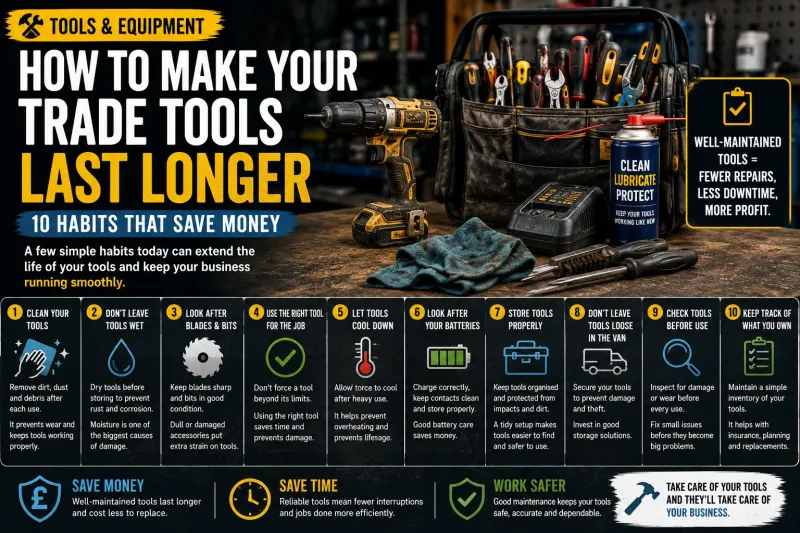
A few consistent habits can make a surprisingly big difference.1. Clean Your Tools Regularly
It sounds obvious, but tools spend much of their working life around dust, dirt, moisture, chemicals and debris.
That can take its toll.
You don't necessarily need to deep-clean every tool after every job.
But removing obvious dirt and debris before putting equipment away can prevent small problems from becoming bigger ones.
Pay particular attention to:
Moving parts
Ventilation openings
Cutting surfaces
Battery contacts
Electrical connections
Threads and adjustment mechanisms
For power tools, follow the manufacturer's cleaning instructions rather than introducing liquids or cleaning products where they shouldn't go.
A few minutes of basic maintenance can be considerably cheaper than replacing equipment prematurely.2. Don't Leave Tools Wet
Water and tools aren't usually a good combination.
This is particularly relevant for tradespeople working outdoors or in damp environments.
If tools get wet during a job, give them an opportunity to dry appropriately before storing them away.
Leaving damp equipment inside a closed toolbox or van can create an environment where corrosion develops.
It can also affect certain electrical and electronic components.
Moisture can be especially problematic when combined with dirt and metal surfaces.
If you've been working outside in poor weather, don't simply throw everything back into the van at the end of the day and forget about it.
Give equipment the attention it needs before storing it.3. Look After Your Blades and Bits
Drill bits, saw blades, cutting discs and other consumables are designed to wear.
That's normal.
The mistake is continuing to use them once they're no longer performing properly.
A blunt or damaged accessory can make the tool work harder while also producing poorer results.
Depending on the application, it can also increase the risk of damaging the material you're working on.
If a blade or bit is no longer performing as it should, don't automatically assume the tool itself is failing.
Sometimes the accessory simply needs replacing.
Using the correct accessory for the material and application can also make a significant difference.4. Don't Force a Tool to Do a Job It Isn't Designed For
One of the quickest ways to shorten a tool's life is to regularly push it beyond what it was designed to handle.
Every tool has limitations.
If a drill is struggling, a saw is cutting unusually slowly or a machine is repeatedly overheating, stop and consider why.
You may be using:
The wrong tool
The wrong accessory
The wrong setting
Too much pressure
The wrong speed
The wrong technique
A more powerful tool isn't always the answer.
Sometimes the problem is simply that the equipment isn't appropriate for the particular task.
Knowing when to change tools is part of using them properly.5. Give Power Tools Time to Cool Down
Power tools generate heat.
Under normal conditions, that's expected.
But repeatedly running equipment when it is becoming excessively hot can put additional stress on components.
If a tool has become noticeably hot, pay attention to the manufacturer's guidance and allow it to cool where appropriate.
Don't cover ventilation openings or obstruct cooling systems.
And if a tool repeatedly overheats during work that should be within its normal operating range, investigate the cause rather than simply continuing to use it.
Overheating can sometimes be a sign that something needs attention.6. Look After Your Batteries
For tradespeople using cordless equipment, batteries can represent a significant part of the overall investment.
They also deserve the same attention as the tools themselves.
Avoid treating batteries as disposable items simply because they're convenient.
Follow the manufacturer's charging and storage instructions.
Keep contacts clean.
Protect batteries from unnecessary impacts.
And pay attention to their condition.
If a battery becomes damaged, unusually hot, swollen or otherwise behaves abnormally, stop using it and follow the manufacturer's guidance.
It's also worth avoiding the habit of leaving batteries loose in the bottom of a toolbox or van where they can be damaged by other equipment.
A little organisation can protect an expensive part of your cordless setup.7. Store Tools Properly
A toolbox isn't just somewhere to throw tools when you've finished a job.
Good storage protects equipment from:
Moisture
Dirt
Impacts
Excessive heat
Loss
Unnecessary wear
Where possible, keep tools organised so they aren't constantly being thrown against each other.
For specialist equipment, use cases or protective storage where appropriate.
This is particularly important for precision instruments and tools that can be affected by knocks or contamination.
Good storage also has another advantage.
You can see what you have.
That makes it easier to notice when something is missing, damaged or needs maintenance.8. Don't Leave Expensive Equipment Loose in the Van
A trade van is effectively a mobile workshop.
But it can also be a difficult environment for tools.
Equipment can move around during driving.
Heavy objects can fall onto smaller tools.
Temperature changes can be significant.
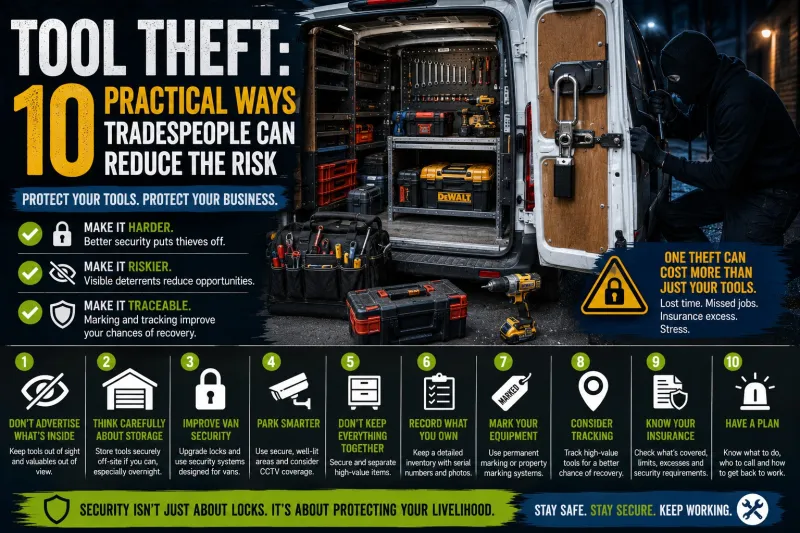
And, of course, tools left in a vehicle can be vulnerable to theft.
Where possible, secure equipment properly.
Use suitable cases, storage systems or fixings where appropriate.
Avoid stacking heavy equipment on top of fragile items.
And don't assume that because something is inside a locked van, it is automatically protected from every risk.
Good van organisation isn't just about looking professional.
It can protect the equipment you've invested in.9. Check Tools Before Using Them
A quick inspection before a tool goes into use can identify problems before they become failures.
Look for things such as:
Damaged cables
Cracked housings
Loose components
Worn switches
Damaged guards
Unusual battery condition
Blunt or damaged accessories
Signs of excessive wear
For electrical equipment, make sure you're following the appropriate safety and inspection requirements for your work and equipment.
If something looks damaged or behaves differently from normal, don't simply carry on because the tool still technically works.
A tool doesn't have to be completely broken to become unsafe or unsuitable for use.10. Keep Track of What You Own
This one is less about maintenance and more about protecting your investment.
When you've accumulated tools over several years, it's surprisingly easy to lose track of what you own.
A basic inventory can help.
You might record:
Tool name
Model
Serial number
Purchase date
Approximate value
Battery ownership
Location
This can be useful for insurance records as well as everyday organisation.
It can also help you identify which equipment is genuinely being used and which items are sitting untouched in the van.
For expensive specialist equipment, keeping records is particularly worthwhile.Maintenance Doesn't Have to Take Hours
Tool maintenance can sound like another job on an already busy list.
But it doesn't need to be.
A few minutes at the end of a working day can make a difference.
Clean the obvious dirt.
Put everything away properly.
Check for damage.
Charge what needs charging.
Remove wet equipment from closed storage.
Replace consumables that are finished.
Then start the next day with equipment that's ready to work.
The biggest benefit comes from consistency.
A small amount of maintenance every day is much easier than discovering a collection of problems after months of neglect.Know When a Tool Needs Replacing
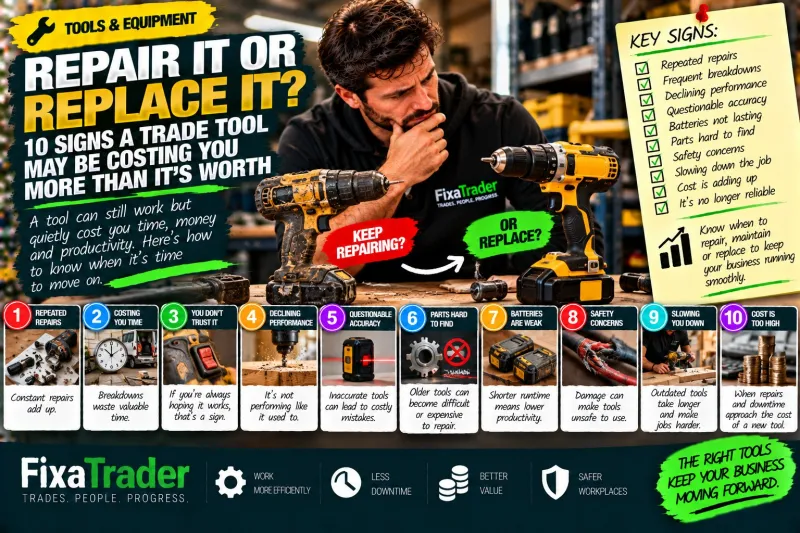
Looking after tools doesn't mean trying to keep everything alive forever.
Eventually, equipment reaches the end of its useful life.
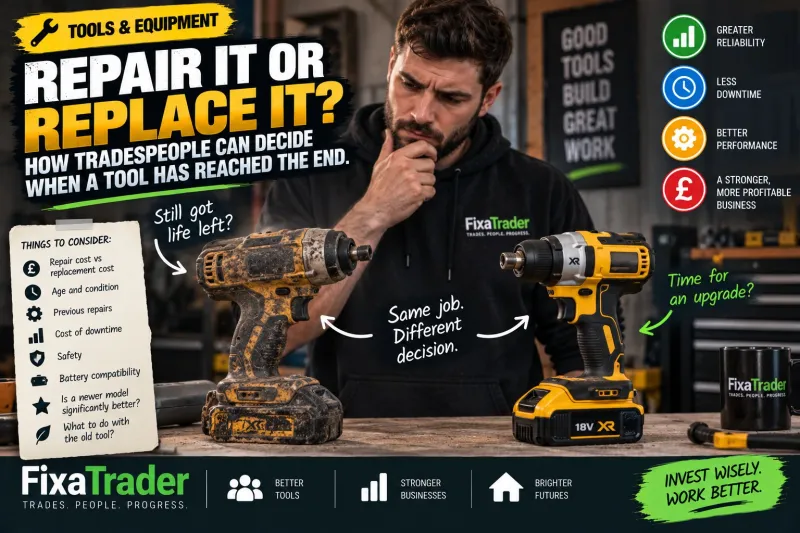
The important thing is recognising when repair or replacement makes more sense.
Consider replacing or professionally servicing equipment when you notice:
Repeated failures
Persistent overheating
Excessive wear
Poor performance
Damaged safety features
Increasing repair costs
Parts becoming difficult to source
A tool that constantly interrupts your work isn't necessarily saving money just because you haven't bought a replacement yet.
Your time has value too.The Cheapest Tool Is Sometimes the One You Already Own
Replacing equipment isn't always the answer.
Sometimes the solution is simply taking better care of what you already have.
A well-maintained tool can continue doing its job for years.
That means fewer unnecessary purchases, less downtime and a more reliable setup when you arrive at a job.
And for a small trade business, reliability matters.
You don't want to discover that your equipment isn't working when you're standing in front of a customer ready to start.Your Tools Are Part of Your Business
It's easy to think about tools as individual objects.
A drill.
A saw.
A tester.
A set of spanners.
A ladder.
A battery.
But collectively, they're part of the infrastructure that allows a tradesperson to earn a living.
Looking after them is therefore more than basic housekeeping.
It's protecting an investment.
It's reducing avoidable downtime.
And it's making sure the equipment you rely on is ready when you need it.
Good tools don't last forever.
But good habits can help them last a lot longer.
0 Comments
No comments yet — be the first to share your thoughts.