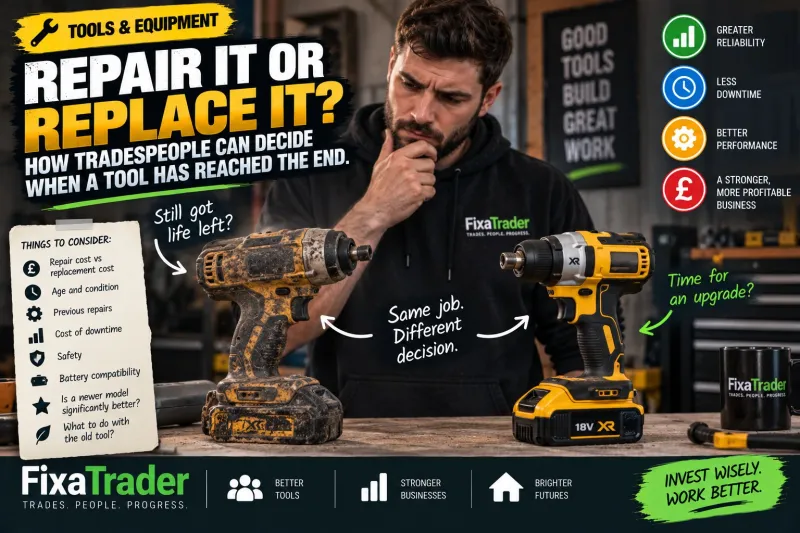
Repair It or Replace It? How Tradespeople Can Decide When a Tool Has Reached the End
Every tradesperson eventually owns that tool. It's been dropped more times than you can remember. The battery doesn't last like it used to. Something rattles th...
It's been dropped more times than you can remember.
The battery doesn't last like it used to.
Something rattles that definitely didn't rattle when you bought it.
You've already repaired it once.
But it still works.
Mostly.
Then one morning it gives up halfway through a job and you're faced with the question:
Do I repair it again, or finally replace it?
For professional tradespeople, that decision isn't simply about whether a repair costs less than a new tool.
Reliability, downtime, safety and how important the equipment is to your work all matter too.
Here are the things worth considering.1. Start With the Repair Cost
The obvious comparison is:
Repair cost vs replacement cost.
If a £500 tool needs a £40 repair, the decision may be relatively straightforward.
If the repair is £300, it deserves more thought.
But don't use a rigid rule such as:
“If the repair costs more than 50% of a replacement, always replace it.”
Different tools have different values, lifespans and importance to the business.
A high-quality professional tool that can reliably provide several more years of service after repair is very different from an ageing budget tool already showing multiple problems.
The repair price is the starting point, not the entire calculation.2. Consider the Tool's Age and Condition
A single failed component doesn't necessarily mean the whole tool is finished.
Ask what condition everything else is in.
Is the tool generally solid apart from one repairable fault?
Or are you also dealing with:
Worn components.
Damaged casing.
Loose connections.
Poor battery performance.
Intermittent operation.
Excessive vibration.
Other developing faults.
Repairing one problem makes more sense when the rest of the equipment still has useful life left.
It makes less sense when you're simply waiting for the next component to fail.3. Look at Its Repair History
One repair?
Normal.
Five repairs in twelve months?
That's information.
Keep some record of what you're spending on important equipment.
A £70 repair doesn't feel particularly expensive.
But if you've spent £70 four times, plus lost several hours each time the tool failed, the economics look very different.
Don't evaluate the latest repair in isolation.
Ask:
“How much has this tool already cost me to keep running?”
Sometimes the cheapest repair becomes an expensive habit.4. Include the Cost of Downtime
This is where professional equipment differs from something you occasionally use at home.
If your lawnmower breaks, perhaps the grass waits until next weekend.
If a tool you depend on for work breaks at 10:30 on Tuesday morning, you may have:
A customer waiting.
An employee unable to continue.
A partially completed job.
A hire cost.
An emergency trip to buy another tool.
Or an entire day disrupted.
That downtime has a value.
A £100 repair that leaves an essential tool unavailable for two weeks may cost your business considerably more than £100.5. Ask How Critical the Tool Is
Not every tool deserves the same decision.
If something rarely leaves the workshop and you have alternatives, waiting for a repair might be easy.
If it's equipment you use every working day and the job stops without it, reliability becomes far more valuable.
For critical tools, some businesses deliberately maintain a backup.
That doesn't mean buying two of everything in the van.
But having redundancy for a few essential pieces of equipment can turn a breakdown from a cancelled day into a minor inconvenience.6. Don't Ignore Batteries
With cordless platforms, the decision may be bigger than one tool.
Suppose an old drill needs replacing.
You already own:
Six compatible batteries.
Several chargers.
Five other tools using the same battery system.
Switching manufacturer isn't simply the cost of a new drill anymore.
Likewise, if your entire battery collection is ageing and several tools are approaching replacement, that may be the point when changing platform becomes more realistic.
Think about the system you're invested in, not just the individual tool.7. Has a Newer Tool Become Meaningfully Better?
Replacing equipment simply because a newer model exists can become very expensive.
Professional tools are there to make money, not keep you permanently equipped with the newest catalogue.
But sometimes newer equipment offers a meaningful improvement.
Perhaps it's:
More efficient.
Lighter.
Safer.
More accurate.
Better at dust control.
Faster.
More ergonomic.
Or capable of work your existing tool struggles with.
The important word is meaningful.
A new feature is valuable if it improves the way you actually work—not merely because it looks good on the box.8. Consider Safety Before Economics
Some decisions shouldn't be based purely on cost.
If equipment has potentially dangerous defects, damaged safety components or problems that could make continued use unsafe, stop using it and follow the appropriate manufacturer or competent repair guidance.
Don't improvise repairs to safety-critical equipment simply because you need to finish today's job.
Likewise, modifications that bypass guards, switches or other protective features aren't a sensible way to extend a tool's life.
Saving money on equipment isn't worthwhile if doing so creates an unacceptable risk.9. Check Whether the Repair Is Actually Supported
Before writing a tool off, investigate what support exists.
Depending on the manufacturer and product, you may have access to:
Warranty coverage.
Authorised repair centres.
Replacement parts.
Fixed-price servicing.
Manufacturer repair programmes.
Or specialist independent repairers.
A fault that appears terminal may turn out to be a routine repair.
Equally, some equipment becomes difficult or uneconomical to repair because parts are unavailable.
Knowing which situation you're dealing with helps make the decision much clearer.10. Think About What Happens to the Old Tool
Replacing equipment doesn't necessarily mean throwing the old one away.
If it's economically repairable, it might become:
A backup.
A workshop tool.
A secondary tool for an employee.
Or something that can legitimately be sold after appropriate repair.
If it really has reached the end of its useful life, dispose of electrical equipment, batteries and other components through appropriate routes rather than simply putting everything into general waste.
For batteries in particular, follow suitable collection and recycling arrangements.The Cheapest Tool Isn't Always the Cheapest Tool
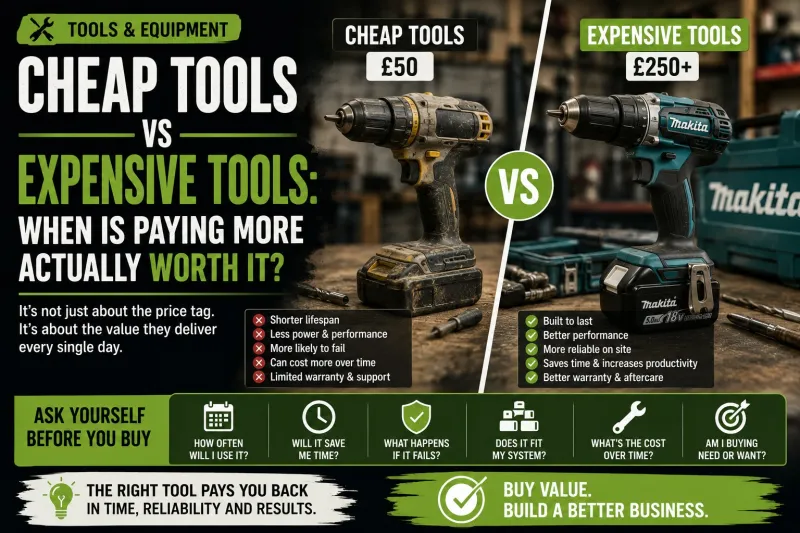
Imagine two options.
Tool A costs £180 and lasts two years.
Tool B costs £320 and lasts five years.
Ignoring every other factor, Tool B may actually represent better long-term value.
But the opposite can also happen.
A tradesperson might spend heavily on premium equipment for a task they perform three times a year when a less expensive professional option would have done the job perfectly well.
Value depends on how you use the equipment.
Ask:
How often will I use it?
How important is reliability?
How much money does this tool help me generate?
What happens if it fails?
That's a much better way to judge equipment than price alone.Create a Replacement Fund Before Something Breaks
Tools eventually wear out.
That shouldn't always arrive as a financial surprise.
If your business depends on thousands of pounds of equipment, some of the money the business generates will eventually need to replace it.
Treat equipment replacement as a normal business cost.
Even putting aside a modest amount regularly can mean that when an essential £600 tool finally dies, you're not suddenly trying to find £600 from that week's cash flow.Use a Simple Five-Question Test
Next time you're deciding whether to authorise another repair, ask:
How much will the repair cost compared with replacement?
What condition is the rest of the tool in?
How much has it already cost me in repairs?
What will downtime cost the business?
Would a replacement materially improve the way I work?
Sometimes the old tool will easily justify another repair.
Sometimes you'll realise you've been keeping it alive mainly because you don't want to let it go.
Professional equipment doesn't need to be new.
It needs to be safe, reliable and capable of doing the work you depend on it to do.
A tool has earned its keep when it makes you money. When keeping it alive starts costing more time and money than it saves, it may have earned its retirement too.
0 Comments
No comments yet — be the first to share your thoughts.