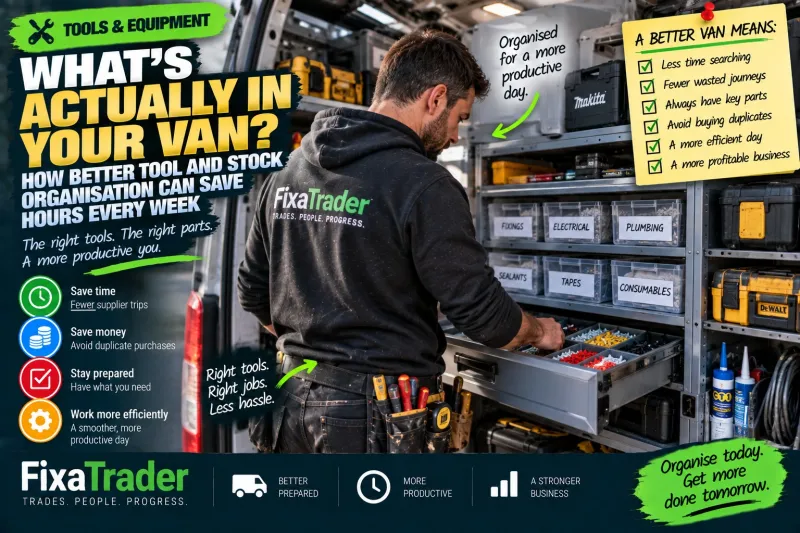
What’s Actually in Your Van? How Better Tool and Stock Organisation Can Save Hours Every Week
You arrive at the job. Open the van. And realise the one fitting you need isn't there. You know you bought some. You can picture the box. But is it in the works...
Twenty minutes later, you're driving to the supplier.
For many tradespeople, wasted time doesn't arrive in dramatic three-hour blocks.
It disappears in ten minutes looking for something.
Twenty-five minutes collecting a forgotten part.
Another fifteen reorganising equipment that was thrown into the van at the end of yesterday.
Do that repeatedly and a surprising amount of the working week can disappear.
A better organised van isn't about making everything look impressive for social media.
It's about making the working day easier.1. Start With What You Actually Use
It's tempting to prepare for every possible situation.
Before long, the van contains tools and materials that haven't moved in eighteen months.
Start by looking at your real work.
What do you use:
Every day?
Every week?
Occasionally?
Almost never?
The equipment you depend on constantly deserves the easiest access.
Something used twice a year probably doesn't need prime position beside the door.
Organise around frequency, not simply where something happened to fit when you first loaded the van.2. Create a Home for Everything
The problem isn't always that something is missing.
Sometimes you simply can't find it.
If drill bits could be in four different boxes, you'll check four boxes.
If electrical connectors migrate around the van every week, you'll repeatedly wonder whether you've run out.
Give commonly used equipment consistent locations.
Then develop the habit of putting it back.
The objective is to reach the point where you can open the van and know where something should be without searching for it.
That also makes missing equipment much easier to notice.3. Keep Frequently Used Items Accessible
Think about how often you're climbing into the van or moving equipment just to reach something underneath.
If the items you use constantly are buried behind rarely used machinery, the layout is working against you.
Frequently used hand tools, consumables and everyday equipment should generally be easier to reach.
Less frequently used items can occupy less convenient storage.
It sounds obvious.
But vans often evolve rather than being deliberately organised.
One new box gets added.
Then another.
Six months later, accessing one toolbox requires unloading half the vehicle.4. Carry Sensible Levels of Common Consumables
Running out of a 20p component can stop a job just as effectively as breaking a £500 tool.
Depending on the trade, there may be small items you use constantly:
Fixings.
Blades.
Discs.
Connectors.
Sealants.
Tapes.
Fasteners.
PPE.
Or other consumables.
Keeping sensible working stock can prevent unnecessary supplier trips.
The important word is sensible.
You don't need six months of everything permanently travelling around in the van.
Carry enough to support the work you realistically perform, then replenish it consistently.5. Set a Reorder Point
This is where stock management becomes much easier.
Instead of waiting until the last item disappears, decide when something should be replenished.
Perhaps when one box remains, another gets ordered.
Or when a container reaches a marked level, it goes onto the supplier list.
You don't need sophisticated inventory software for ordinary van stock.
A simple rule can be enough.
Don't reorder when you run out. Reorder before running out becomes possible.6. Stop Buying Things You Already Own
Disorganisation creates another hidden cost.
You can't find something.
You're near the supplier.
So you buy another.
Three weeks later, you discover the original.
Now you own four versions of a tool you only needed once.
Occasional duplicates can be useful, especially for critical equipment.
Accidental duplicates are different.
Knowing what you already own helps prevent money becoming trapped in unnecessary tools and stock.7. Build a Restock Routine
The best van organisation system eventually fails if nothing gets replenished.
Pick a routine that fits your work.
That might mean:
Ten minutes at the end of each day.
A Friday afternoon check.
A Monday morning restock.
Or replenishing immediately after certain materials are used.
The exact timing matters less than consistency.
A van that was perfectly stocked on Monday can be missing half its consumables by Thursday.
Organisation isn't something you complete once.
It's a process.8. Prepare for Tomorrow Before Tomorrow Arrives
Your everyday van stock shouldn't be expected to cover every specialist job.
Look at the next day's work.
Do you need:
A particular machine?
Special fixings?
Specific materials?
Access equipment?
A charger?
Documentation?
Protective equipment?
Something that normally stays in the workshop?
Loading those things the evening before can prevent the 7:45am realisation that an important piece of equipment is still sitting at home.
For unusual jobs, a simple checklist can be extremely useful.9. Don't Let Organisation Create a Weight Problem
More equipment isn't always better.
Tools and materials have weight.
So do shelving systems, batteries, machines and everything else gradually added to a working vehicle.
Payload limits matter.
A van can look perfectly normal while carrying more than it should.
Know the limits applicable to your vehicle and remember that payload includes more than the obvious boxes in the back.
Driver, passengers, tools, materials, accessories and other loads all contribute.
If you're regularly carrying substantial materials or equipment, don't treat vehicle capacity as guesswork.10. Think About Security While Organising
Organisation and tool security should work together.
Avoid making expensive equipment unnecessarily visible from outside.
Think about what remains in the vehicle overnight.
Keep an inventory of valuable tools, including identifying information where appropriate.
Photographs can also help document what you own.
And don't assume a beautifully labelled storage system means the contents are adequately protected.
The objective is to make equipment accessible to you, not to somebody who shouldn't be in the van.Create a Small “Always With Me” Kit
Many tradespeople have a group of items that appear on almost every job.
Instead of repeatedly assembling them, consider maintaining a core kit.
The contents will vary enormously by trade, but the principle is useful.
If 80% of jobs require the same basic equipment, that equipment shouldn't need reinventing every morning.
Then job-specific tools and materials can be added around the core.
This makes preparation much faster.Keep the Cab Organised Too
The back of the van isn't the only place where time disappears.
Receipts.
Parking tickets.
Supplier paperwork.
Job sheets.
Charging cables.
Pens.
Keys.
Business cards.
Half-finished coffee cups.
The cab can become an administrative dumping ground.
Create somewhere for paperwork that needs processing and clear it regularly.
Otherwise the receipt you need in three weeks will inevitably be underneath the passenger seat with seventeen others.Your Van Can Tell You Something About Your Business
After a few months, look at what you're carrying.
You might discover that your work has changed.
Tools that used to be essential barely move.
One category of materials now needs constant replenishment.
A specialist piece of equipment is being used far more often.
That can reveal where the business itself is heading.
Your van is effectively a physical record of the work you perform.
If the contents have changed significantly, perhaps your purchasing, pricing and services should change with them.Measure the Supplier Runs You Didn't Need
For two weeks, make a note every time you have to leave a job because something preventable is missing.
Don't include genuinely unpredictable requirements.
Track the avoidable ones.
You forgot it.
You ran out.
You couldn't find it.
You didn't check beforehand.
Then total the time.
If you discover you're losing three hours every week to preventable supplier trips, that's more than 150 hours across a working year if the pattern continued.
You don't need to eliminate every unexpected journey.
Even cutting that number in half would return a meaningful amount of working time.The Best Van Isn't Necessarily the Fullest Van
A professional setup isn't about opening the doors and revealing every tool ever manufactured.
It's about reliability.
You know what you have.
You know where it is.
You know when it's running low.
And you know what needs adding for tomorrow's job.
That means less time searching, fewer unnecessary purchases and fewer journeys made because the one thing you needed wasn't where you thought it was.
Your van is more than transport.
For many tradespeople, it's a mobile workshop, storeroom and one of the most important pieces of infrastructure in the business.
A well-organised van won't make the working day longer — it helps you stop wasting the hours you've already got.
0 Comments
No comments yet — be the first to share your thoughts.