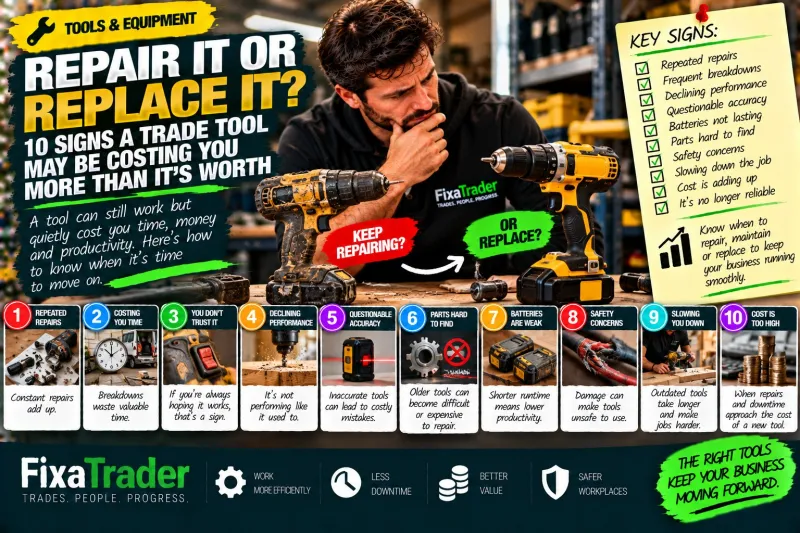
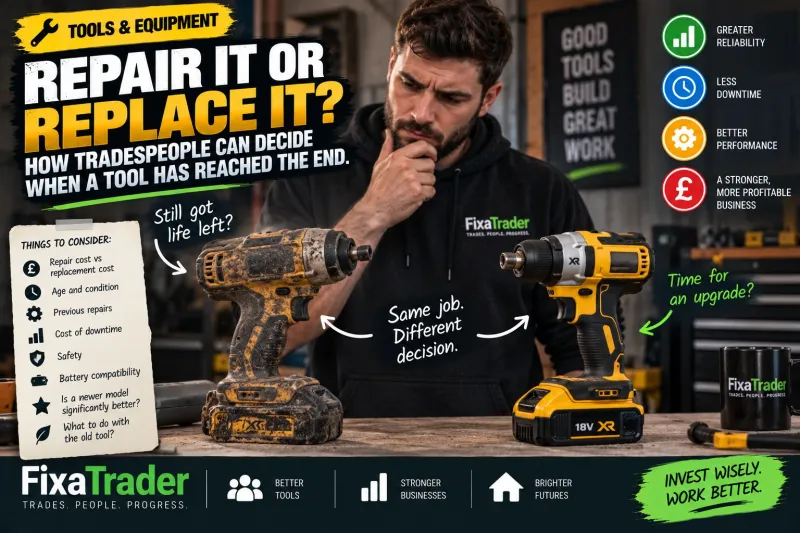
Repair It or Replace It? 10 Signs a Trade Tool May Be Costing You More Than It’s Worth
Every tradesperson has one. The drill that's been dropped more times than you can remember. The saw with the temperamental switch. The tester that's been back f...
The drill that's been dropped more times than you can remember.
The saw with the temperamental switch.
The tester that's been back for repair twice.
The extractor that makes a noise it definitely didn't make when it was new.
It still works.
Mostly.
So you keep using it.
And sometimes that's exactly the right decision. Professional tools can be expensive, and replacing perfectly serviceable equipment simply because something newer exists isn't good business.
But there's another extreme.
A tool can remain technically operational long after it has stopped being economically sensible to rely on.
It wastes time. It needs repeated repairs. Batteries barely last. Accuracy becomes questionable. Replacement parts get harder to find. You start carrying a backup because you don't trust it.
Eventually, keeping an old tool becomes more expensive than replacing it.
The difficult part is recognising when you've reached that point.1. You're Repairing the Same Tool Repeatedly
One repair isn't necessarily a reason to replace good equipment.
A worn switch, cable, bearing or another serviceable component may be perfectly economical to repair, particularly on higher-value professional equipment.
The calculation changes when the same tool repeatedly causes problems.
Imagine you've spent:
£90 repairing it in January.
£120 in May.
Another £80 in September.
The tool hasn't cost you £80 this year.
It's cost at least £290—and that still doesn't include the disruption each failure caused.
Keep a basic repair history for expensive equipment. Memory has a habit of treating each repair as an isolated event.
Your records show the pattern.2. Breakdowns Are Starting to Cost You Working Time
The repair bill is only one part of tool failure.
Suppose a saw breaks halfway through a job.
You stop working.
Drive to a supplier.
Buy or hire another one.
Return to site.
Reorganise the afternoon.
Perhaps the job now runs into tomorrow.
That failure may have cost far more in lost productive time than the actual repair.
Ask:
If this tool fails during tomorrow's job, what happens?
If the answer is:
“Almost nothing—we've got another one in the van,”
the operational risk may be small.
If the answer is:
“The entire job stops,”
reliability becomes much more valuable.3. You No Longer Trust It
This is one of the clearest signs.
You pick the tool up and think:
“Hopefully it behaves today.”
Maybe you tap it a certain way to get it started.
Perhaps the battery has to sit at exactly the right angle.
Maybe you avoid using one setting.
Or you've developed a little ritual that everybody in the team knows:
“Don't push that button too hard or it cuts out.”
At that point, you're adapting your work around the tool's defects.
Professional equipment should help you complete the job.
You shouldn't need to negotiate with it.4. Its Performance Has Noticeably Declined
Tools don't always fail dramatically.
Sometimes they gradually become worse.
A vacuum loses suction.
A saw develops excessive vibration.
A drill struggles under loads it previously handled comfortably.
A laser becomes difficult to rely on.
A compressor takes noticeably longer to build pressure.
A battery that once lasted most of the day now needs constant swapping.
Declining performance doesn't automatically mean replacement. Servicing, cleaning, consumables or a relatively simple repair may restore it.
But investigate the change.
Don't allow “it's always been like that” to become the standard simply because deterioration happened slowly.5. Accuracy Is Becoming Questionable
For some tools, reliability means more than whether the motor turns.
It means whether you can trust the result.
Measurement and testing equipment is an obvious example.
Depending on the equipment and work involved, inspection, calibration, verification or other checks may be required or appropriate.
The same broader principle applies to tools whose wear can affect the finished work.
If you find yourself repeatedly checking one tool against another because you don't trust the first result, that's telling you something.
A tool that produces uncertain measurements can cost considerably more than its purchase price if the error reaches the finished job.6. Replacement Parts Are Becoming Difficult to Find
A good professional tool can remain useful for many years.
Eventually, however, support for older equipment can become more difficult.
Certain parts may be discontinued.
Repairs take longer.
Batteries become difficult or disproportionately expensive to source.
Accessories move to newer systems.
One failed component suddenly means searching through used equipment online to keep the tool alive.
You don't necessarily need to replace equipment the moment a newer generation appears.
But availability of parts and support belongs in the calculation.
Especially for tools the business depends on every day.7. The Batteries Are Becoming the Weak Point
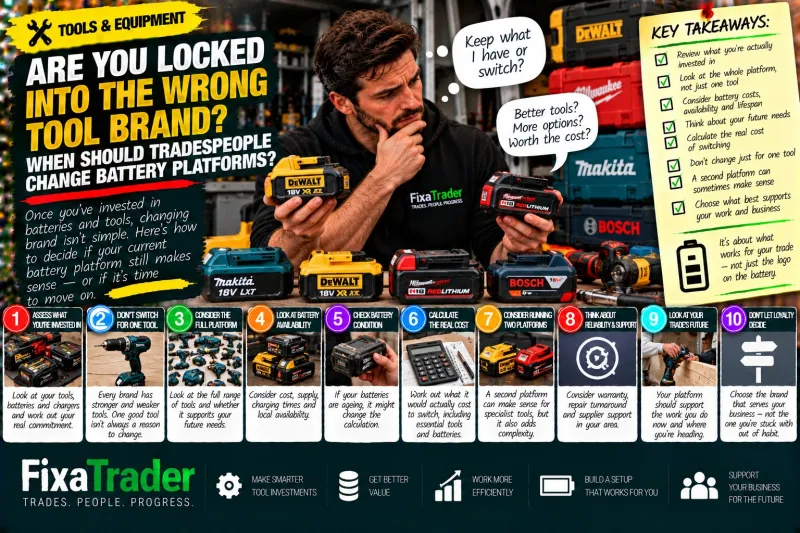
Cordless platforms make replacement decisions interesting because you're not only buying individual tools.
You're often investing in an ecosystem.
Suppose you have eight tools using the same battery platform.
Several batteries are ageing.
One charger is unreliable.
Newer tools use a different system.
Now the question isn't:
“Should I replace this drill?”
It's:
“When does it make sense to reconsider the entire platform?”
But don't keep buying expensive replacements for an ageing platform indefinitely without considering where the manufacturer and your own work are heading.
Think several years ahead.8. Safety Features or Physical Condition Concern You
Some defects should not be evaluated purely through profitability.
Damaged guards.
Compromised electrical cables.
Cracked housings.
Defective switches.
Unusual overheating.
Damaged plugs.
Excessive vibration.
Loose components.
Or other deterioration affecting safe operation should be taken seriously.
Stop using equipment where its condition makes continued use unsafe.
Depending on the tool and defect, appropriate repair may restore it.
In other cases, replacement may be the sensible option.
“It still turns on” isn't a safety assessment.
Tools used at work also sit within wider employer and worker responsibilities around providing and using suitable, properly maintained work equipment.9. An Older Tool Is Slowing Down the Job
This one is different from failure.
The tool works perfectly.
It may even be extremely reliable.
But the way you work has changed.
Perhaps a newer type of equipment can perform a task substantially faster.
Maybe improved dust extraction reduces cleanup.
A cordless solution removes repeated setup.
A better diagnostic tool reduces fault-finding time.
Or equipment designed for the type of work you now specialise in improves productivity.
Don't replace tools merely because marketing says the new version is “30% faster”.
Calculate what the improvement means in your actual work.
Saving five minutes on something you do twice a year is irrelevant.
Saving 20 minutes on something you do three times every day is different.10. The Cost of Keeping It Is Approaching the Cost of Replacing It
Eventually the decision becomes financial.
Suppose replacement costs £600.
Keeping the existing tool for another year is likely to involve:
£180 in repairs.
£150 replacing ageing batteries.
Several hours of downtime.
A hire charge when it fails.
And continued uncertainty.
The new tool no longer looks like a £600 expense compared with doing nothing.
You're comparing two costs:
Cost of replacement
versus
cost and risk of continued ownership.
That's a much better comparison.Don't Replace Tools Just Because They're Old
Age alone isn't a defect.
A ten-year-old professional tool that remains safe, accurate, reliable and suitable for the work can still be an excellent asset.
Likewise, a relatively new tool can be a poor investment if it's unreliable or unsuitable for what you're asking it to do.
Ask about condition and usefulness rather than birthdays.
There is no universal rule saying:
“Replace every power tool after X years.”
Different tools experience completely different workloads and environments.Maintenance Can Delay Replacement Considerably
Before writing equipment off, ask whether the real problem is poor maintenance.
Depending on the equipment, appropriate maintenance might involve:
Cleaning.
Lubrication.
Replacing filters.
Checking consumables.
Servicing.
Inspecting cables and plugs.
Replacing worn components.
Battery care.
Dust removal.
Calibration or verification.
Following manufacturer maintenance schedules.
A tool that's neglected for three years and then declared “worn out” may not have received a fair chance.
Good maintenance protects the investment you've already made.Consider Repairability When Buying the Replacement
There's a useful lesson when an old tool finally reaches the end.
Don't evaluate the replacement only on purchase price and performance.
Ask:
Can it be repaired?
Are parts readily available?
How long is manufacturer support likely to continue?
What warranty applies?
Is there a competent repair network?
How expensive are batteries and accessories?
Are consumables widely available?
What happens if it breaks in the middle of a working week?
A slightly more expensive tool with strong long-term support can sometimes be cheaper to own.Standardising Equipment Can Reduce Downtime
As a trade business grows, there can be benefits to standardising certain equipment.
If three people use the same cordless platform, batteries and chargers can be interchangeable.
Common consumables are easier to stock.
People already know how the equipment operates.
Backups are easier to manage.
That doesn't mean every tool must have the same badge on it.
Choose equipment based on what performs the work properly.
But consider the operational value of compatibility rather than treating every purchase as completely independent.Keep Critical Spares Where Failure Would Stop the Job
You probably don't need two of every expensive tool.
But some relatively inexpensive equipment can bring an entire day's work to a halt when it fails.
Think about your own trade.
What are the items where losing one means:
“We're going home.”
A sensible backup strategy might involve:
A spare battery.
Charger.
Lead.
Common consumables.
Basic hand tool.
Or duplicate of a particularly critical low-cost item.
The aim isn't to fill the van with unnecessary equipment.
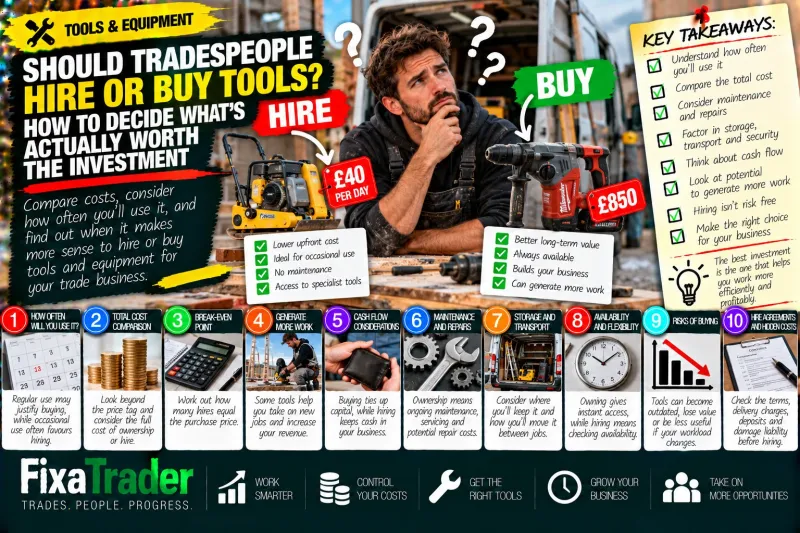
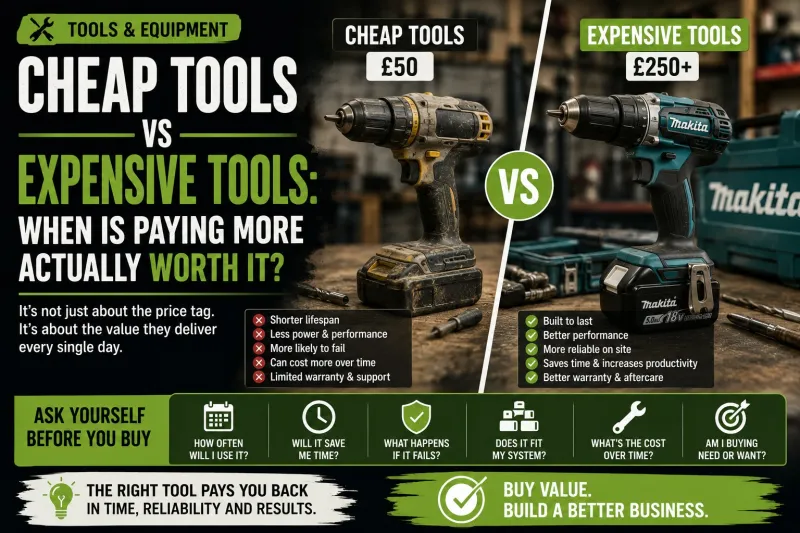
It's to distinguish inconvenient failures from business-stopping failures.Calculate Cost Per Use, Not Just Purchase Price
Imagine Tool A costs £200 and lasts two years.
Tool B costs £500 and lasts seven years under comparable use while requiring fewer repairs.
The cheaper purchase isn't necessarily the cheaper tool.
For frequently used equipment, consider:
Purchase cost.
Expected useful life.
Repair costs.
Consumables.
Downtime.
Productivity.
Resale value where relevant.
And how often you actually use it.
A £1,000 tool used productively every working day can represent better value than a £300 specialist tool that spends 360 days a year on a shelf.Keep a Simple Equipment Register
Larger businesses often formalise this, but even a sole trader can benefit from basic records for important equipment.
You might record:
Tool.
Purchase date.
Serial number.
Purchase price.
Warranty details.
Repairs.
Service history.
Relevant inspection or calibration dates.
Battery replacements.
And eventual disposal or replacement.
This is useful for maintenance, insurance, theft records and purchasing decisions.
It also stops you relying on:
“I'm pretty sure we bought that about four years ago.”Don't Wait for the Tool to Die on Your Busiest Day
The worst possible replacement strategy is often:
Use the tool until it fails completely.
Discover it has failed at 10:15 on Monday morning.
Immediately buy whatever replacement is available locally.
That's not really choosing equipment.
That's emergency procurement.
If an important tool is clearly approaching the end of its reliable life, start researching replacements while it still works.
Compare options.
Watch actual prices.
Consider compatibility.
Budget for the purchase.
Then replace it on your terms.
You may even keep the old tool as an appropriate backup if it remains safe and usable.Create Three Equipment Categories
A simple way to review your tools is to divide important equipment into three groups.
Keep
Reliable, safe, appropriate and economical to continue using.
Monitor or repair
Showing wear or reduced performance but still economically worth maintaining.
Plan to replace
Reliability, safety, support, accuracy or operating cost is becoming unacceptable.
That final category doesn't mean everything gets thrown away tomorrow.
It means you've acknowledged that replacement is coming.
Now you can plan for it.A Tool Doesn't Need to Be Dead to Be Finished
Tradespeople are often remarkably good at keeping equipment alive.
That's a useful instinct.
Repairing rather than unnecessarily replacing equipment can save money and reduce waste.
But there's a point where persistence stops being economical.
If a tool is repeatedly breaking, disrupting jobs, producing questionable results or making you carry a backup because you don't trust it, the fact that it technically still switches on becomes less important.
The question isn't:
“Can I squeeze another year out of this?”
It's:
“Does keeping this tool still make sense for the business?”
Sometimes the answer will absolutely be yes.
Maintain it, repair it and keep earning with it.
Other times, the old tool has already told you the answer through repair bills, downtime and frustration.
The right time to replace a professional tool isn't necessarily when it finally stops working—it's when keeping it working begins to cost the business more than moving on.
0 Comments
No comments yet — be the first to share your thoughts.