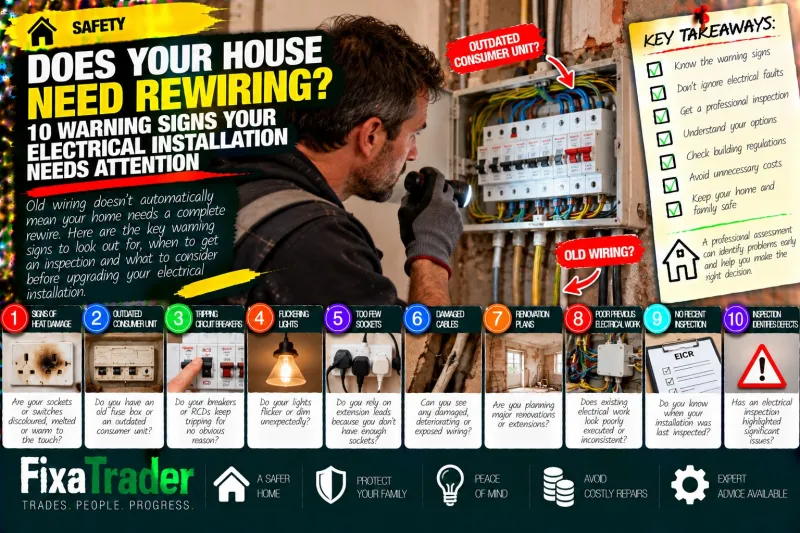
Does Your House Need Rewiring? 10 Warning Signs Your Electrical Installation Needs Attention
You move into an older property and notice that some of the sockets look dated. Perhaps the consumer unit has an unfamiliar arrangement of switches and fuses. O...
You move into an older property and notice that some of the sockets look dated.
Perhaps the consumer unit has an unfamiliar arrangement of switches and fuses.
Or you've started experiencing electrical problems that don't seem to have an obvious explanation.
Eventually, you begin wondering whether the house needs rewiring.
It's an understandable concern.
Electrical wiring is largely hidden behind walls, beneath floors and above ceilings.
Unlike a leaking tap or damaged roof tile, you can't easily inspect most of it yourself.
And because electrical faults can create serious risks, homeowners may feel pressured to replace everything as a precaution.
But there's an important distinction between an electrical installation that is old and one that is unsafe.
A property doesn't automatically need rewiring because of its age. The decision should be based on the condition, safety and suitability of the installation.
Here are ten warning signs worth understanding.1. Your Sockets or Switches Show Signs of Heat Damage
One of the more concerning warning signs is visible heat damage around electrical accessories.
You might notice:
Brown or black discolouration.
Melted or distorted plastic.
Cracking around a socket.
A persistent burning smell.
Unusual warmth from an accessory.
These symptoms may indicate overheating caused by a poor connection, damaged equipment or another electrical fault.
However, the problem might be limited to an individual socket or circuit rather than the entire property.
What should you do?
Stop using the affected socket or switch.
If it is safe to do so, isolate the affected circuit using the consumer unit.
Arrange an inspection by a competent electrician.
Do not remove socket covers or attempt to tighten electrical connections yourself.
If you see smoke, flames or signs of an active electrical fire, leave the property, call 999 and do not re-enter until it is safe.2. Your Consumer Unit Is Very Old or Damaged
The consumer unit distributes electricity to different circuits and contains protective devices.
Older properties may have fuse boxes with rewirable fuses or other arrangements that differ from modern installations.
An older consumer unit isn't automatically unsafe simply because it doesn't resemble a new one.
However, its condition and the protection provided need to be assessed.
Potential concerns include:
Visible damage or overheating.
Missing covers or exposed live parts.
Signs of water ingress.
Inadequate protection for the installation.
Poorly labelled or altered circuits.
Modern electrical installations commonly use residual current devices (RCDs) or RCBOs to provide additional protection against certain electric shock risks.
An electrician can assess whether your existing arrangements provide appropriate protection and whether improvements are needed.
Replacing a consumer unit is not the same as rewiring the entire house.3. Circuit Breakers or RCDs Keep Tripping
Protective devices are designed to disconnect electricity under certain fault conditions.
If a circuit breaker or RCD repeatedly trips, it may be responding to a genuine problem.
Possible causes include faulty appliances, damaged cables, moisture or defects within the fixed wiring.
A single trip doesn't necessarily indicate a major installation problem.
But repeated tripping shouldn't be ignored.
Avoid continually resetting a protective device without investigating why it operates.
If a particular appliance appears to trigger the fault, stop using it until it has been checked.
An electrician can carry out appropriate testing to identify whether the issue involves the appliance, circuit or wider installation.
Repeated tripping is a reason to investigate, not automatic evidence that every cable needs replacing.4. Lights Flicker or Dim Unexpectedly
Occasional flickering may result from a faulty lamp or incompatible dimmer.
But repeated or widespread changes in lighting can also indicate electrical problems.
Pay attention to whether:
Several lights flicker together.
Lighting changes when appliances operate.
The problem affects multiple rooms.
Switches behave unpredictably.
Flickering is accompanied by buzzing or burning smells.
These symptoms can have different causes.
Some involve individual fittings.
Others may relate to loose connections, circuit problems or the electricity supply.
A competent electrician can help establish the cause.
If you notice widespread unusual electrical behaviour, particularly accompanied by heat, noise or burning smells, seek urgent professional advice.5. Your Home Has Too Few Sockets
Older homes were often designed for very different electrical demands.
Today, households may use computers, televisions, kitchen appliances, chargers and numerous other devices.
If your home has too few sockets, you might rely heavily on extension leads and multiway adaptors.
That doesn't automatically mean the existing wiring is defective.
However, it may indicate that the installation no longer suits how the property is used.
A professional assessment can determine whether additional socket outlets or circuits would be appropriate.
In some cases, improvements can be made without rewiring every room.
In others, a broader upgrade may be more practical, particularly if the installation is already being renovated.
The need for more sockets is a reason to review the installation, not necessarily replace it completely.6. You Can See Damaged or Deteriorating Cables
Most fixed electrical wiring is concealed.
But cables may be visible in lofts, cupboards, garages or other accessible areas.
Warning signs include:
Cracked or damaged insulation.
Exposed conductors.
Cables showing signs of overheating.
Poorly supported wiring.
Evidence of rodent damage.
Unsafe or improvised alterations.
Some older cable types and insulation materials require particular attention.
However, identifying a cable's condition and suitability isn't always possible through visual inspection alone.
Don't touch or disturb damaged wiring.
Arrange an assessment by a competent electrician.
If an installation contains obsolete or deteriorated wiring, replacement may be necessary.
But the extent of that replacement should be determined through proper inspection and testing.7. You're Planning Major Renovation Work
Sometimes rewiring is considered because of the work you're already planning rather than an existing fault.
For example, you might be renovating a kitchen, extending the property or stripping rooms back to their original structure.
These projects can provide an opportunity to inspect concealed wiring and improve electrical provision.
It may be more economical to complete necessary electrical upgrades while walls and floors are already accessible.
However, the decision should still be based on the condition of the installation and the requirements of the proposed work.
You may only need additional circuits, relocated outlets or targeted replacement.
A major renovation is a sensible time to review the wiring, but it doesn't automatically justify a complete rewire.8. Previous Electrical Work Looks Poorly Executed
Some properties have been altered repeatedly over several decades.
Additional sockets, lighting circuits and other electrical equipment may have been installed by different people.
You might notice inconsistent accessories, unusual cable routes or poorly finished alterations.
These observations don't necessarily prove that the work is unsafe.
But they can justify further investigation, especially where there are signs of damage or exposed wiring.
A professional inspection can assess whether the installation has been altered appropriately.
Where unsafe work is identified, remedial work may be necessary.
The extent could range from correcting a single connection to replacing substantial sections of wiring.9. You Don't Know When the Installation Was Last Inspected
If you've recently purchased a property, you may have little information about its electrical history.
Perhaps the seller couldn't provide an Electrical Installation Condition Report.
Or you know the property has undergone several alterations without clear records.
A lack of paperwork doesn't automatically mean the installation is dangerous.
However, it can make an inspection particularly useful.
An Electrical Installation Condition Report, commonly called an EICR, assesses the condition of an existing electrical installation against relevant safety requirements.
It can identify defects, deterioration and matters requiring further investigation.
An EICR is often a more sensible starting point than asking an electrician to quote immediately for a full rewire.10. An Electrical Inspection Identifies Significant Defects
Sometimes the strongest evidence that rewiring is necessary comes from formal inspection and testing.
An electrician may identify deteriorated insulation, unsuitable wiring, unsafe connections or other serious defects.
An EICR uses classification codes to communicate the significance of observations.
These commonly include:
C1: Danger present, with risk of injury. Immediate action is required.
C2: Potentially dangerous. Urgent remedial action is required.
C3: Improvement recommended.
FI: Further investigation required without delay.
A C3 observation alone does not make an EICR unsatisfactory.
C1, C2 or FI observations generally result in an unsatisfactory report.
However, an unsatisfactory EICR doesn't automatically mean the entire property must be rewired.
The required work depends on the defects identified.
Ask the electrician to explain which parts of the installation are affected and why the recommended remedy is necessary.How Old Is Too Old for Electrical Wiring?
There's no single age at which every home's electrical wiring must be replaced.
The lifespan of an installation depends on factors such as the materials used, installation quality, environmental conditions, loading and subsequent alterations.
Some older installations remain serviceable.
Others deteriorate prematurely because of damage, moisture or poor workmanship.
You may see general estimates for how long wiring should last.
But these shouldn't replace a condition-based assessment.
Age is useful background information. Actual condition is what determines whether wiring remains safe and suitable.What Is an EICR and What Does It Involve?
An Electrical Installation Condition Report is a formal assessment of an existing electrical installation.
A competent person carries out inspection and testing to identify relevant safety issues.
Depending on the property and agreed scope, the process may involve:
Inspecting accessible electrical equipment.
Checking the consumer unit.
Testing protective measures.
Assessing circuit condition.
Identifying visible damage or deterioration.
Recording limitations on the inspection.
Reporting observations and recommended action.
An EICR isn't a guarantee that every concealed cable has been visually examined.
Inspection and testing have practical limitations.
For example, furniture, inaccessible wiring and concealed building elements may restrict what can be checked.
The report should identify relevant limitations.
Ask for a copy and make sure you understand the findings before agreeing to significant remedial work.Does an Unsatisfactory EICR Mean You Need a Full Rewire?
Not necessarily.
An EICR may be unsatisfactory because of one or several defects.
Some can be addressed through relatively limited repairs.
For example, the solution might involve replacing a damaged accessory, correcting a connection or improving protective arrangements.
Other findings may indicate widespread deterioration requiring extensive replacement.
The electrician should be able to explain the relationship between the observations and the proposed work.
If a full rewire is recommended, ask:
Which circuits are affected?
What defects make replacement necessary?
Could targeted repairs address the problems?
Is the recommendation based on safety, capacity or both?
What testing supports the conclusion?
For substantial work, obtaining another qualified opinion can be reasonable.
The purpose of an EICR is to establish the installation's condition, not automatically generate a quotation for replacing it.Can You Rewire One Room at a Time?
In some circumstances, electrical work can be completed in stages.
For example, a property undergoing gradual renovation may have circuits upgraded as individual areas are refurbished.
However, the suitability of this approach depends on the existing installation.
Circuits don't always correspond neatly to individual rooms.
A single circuit may supply several areas of the property.
The condition of the consumer unit, earthing arrangements and existing wiring may also affect the options.
An electrician can assess whether phased work is technically appropriate and how the completed installation will remain safe throughout the process.
Don't assume that rewiring one room is as simple as replacing the cables visible in that room.How Disruptive Is a Full House Rewire?
A full rewire can involve significant work.
Cables may need routing through walls, ceilings and floors.
Sockets, switches and light fittings may need replacing or relocating.
Depending on the building and installation method, the work can involve lifting floorboards, cutting channels and making openings.
Decorative repairs may then be required.
The extent of disruption depends on whether the property is occupied, its construction and how accessible the wiring is.
Before accepting a quotation, clarify whether it includes:
Electrical installation and materials.
Consumer unit work where required.
Testing and certification.
Making good disturbed surfaces.
Plastering and decorating.
Waste removal.
Any necessary building regulations notification.
Don't assume that decorative finishing is included unless the quotation says so.What Should a Homeowner Ask Before Agreeing to a Rewire?
If an electrician recommends extensive replacement, ask for a clear explanation.
Useful questions include:
What evidence shows the existing wiring needs replacing?
Is the problem affecting the whole installation or particular circuits?
Would targeted repairs be safe and practical?
What new sockets, switches and circuits are included?
Will the consumer unit be replaced?
How will disruption be managed?
What testing and certification will be provided?
Who is responsible for any required building regulations notification?
What making-good work is included?
How will the installation be left safe if the work is completed in stages?
A detailed written quotation makes it easier to compare proposals and avoid misunderstandings.Do You Need a Registered Electrician?
Electrical work should be undertaken by someone competent for the tasks involved.
For domestic electrical work in England, certain activities are notifiable under Part P of the Building Regulations.
A registered competent person may be able to self-certify qualifying work through an authorised scheme.
Other routes for building control compliance may also be available.
Requirements differ across the UK.
Before commissioning substantial electrical work, check how compliance, notification and certification will be handled.