10 Warning Signs Around Your Home You Shouldn’t Ignore
Homes make noises. Cracks appear. Lights occasionally flicker. Boilers behave strangely. And most of the time, there is a perfectly manageable explanation. The...
And most of the time, there is a perfectly manageable explanation.
The difficulty for homeowners is knowing which problems are minor inconveniences and which could be warning signs of something more serious.
You don't need to assume the worst every time something changes in your property.
But there are certain signs that shouldn't simply be ignored in the hope that they'll disappear.
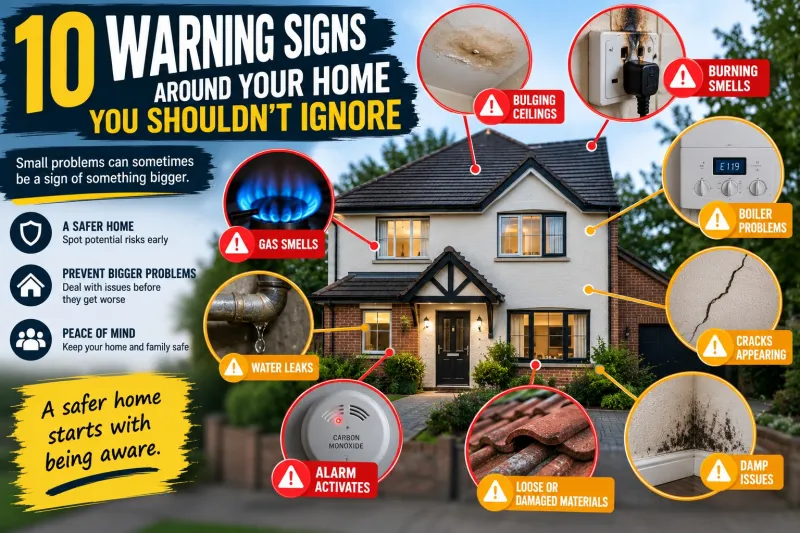
Here are ten worth paying attention to.1. A Burning Smell From Electrical Equipment
A persistent burning, melting or unusual electrical smell deserves attention.
It could potentially be associated with an appliance, socket, plug, wiring or another electrical component becoming excessively hot.
You might also notice:
Discolouration around a socket
Unusual warmth
Crackling or buzzing
Melted plastic
Scorch marks
Smoke
Don't continue repeatedly using electrical equipment that appears damaged or is showing signs of overheating.
Where safe to do so, stop using the affected equipment and have the problem appropriately assessed.
If there is smoke or fire, treat it as an emergency rather than attempting to investigate the electrical fault yourself.2. Your Electrical Protection Keeps Tripping
A circuit breaker or RCD operating isn't necessarily evidence that the device itself is faulty.
It's there to provide protection.
The important question is why it operated.
An isolated trip associated with an identifiable faulty appliance may be relatively straightforward.
Repeated tripping without an obvious explanation deserves investigation.
Don't simply keep resetting a device indefinitely while ignoring the underlying problem.
And don't attempt to bypass electrical protection to keep something running.
If the problem continues, an appropriately qualified electrician can investigate what is causing it.3. You Can Smell Gas
If you think you can smell gas, don't treat it like an ordinary household maintenance problem.
In Great Britain, the National Gas Emergency Service advises people who smell gas or suspect a gas leak to call 0800 111 999.
Avoid doing anything that could create an ignition source and follow the emergency safety advice provided.
This isn't a situation where you should spend half an hour searching online for DIY troubleshooting tips.
Suspected gas leaks require the appropriate emergency response.4. Your Carbon Monoxide Alarm Activates
Carbon monoxide is particularly dangerous because you cannot see, taste or smell it.
That's why a carbon monoxide alarm should never be dismissed as an inconvenience.
If an alarm sounds, follow the manufacturer's instructions and current emergency safety guidance.
Don't simply remove the batteries because you assume the alarm is faulty.
Carbon monoxide can be associated with faulty or incorrectly operating fuel-burning appliances and inadequate ventilation, among other causes.
An alarm exists to warn you.
Take the warning seriously.5. Cracks Are Appearing or Changing Quickly
Not every crack indicates a structural problem.
Buildings move.
Plaster cracks.
Materials expand and contract.
Newly decorated surfaces can develop minor imperfections.
But some cracking patterns deserve professional assessment, particularly where cracks are significant, changing noticeably or accompanied by other movement.
Pay attention if you notice things such as:
Cracks becoming wider
New substantial cracks appearing
Doors or windows suddenly sticking
Floors noticeably changing level
Cracking around openings
Other signs of movement appearing at the same time
Photographs can be useful for monitoring change over time.
If you're concerned about structural movement, seek appropriate professional advice rather than trying to diagnose the severity from photographs online.6. Water Is Getting Near Electrical Equipment
Water and electrical installations are not a combination to take casually.
A leaking pipe through a ceiling is already a problem.
If that water is reaching light fittings, sockets, electrical equipment or wiring, there may also be an electrical risk.
Don't start dismantling fittings to see where the water has gone.
Depending on the circumstances, both the source of the water and the affected electrical installation may need attention.
The priority is making the situation safe.7. Your Boiler Is Behaving Very Differently
Not every unusual boiler noise means something dangerous is happening.
Heating systems can make a variety of sounds, and many faults are routine repair issues.
But significant changes shouldn't simply be ignored.
For example:
Repeated shutdowns.
Persistent fault codes.
Unusual smells.
Evidence of leaking.
Unexpected changes in operation.
Or other behaviour that makes you concerned about the appliance.
Gas appliances should be worked on by appropriately registered professionals where required.
If you suspect a gas leak or carbon monoxide issue, follow the relevant emergency guidance rather than waiting for a routine boiler appointment.8. A Ceiling Is Bulging or Sagging
A ceiling that suddenly begins bulging or sagging needs attention.
One possible cause is water accumulating above it.
That could come from:
A plumbing leak.
A bathroom above.
A roof leak.
A water tank.
Or another source.
A waterlogged ceiling can become heavy and may eventually fail.
Avoid standing directly underneath an area that appears unstable.
If water is involved, remember that electrical equipment may also be present within or around the ceiling.
Identify the source safely and seek professional assistance where necessary.9. You Notice Loose or Unstable Building Materials
A loose roof tile isn't only a roofing issue if it can fall onto somebody below.
The same principle applies to:
Loose masonry.
Unstable fencing.
Damaged chimney components.
Loose render.
Unsecured external fixtures.
Broken glazing.
Or anything else that could fall, collapse or create an immediate hazard.
The repair itself may not always be an emergency.
Making the area safe could be.
Keep people away from the potential danger and arrange appropriate assessment.
Don't climb onto roofs or unstable structures to investigate them yourself.10. Damp Is Affecting Electrical Installations or the Building Fabric
Damp isn't always an immediate safety emergency.
But persistent moisture can cause wider problems if the source isn't addressed.
The situation becomes more concerning when moisture is affecting electrical installations, structural materials or large areas of the property.
Repeatedly painting over the visible damage doesn't solve the source.
Neither does assuming every damp patch has the same cause.
Moisture could potentially be associated with:
Plumbing leaks.
Roof defects.
Rainwater systems.
Condensation.
Drainage.
External defects.
Or other building issues.
The appropriate solution depends on identifying where the water is actually coming from.Know the Difference Between Urgent and Important
Not every problem needs somebody at your property within the hour.
But that doesn't mean it should be forgotten.
It can help to think about household problems in three broad ways.
Emergency: There may be an immediate risk to people or property and appropriate emergency action is needed.
Urgent: The situation may not require the emergency services, but delaying action could significantly worsen the problem or create additional risk.
Important: The problem needs investigating or repairing, but can reasonably be scheduled.
The difficult part is that homeowners aren't always equipped to know which category a problem belongs in.
When you're uncertain about a potentially serious safety issue, seek appropriate professional advice.Don't Let the Cost of a Call-Out Encourage You to Ignore a Warning
It's understandable to worry about repair costs.
Nobody wants to pay for an unnecessary call-out.
But delaying a potentially serious problem can sometimes turn a relatively manageable repair into a much larger one.
A small leak can damage ceilings.
A loose roof component can deteriorate further.
An electrical fault can continue developing.
A structural problem can change.
The objective isn't to panic.
It's to respond proportionately to the evidence in front of you.Take Photographs When It Is Safe
Some problems are intermittent.
A leak only appears during heavy rain.
A boiler briefly displays an error.
A crack seems to be changing.
A drain overflows and then clears.
Where it is safe, photographs or videos can give a tradesperson useful information later.
For developing cracks or stains, photographs taken periodically from a similar position can also help demonstrate whether something is actually changing.
Never put yourself in danger simply to obtain evidence.Don't Attempt Work Outside Your Competence
The internet has made instructions available for almost everything.
That doesn't mean every household repair is a suitable DIY job.
There is a substantial difference between learning how to repaint a wall and attempting to investigate a potentially dangerous gas or electrical fault.
Know when to stop.
A professional isn't only being paid to physically perform a repair.
You're also paying for their ability to identify what is wrong, determine an appropriate solution and carry out the work safely.Your Home Usually Gives You Clues