Could Your Home Contain Asbestos? 10 Places to Check Before Starting Renovation Work
You're planning to renovate an older property. Perhaps you're removing a dated ceiling finish, replacing bathroom tiles or knocking through a wall to create a l...
Perhaps you're removing a dated ceiling finish, replacing bathroom tiles or knocking through a wall to create a larger living space.
The work seems straightforward.
But there's one potential hazard that homeowners sometimes overlook: asbestos.
Asbestos was used in many building products because of its resistance to heat, fire and certain forms of deterioration.
Although its use was banned in the UK in 1999, materials installed before the ban can still be present in homes today.
That doesn't automatically mean every older property is dangerous.
Many asbestos-containing materials present a relatively low risk when they remain in good condition and are left undisturbed.
The greater concern arises when materials are drilled, cut, sanded, broken or removed incorrectly.
These activities can release microscopic asbestos fibres into the air.
The most important thing to understand is that asbestos cannot be reliably identified by appearance alone. If you suspect a material contains asbestos, don't disturb it until it has been properly assessed.
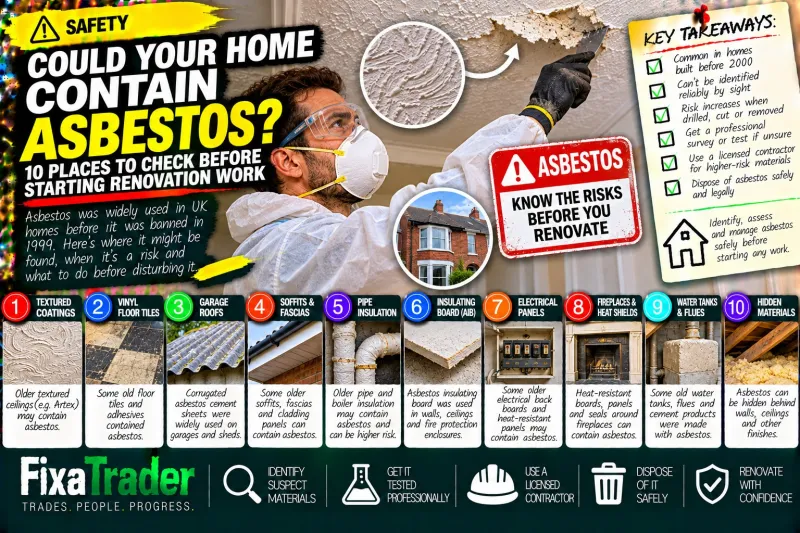
Here are ten places where asbestos-containing materials may be found in older UK homes.1. Textured Ceiling and Wall Coatings
Textured decorative coatings were popular in UK homes for many years.
Some older products, including certain Artex-type coatings, contained asbestos.
These finishes can appear on ceilings and occasionally walls.
They may have swirled, stippled or patterned surfaces.
However, the presence of a textured coating doesn't automatically mean asbestos is present.
Many coatings were manufactured without asbestos.
When might it become a problem?
The main concern is work that disturbs the coating.
For example:
Sanding a textured ceiling.
Scraping off the coating.
Drilling numerous holes.
Cutting through the ceiling.
Removing damaged sections.
Painting an intact coating is very different from mechanically removing it.
If you're planning to strip or significantly disturb an older textured finish, arrange appropriate identification first.
Don't assume that a coating is asbestos-free simply because it looks similar to a modern product.2. Old Vinyl Floor Tiles and Adhesives
Some older floor tiles contained asbestos.
Certain adhesives and bituminous products used beneath flooring could also contain it.
These materials may be hidden beneath carpet, laminate or newer floor coverings.
Homeowners sometimes discover them when removing an old kitchen or hallway floor.
The tiles may appear hard, brittle or unusually well bonded to the subfloor.
But these characteristics aren't proof of asbestos.
Potentially risky activities include:
Breaking up old tiles.
Grinding away adhesive.
Sanding contaminated flooring materials.
Using aggressive mechanical removal methods.
If old flooring is intact, it may sometimes be possible to leave it in place as part of an appropriately designed refurbishment.
However, suitability depends on its condition and the proposed work.
Before removing unknown flooring from an older property, establish what the tiles and adhesive are made from.3. Garage Roof Sheets
Corrugated asbestos cement sheets were widely used for garages, sheds and other outbuildings.
Some remain in place today.
Asbestos cement generally binds fibres within a cement-based material.
When intact and undisturbed, it typically presents a lower risk than more friable asbestos materials.
However, that doesn't make it harmless.
Weathering, damage and inappropriate removal can create hazards.
Warning situations include:
Broken roof sheets.
Crumbling or severely deteriorated panels.
Drilling through sheets.
Cutting sheets with power tools.
Breaking panels during removal.
Never use abrasive power tools to cut or grind suspected asbestos cement.
If you're replacing an older garage roof, identify the material and arrange an appropriate removal method.
A roof that has remained in place for decades shouldn't automatically be treated as safe to break apart or dispose of with ordinary building waste.4. Soffits, Fascias and External Panels
Asbestos-containing products were also used in certain external building components.
These could include soffit boards, cladding panels and other flat sheets.
Some products resemble ordinary cement boards or painted timber.
That can make them difficult to identify visually.
Problems may arise during roofline replacement, window installation or external refurbishment.
For example, a contractor replacing guttering may need to work close to older soffit panels.
If those panels are drilled, broken or removed, asbestos precautions may be necessary.
Before replacing or modifying older roofline materials, check whether asbestos-containing boards could be present.
The type of board matters because some asbestos-containing insulation boards are substantially more hazardous to disturb than asbestos cement.5. Pipe Insulation and Boiler Insulation
Certain older heating systems used asbestos-containing insulation around pipes, boilers and other equipment.
These materials deserve particular caution.
Some forms of asbestos insulation are relatively friable, meaning they can release fibres more readily when disturbed.
Insulation may be concealed in cupboards, service voids, lofts or around older equipment.
It may appear as a wrapped, lagged or plaster-like covering.
However, appearance alone cannot establish its composition.
If you encounter suspicious insulation around older pipework or heating equipment, do not pull it apart, scrape it or attempt to remove it yourself.
Stop the affected work and seek specialist advice.
Some asbestos insulation work requires a licensed contractor.6. Asbestos Insulating Board
Asbestos insulating board, often abbreviated to AIB, was used in various building applications.
It could be found in certain partition walls, ceiling panels, fire protection systems and service enclosures.
AIB can look similar to other board materials.
This is one reason it can be overlooked during refurbishment.
Cutting, drilling or breaking it may release hazardous fibres.
The work required to remove or disturb AIB can be subject to particularly strict controls, depending on the circumstances.
Some activities require an HSE-licensed asbestos contractor.
If an older board forms part of a wall, ceiling or fire-resistant enclosure, don't assume it's ordinary plasterboard or timber-based sheet material.
Have suspicious materials identified before proceeding.7. Old Electrical Equipment and Heat-Resistant Panels
Asbestos was historically used in some electrical and heat-resistant applications.
Potential examples include certain older electrical equipment, backing boards and heat-resistant panels.
These materials may be encountered when replacing outdated electrical installations or modifying service cupboards.
The exact risk depends on the product and its composition.
Not every old electrical board contains asbestos.
But electrical age and appearance alone aren't reliable ways to rule it out.
There is also the separate danger of electric shock when working around electrical equipment.
If a suspicious panel is associated with an electrical installation, have it assessed by appropriately competent professionals rather than attempting to remove it yourself.8. Fireplaces, Stove Surrounds and Heat Shields
Some older fireplaces and heating installations incorporated asbestos-containing heat-resistant materials.
These could include boards, panels, ropes, seals or other components.
You might encounter them when removing a fireplace, installing a stove or renovating a chimney breast.
Because these products were designed to withstand heat, their appearance can resemble other fire-resistant materials.
The presence of asbestos cannot be confirmed simply by looking at them.
Take particular care when:
Removing an old fireplace.
Dismantling heating equipment.
Cutting through heat-resistant panels.
Removing old seals or insulation.
Altering a chimney breast.
If a suspicious material is present, pause the work until its composition and appropriate handling requirements are established.9. Water Tanks, Flues and Cement Products
Asbestos cement was used in various building products.
Depending on the age and construction of the property, these may include certain water tanks, flue pipes, drainage components and other cement-based products.
Asbestos cement is not the same as asbestos insulation or insulating board.
Different materials have different properties and risk profiles.
However, asbestos cement can still release fibres when broken, drilled or mechanically worked.
For example, replacing an old flue or removing a redundant tank may involve disturbing the material.
Don't assume a hard, cement-like product is asbestos-free simply because it doesn't look fibrous.10. Hidden Materials Behind Walls and Ceilings
One of the biggest challenges during renovation is that hazardous materials may be concealed.
A property can appear modern because its kitchen, bathroom and flooring have been replaced.
But older materials may remain behind the visible finishes.
Potential locations include:
Service risers and pipe enclosures.
Ceiling voids.
Partition walls.
Boxing around older installations.
Behind newer wall linings.
Beneath replacement flooring.
This is why a visual inspection of finished rooms cannot always establish whether renovation work will disturb asbestos.
If you're planning intrusive work in a building constructed or refurbished before 2000, consider whether an appropriate asbestos survey is needed before work begins.How Can You Tell Whether a Material Contains Asbestos?
In most cases, you can't tell reliably by looking at it.
Colour, texture and age may provide clues, but they aren't conclusive.
Two visually similar products may have different compositions.
One may contain asbestos while the other does not.
The reliable approach is appropriate sampling and laboratory analysis.
Samples should be collected safely by someone competent to assess the risks and use suitable procedures.
In the UK, asbestos bulk sample analysis should be carried out by a laboratory accredited to ISO/IEC 17025 for the relevant testing.
Don't break off a piece of suspicious material yourself simply to send it away for testing.
Disturbing the material to obtain a sample can create the exposure you're trying to avoid.Does Every Older UK Home Contain Asbestos?
No.
Asbestos was widely used, but that doesn't mean every property built before 2000 contains it.
The likelihood depends on construction methods, materials, alterations and previous refurbishment.
The year 2000 is commonly used as a practical screening point because the UK ban on asbestos use was completed in 1999.
However, a property's age alone cannot confirm whether asbestos is present.
An older home may have had asbestos-containing products removed.
A more recently renovated room may still conceal older materials.
Treat the age of the building as a reason to investigate, not as proof that asbestos is present.Is Asbestos Dangerous If You Leave It Alone?
Asbestos-containing materials that remain in good condition and are not disturbed often present a lower risk than damaged or friable materials.
In some circumstances, managing a material in place may be preferable to unnecessary removal.
However, the decision depends on its condition, location and likelihood of disturbance.
For example, an intact panel in an inaccessible location may present a different risk from damaged insulation beside frequently accessed equipment.
You should not attempt to seal, encapsulate or repair unknown asbestos-containing materials without appropriate assessment.
The safest option isn't always removal. It's making an informed decision based on the material and the risk of fibre release.What Should You Do If You Accidentally Disturb Suspected Asbestos?
If you unexpectedly damage material that may contain asbestos, stop work immediately.
Avoid further disturbance.
Keep other people away from the affected area.
Don't sweep up the debris with a broom or use an ordinary household vacuum cleaner.
These activities can spread fibres.
Avoid moving contaminated materials or clothing around the property.
Seek advice from a competent asbestos professional about the appropriate next steps, including assessment, cleaning and disposal.
If the incident occurred during contracted work, the contractor should follow the applicable health and safety procedures.
Where significant exposure may have occurred, seek appropriate medical or occupational health advice.
The priority is to prevent further disturbance and avoid spreading potentially contaminated dust.Do You Need an Asbestos Survey Before Renovating?
Not every minor home maintenance task automatically requires a formal asbestos survey.
However, work that could disturb suspect materials should not proceed without appropriate assessment.
A management survey is generally intended to help identify asbestos-containing materials that could be disturbed during normal occupation and routine maintenance.
A refurbishment or demolition survey is designed to identify relevant asbestos-containing materials before intrusive refurbishment or demolition work.
The appropriate survey depends on the proposed work and the building.
For domestic properties, the legal duties under the Control of Asbestos Regulations 2012 can differ from those applying to non-domestic premises.
Nevertheless, contractors still have responsibilities to protect workers and others from asbestos exposure.
If a renovation will involve opening walls, removing ceilings or disturbing older building materials, discuss asbestos assessment with the contractor before work begins.Can Homeowners Remove Asbestos Themselves?
Asbestos work is subject to different legal requirements depending on the material and activity.
Some lower-risk work may be non-licensed, provided the relevant conditions and controls are met.
Other work requires notification or a licensed asbestos contractor.
However, the fact that some work may legally be non-licensed doesn't mean it's a suitable DIY project.
Incorrect handling can contaminate the home and expose occupants to hazardous fibres.
Asbestos waste also requires appropriate handling and disposal.
Local council facilities may have specific arrangements for accepting certain asbestos-containing materials from households.
Never place asbestos waste in ordinary household rubbish or dispose of it illegally.
For homeowners, professional assessment and appropriately controlled removal are generally the safer approach.How Much Does Asbestos Testing or Removal Cost?
Costs vary considerably.
A limited assessment of a suspected material is different from a full refurbishment survey.
Removing a small quantity of asbestos cement is also very different from removing asbestos insulation or insulating board.
The price may depend on:
The type of material.
Its condition.
Accessibility.
The amount involved.
The required controls.
Whether licensed work is necessary.
Waste handling and disposal.
Reinstatement after removal.
For significant work, obtain quotations that clearly identify the scope and applicable safety arrangements.
Where licensing is required, verify the contractor's HSE asbestos licence.
You can also check whether surveyors and laboratories hold appropriate UKAS accreditation for the services being offered.
Don't select an asbestos contractor solely because they provide the cheapest quotation. Competence, appropriate controls and lawful disposal are essential.Five Questions to Ask Before Renovating an Older Home
Before starting work, consider:
When was the property built or last substantially refurbished? Older construction may contain asbestos products.
Which materials will be disturbed? Consider ceilings, flooring, walls, insulation and service enclosures.
Has asbestos been assessed? Ask whether relevant surveys or test results are available.
Who will carry out the work? Confirm that contractors understand the potential risks and applicable requirements.
What happens if suspicious materials are discovered? Agree that work will stop until the material is appropriately assessed.
These questions can help prevent an avoidable exposure incident.The Bottom Line: Identify Suspected Asbestos Before Disturbing It
Asbestos remains relevant to UK homeowners because many older buildings still contain products installed before the 1999 ban.
It may be present in textured coatings, floor tiles, garage roofs, insulation, boards and other building materials.
But not every old material contains asbestos, and not every asbestos-containing product needs immediate removal.
The risk depends on the material, its condition and whether it is disturbed.
If you're planning renovation work, establish what materials may be affected before cutting, drilling or removing them.
Use competent professionals for identification and appropriate handling.
And if you unexpectedly encounter suspicious materials, stop work rather than trying to finish the job.
When it comes to asbestos, the safest renovation is one where the risks are identified before the first material is disturbed.Useful UK Guidance