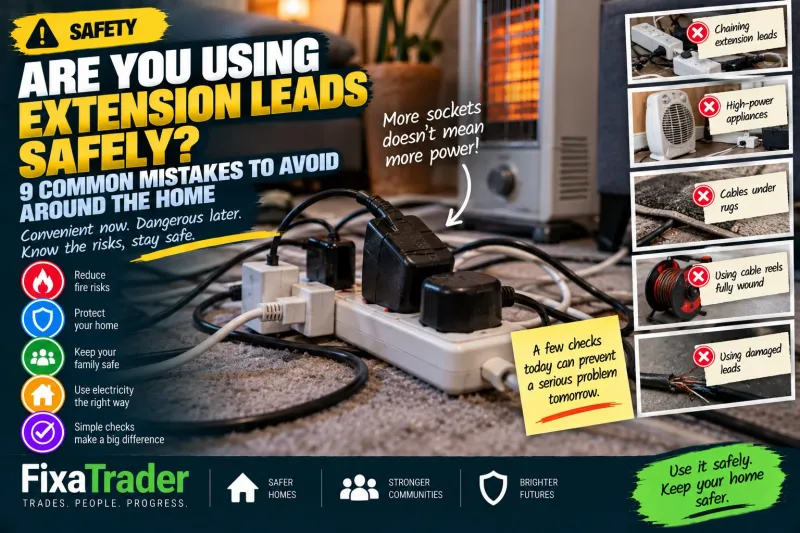
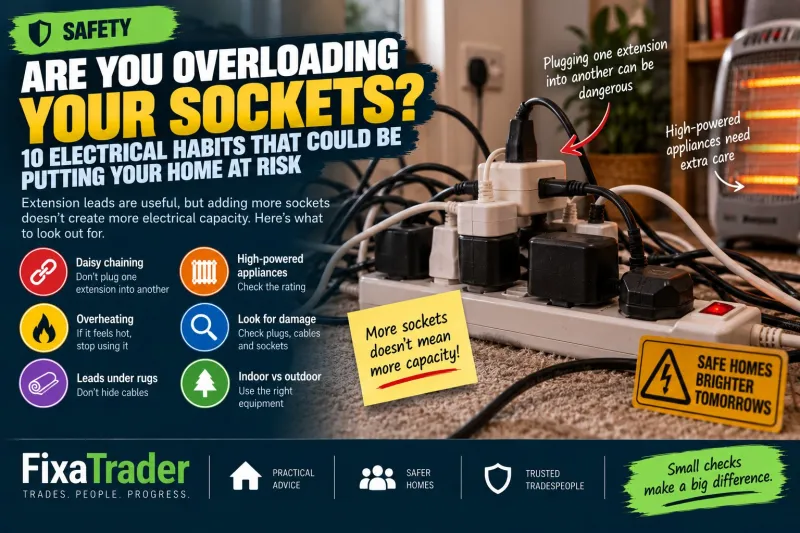
Are You Using Extension Leads Safely? 9 Common Mistakes to Avoid Around the Home
Extension leads are everywhere. Behind televisions. Under desks. Next to beds. In garages. Across workshops. And increasingly underneath home-office setups cont...
And increasingly underneath home-office setups containing computers, monitors, chargers and other equipment.
Most of the time, nobody thinks twice about them.
You plug something in and it works.
The problem is that an extension lead gives you more places to connect equipment. It doesn't give the electrical circuit—or the extension lead itself—unlimited capacity.
How you use one matters.
Here are nine common mistakes worth avoiding.1. Plugging One Extension Lead Into Another
You need another socket.
So you plug a second extension lead into the first.
Then perhaps another adapter goes into that.
You've created plenty of places to connect appliances, but you haven't magically increased the amount of electrical load the original extension lead can safely handle.
Everything connected downstream is ultimately feeding through that first connection.
If you regularly need several extensions joined together just to reach your equipment, that's a sign the setup itself may need reconsidering.
A properly located additional socket may be a better long-term solution.2. Assuming Every Appliance Uses Roughly the Same Amount of Power
Four plugs don't necessarily mean four similar loads.
A phone charger and a portable electric heater are very different appliances.
Equipment that produces significant heat can be particularly power-hungry.
Examples can include appliances such as:
Portable heaters.
Kettles.
Toasters.
Hair dryers.
And certain cooking appliances.
The relevant rating of the extension lead and connected equipment matters far more than simply counting how many sockets are occupied.
An extension with one high-powered appliance connected can potentially be under more load than another extension with several low-powered devices.3. Ignoring the Maximum Rating
Extension leads should carry information about the electrical load they're designed to handle.
Don't treat that information as decoration.
If you're unsure whether a combination of appliances is suitable, check the ratings rather than guessing.
Electrical Safety First provides a useful Socket Calculator that can help illustrate how different combinations of appliances can affect the load placed on an extension lead.
More available sockets doesn't mean you should automatically fill every one.4. Leaving a Cable Reel Fully Wound When It Should Be Unreeled
Cable reels deserve particular attention.
When current passes through a cable, heat is produced.
With some cable reels, using them while the cable remains wound can affect their ability to dissipate that heat, and manufacturers may specify different ratings depending on whether the cable is wound or fully unwound.
Follow the instructions and ratings for the particular reel you're using.
Don't assume a heavy-looking reel can handle anything simply because it appears more substantial than a normal extension lead.5. Running Extension Leads Under Rugs
A cable across the middle of a room is annoying.
The tempting solution?
Hide it under a rug.
That creates other problems.
The cable can become damaged without you noticing, and putting cables beneath floor coverings isn't a sensible substitute for having electrical outlets where they're actually required.
It can also create an uneven surface and potential trip issue.
If a cable has become a permanent part of how the room functions, consider whether the room needs a better permanent electrical arrangement.6. Continuing to Use Damaged Leads
Extension leads live fairly hard lives.
They're pulled from sockets.
Wrapped around things.
Caught under furniture.
Dropped.
Stored in sheds.
Driven over in garages.
And sometimes yanked by the cable rather than removed by the plug.
Inspect them occasionally.
Stop using equipment if you discover obvious damage such as:
Split cable insulation.
Exposed conductors.
Cracked plugs or sockets.
Burning or melting.
Loose components.
Or other significant deterioration.
Tape isn't an appropriate universal repair for damaged electrical equipment.7. Ignoring Heat, Burning Smells or Discolouration
Electrical problems sometimes provide warning signs.
A plug, socket or extension that becomes unusually hot, shows scorching, smells of burning, crackles or begins deforming needs attention.
Don't repeatedly reconnect equipment and hope the problem disappears.
Stop using the affected setup and have the issue appropriately investigated.
If you see smoke, active burning or another immediate electrical danger, treat it as an emergency rather than a DIY troubleshooting exercise.8. Using Indoor Extension Leads Outdoors
You're doing something in the garden.
The nearest socket is inside.
So the household extension lead goes through the window.
Electrical equipment used outdoors can be exposed to moisture and harsher conditions than equipment used inside the home.
Use equipment that is suitable for the environment and follow the manufacturer's instructions.
Outdoor electrical safety can also involve appropriate RCD protection.
Electrical Safety First provides further guidance on using electrical equipment outdoors.
If you're unsure whether your electrical arrangement is suitable, get advice from a competent electrician rather than improvising.9. Using Extension Leads as Permanent Wiring
An extension lead is extremely useful when you temporarily need power somewhere.
But look around your home.
Has the extension behind the television been there for eight years?
Is another permanently running around the bedroom because there aren't enough sockets?
Does your home office depend on several extensions every working day?
At some point, a temporary solution has become the permanent electrical arrangement.
That doesn't automatically mean the setup is dangerous, but persistent reliance on extension leads can indicate that the property's socket provision no longer matches how the room is being used.
It may be worth discussing additional fixed outlets or other appropriate improvements with a qualified electrician.What About Multi-Plug Adaptors?
Plug-in adaptors can create similar misunderstandings.
They provide additional connection points, but the electrical load still matters.
Don't assume an adaptor is safe simply because all of its sockets physically accept a plug.
Look at what you're connecting and follow the manufacturer's ratings and instructions.
Poor-quality or damaged electrical accessories are another reason to be cautious.Home Offices Deserve a Check
The way many homes use electricity has changed.
A desk might now contain:
Two monitors.
A desktop computer.
Laptop charger.
Speakers.
Printer.
Phone charger.
Desk lamp.
Router or networking equipment.
That's a lot of plugs concentrated in one place.
Not all of those devices necessarily draw large amounts of power, but the setup can gradually grow without anyone reconsidering how everything is connected.
Every so often, look behind the desk.
Check the condition of cables and extension leads.
Remove equipment that is no longer used.
Make sure you're not unknowingly creating chains of adaptors simply because the wiring has been hidden from view.Children's Bedrooms Can Change Quickly Too
A child's room might begin with a lamp and alarm clock.
A few years later it contains:
Television.
Games console.
Computer.
Chargers.
Speakers.
Lighting.
And perhaps other electrical equipment.
The room has changed.
The number of fixed sockets hasn't.
That's another environment where extension leads can gradually multiply without anybody consciously deciding to create that setup.
It's worth checking periodically.Don't Forget the Socket the Extension Is Connected To
Sometimes attention focuses entirely on the extension lead.
But the wall socket matters too.
If a socket is damaged, loose, scorched, crackling or showing other signs of deterioration, don't simply move the extension around until the problem becomes less noticeable.
The fixed electrical installation may need attention from a competent electrician.
The extension lead is only one part of the system.Extension Leads Aren't the Enemy
There's nothing inherently wrong with using an extension lead appropriately.
They're extremely useful.
The problem is treating them as though adding four sockets means you've created four new independent electrical supplies.
You haven't.
So every so often, take a look at the extensions around your home.
Ask:
What is connected?
Is anything damaged?
Are high-powered appliances involved?
Have several extensions been chained together?
Has a temporary setup quietly become permanent?
If the answer to that final question is yes, it may be time to improve the setup rather than add another adaptor.
An extension lead can give you more sockets — but using those sockets safely still depends on what you plug into them and how the equipment is being used.
0 Comments
No comments yet — be the first to share your thoughts.