What to Do If You Find a Water Leak at Home: 10 Steps to Limit the Damage
You walk into the kitchen and your socks are suddenly wet. There's water dripping through the ceiling. A pipe beneath the sink is spraying. Or you've opened a c...
You walk into the kitchen and your socks are suddenly wet.
There's water dripping through the ceiling.
A pipe beneath the sink is spraying.
Or you've opened a cupboard and discovered a pool of water that definitely wasn't there yesterday.
The first few minutes matter.
When people discover a leak, the natural reaction is often to focus immediately on fixing the pipe.
But unless the cause is obvious and you're competent to deal with it, that isn't necessarily your first priority.
Your immediate objectives are simpler:
Stop or reduce the water. Protect people from electrical hazards. Limit further damage. Then establish what has actually happened.
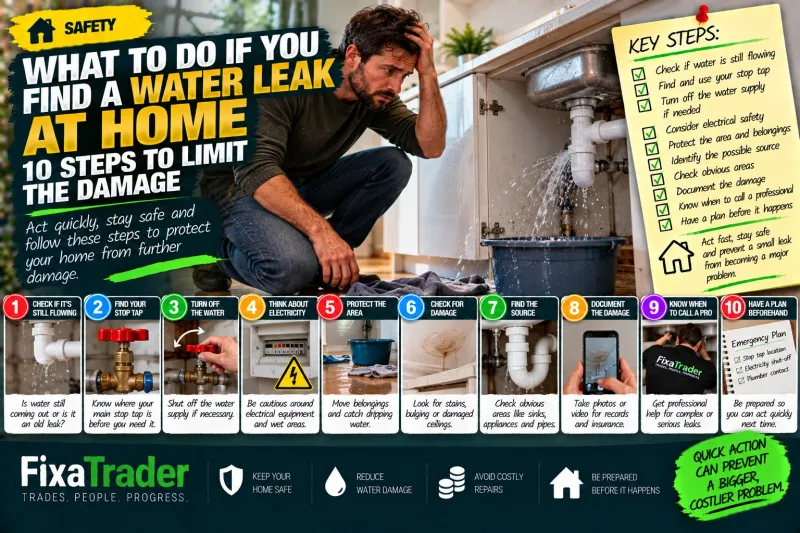
Here's a sensible order to approach it.1. Work Out Whether Water Is Still Flowing
First, determine whether you're looking at an active leak or evidence of one.
Is water currently dripping?
Can you hear it?
Is the wet area growing?
Is a ceiling continuing to stain?
Is water visibly escaping from a pipe or fitting?
Sometimes you discover the aftermath of a small leak after the source has stopped.
Other times, water is continuing to enter the property every second.
That distinction determines how urgently you need to isolate the supply.
If water is actively escaping and you can't immediately identify a safe local way to stop it, locating the property's main water shut-off becomes important.2. Know Where Your Stop Tap Is
This is something worth knowing before you have a leak.
The internal stop tap controls the incoming mains water supply to the property.
In many homes it may be found beneath the kitchen sink, although locations vary considerably depending on the property and plumbing arrangement.
It might instead be in:
A utility area.
Cupboard.
Garage.
Under the stairs.
Cellar.
Or another location near where the water supply enters the property.
Don't wait until water is pouring through the ceiling to begin searching for it.
Find yours on a normal day.
Make sure everyone appropriate in the household knows where it is.3. Shut Off the Water When Necessary
If you have a significant active leak from the mains-fed plumbing and can safely access the appropriate stop tap, turning off the water supply can help prevent more water entering the system.
Turn the tap carefully rather than applying excessive force to an old or seized valve.
If it won't move, don't attack it with tools until something breaks.
There may also be local isolation valves for individual appliances or fixtures, depending on the installation.
If you know exactly what you're isolating, a local valve can sometimes stop the affected supply without shutting down the whole property.
But don't start turning unfamiliar valves randomly during an emergency.
If you're unsure, isolate the main supply where appropriate and seek professional help.4. Think About Electricity Immediately
Water and electricity are an obvious but important combination to take seriously.
If water is leaking:
Through a ceiling containing lights.
Around sockets.
Near electrical equipment.
Into a consumer unit.
Or around other electrical installations...
...don't simply continue using the area normally.
Avoid touching electrical equipment or switches that are wet or where doing so could expose you to danger.
Where there is a potential electrical hazard, the correct response depends on the circumstances and whether electrical isolation can be carried out safely.
If you cannot safely approach the electrical installation, don't enter the hazardous area merely to turn something off.
Get appropriate emergency assistance.
The leaking pipe may not be the most immediate danger anymore.5. Protect the Area Below the Leak
Once immediate safety and water isolation have been considered, limit the damage where you safely can.
Move vulnerable belongings away.
Use suitable containers to catch dripping water.
Protect flooring where practical.
Move furniture.
Remove electrical devices from unaffected areas before water reaches them, provided it is safe to do so.
Towels can help with relatively small amounts of water, but don't underestimate how quickly a significant leak can overwhelm them.
Your objective isn't to make the room look tidy.
It's to stop one plumbing problem becoming damage to five other things.6. Be Careful With Bulging Ceilings
Water leaking from above can collect on or within ceiling materials.
You may notice:
Sagging.
Bulging.
Cracking.
Discolouration.
Or water emerging around fittings.
Treat a heavily water-affected ceiling cautiously.
Wet building materials can become damaged and potentially unstable.
Don't stand directly beneath a visibly sagging section wondering how much water it contains.
Keep people away from an area that appears unsafe and get appropriate professional advice.
And again, if electrical fittings are involved, factor in the electrical risk.7. Try to Identify the Source—Without Creating Another Problem
Once the immediate flow is under control, start investigating logically.
Ask:
What is directly above or beside the wet area?
A bathroom?
Radiator?
Sink?
Washing machine?
Dishwasher?
Water tank?
Heating pipe?
Roof?
Remember that the place where water becomes visible isn't necessarily where the leak began.
Water can travel along:
Joists.
Pipes.
Cables.
Walls.
Ceilings.
And other building elements before appearing somewhere else.
A stain beneath the bathroom doesn't automatically mean the bath itself is leaking.
It tells you where the water eventually became visible.8. Check the Obvious Accessible Areas
Without dismantling the property, inspect what you can safely see.
Under sinks, look at:
Supply connections.
Waste pipes.
Traps.
Visible valves.
And the bottom of the cupboard.
Around toilets, check for visible water near accessible connections and the base.
Around baths and showers, consider whether water could be escaping around seals, screens or waste components.
Near appliances, look at accessible hoses and connections.
Around radiators, inspect valves and visible pipework.
Sometimes the cause is immediately obvious.
Other times everything visible is completely dry.
That's useful information too.9. Don't Assume Every Leak Comes From the Water Supply
A wet patch doesn't automatically mean a pressurised pipe has failed.
Water inside a property can come from numerous sources.
For example:
A leaking supply pipe.
A waste pipe.
A bath or shower seal.
An appliance.
A heating system.
Condensation.
A roof defect.
Guttering or rainwater.
An overflow.
Or water entering through the building fabric.
This matters because turning off the main stop tap won't stop every possible source.
If water only appears during heavy rain, for example, the investigation is likely to be very different from a pipe spraying beneath the kitchen sink.
Look at when the leak happens as well as where it appears.10. Document the Damage
Once the immediate situation is safe, take photographs or video of the affected areas.
Capture:
Where the water appeared.
Visible damage.
Affected belongings where relevant.
The suspected source if visible.
And the condition before extensive cleanup or repair begins.
This can be useful for several reasons.
It helps a tradesperson understand what happened.
It gives you a record if the damage develops.
And if an insurance claim becomes relevant, documentation may help establish the circumstances and extent of the damage.
Don't delay emergency action just to take photographs.
Stop the problem first.
Document it when safe.What If You Can't Find the Stop Tap?
This is more common than it should be.
If you've just discovered a major leak, searching every cupboard while water continues escaping isn't ideal.
That's why identifying the stop tap in advance is worthwhile.
If you genuinely cannot locate or operate it during an active leak, contact an appropriate plumber or emergency service provider for advice and assistance.
Properties may also have external water-company stop valves associated with the supply, but access and responsibility arrangements can vary.
Don't interfere with infrastructure you're not authorised or competent to operate.What If the Leak Is From the Heating System?
A central-heating leak can behave differently from a straightforward mains-water leak.
If a radiator valve or heating pipe is leaking, the water may be coming from the heating circuit.
Turning off the mains water may not instantly empty or isolate all water already within that system.
If you're unsure how your heating system is configured, don't start draining or manipulating boiler components at random.
Turn the heating off where appropriate and seek help from someone competent to work on the system.
For relevant work on gas appliances, use an appropriately Gas Safe registered engineer.What About a Leaking Toilet?
First determine what is actually leaking.
A toilet that continuously runs into the bowl is different from water escaping onto the floor.
Water on the floor may come from:
A supply connection.
Cistern.
Flush connection.
Waste connection.
Condensation.
Or another source.
If water is escaping externally, treat it as an active leak and isolate the appropriate supply where possible.
If wastewater is involved, hygiene becomes another consideration.
Avoid unnecessary contact and clean affected areas appropriately once the cause has been addressed.What About a Washing Machine or Dishwasher?
If an appliance appears to be the source, stop using it.
If safe and you know the relevant isolation arrangement, the appliance's water supply may be capable of being isolated locally.
Be especially cautious if water is around the electrical connection or appliance electrics.
Don't pull electrical equipment through standing water or reach behind a wet appliance to unplug it if doing so could expose you to electrical danger.
Safety takes priority over protecting the appliance.Don't Automatically Reach for Leak-Sealing Products
Temporary leak products are widely available.
That doesn't mean every leak should immediately be covered, wrapped, filled or chemically sealed.
A temporary measure can sometimes be useful in the right circumstances.
It can also:
Hide the original problem.
Make a later repair more difficult.
Fail unexpectedly.
Or create false confidence that the problem has been fixed.
If you don't understand what has failed, focus on isolation and damage limitation rather than improvising a permanent plumbing repair.Drying the Property Matters Too
Stopping the leak is only the first half of the problem.
Water may have entered:
Carpets.
Flooring.
Insulation.
Plasterboard.
Timber.
Cabinetry.
Wall cavities.
And other materials.
Simply repairing the pipe doesn't instantly make those materials dry.
For a small spill, ordinary drying and ventilation may be sufficient.
More substantial water damage can require professional drying and assessment, particularly where moisture has entered hidden parts of the building.
Don't redecorate a damp surface simply because the leak has stopped.Watch for Changes After the Repair
Once the source has been repaired, keep an eye on the affected area.
Is the damp patch drying?
Has staining expanded?
Is there a smell developing?
Are materials swelling?
Has paint started bubbling?
Does the ceiling still feel or look compromised?
A leak can be fixed while the consequences of the escaped water continue developing.
This is especially relevant when the leak existed unnoticed for some time.When Is a Leak an Emergency?
There isn't one universal threshold, but urgent professional help is sensible when:
Water is escaping rapidly.
You can't isolate the supply.
Water is affecting electrical installations.
A ceiling is significantly sagging or appears unsafe.
A major heating-system component is involved.
Water is entering several parts of the property.
The source cannot be identified.
Wastewater or contaminated water is involved.
Or the situation is beyond what you can safely control.
If there is immediate danger to people, treat the safety risk as the priority rather than the property repair.Make a Five-Minute Leak Plan Before You Ever Need It
There's a simple piece of home maintenance almost anyone can do today.
Find your stop tap.
Make sure appropriate members of the household know where it is.
Understand which way it operates.
Know where your consumer unit is.
Keep contact details for a trusted plumber accessible.
And periodically look beneath sinks and around accessible plumbing rather than waiting for water to appear through the ceiling.
Five quiet minutes spent doing that today can feel extremely valuable during a leak at 2am.Stop the Water Before You Start Solving the Mystery
When a leak appears, you naturally want to know:
What's broken?
But the order matters.
First consider people's safety.
Then stop or reduce the flow where it is safe and appropriate.
Protect the surrounding property.
Document what happened.
Then establish the cause and arrange the correct repair.
There will be time to work out whether it was a failed valve, damaged pipe, appliance connection, shower seal or something else.
What you don't want is another fifty litres of water entering the property while you're trying to diagnose it.
When water starts appearing where it shouldn't, the first job isn't necessarily repairing the leak—it's making the situation safe, stopping more water arriving and preventing a small failure from causing much bigger damage.
0 Comments
No comments yet — be the first to share your thoughts.