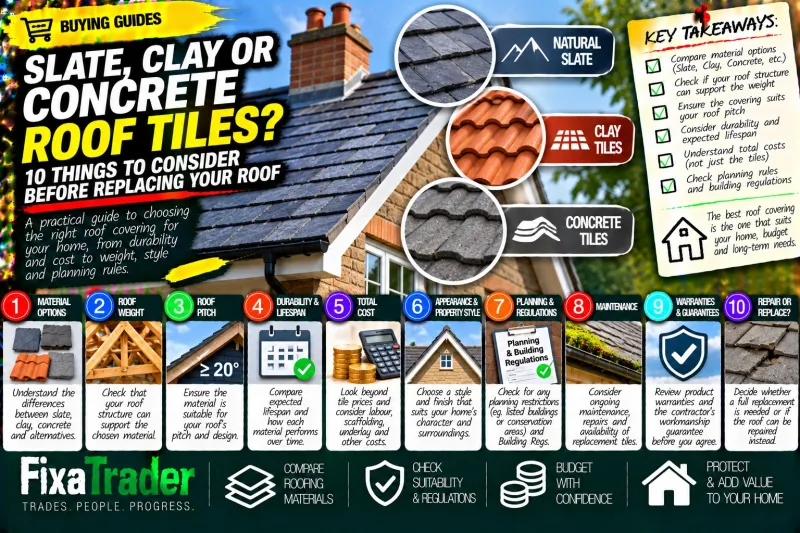
Slate, Clay or Concrete Roof Tiles? 10 Things to Consider Before Replacing Your Roof
Your roof has reached the point where repairs are becoming more frequent. Perhaps tiles are slipping, water is getting into the loft or the covering is simply a...
Your roof has reached the point where repairs are becoming more frequent.
Perhaps tiles are slipping, water is getting into the loft or the covering is simply approaching the end of its useful life.
You've spoken to a few roofing contractors and received different recommendations.
One suggests concrete tiles.
Another recommends natural slate.
A third believes clay tiles would be a better long-term investment.
Each option comes with different costs, benefits and installation requirements.
So how do you decide?
The answer depends on more than the price of the tiles themselves.
Your property's roof structure, pitch, location, architectural style and existing covering can all influence which materials are suitable.
The best roofing material isn't necessarily the cheapest or the one with the longest advertised lifespan. It's the one that suits your property, budget and long-term maintenance expectations.
Here are ten things to consider before choosing a replacement roof covering.1. Understand the Main Roofing Materials
Before comparing prices, it's worth understanding the differences between the most common pitched-roof coverings.
Natural slate
Natural slate is a stone roofing material, traditionally used on many UK properties.
It is valued for its appearance, durability and suitability for certain architectural styles.
Quality varies according to the source, grade and characteristics of the slate.
Clay tiles
Clay roof tiles are manufactured from fired clay.
They are available in various shapes, profiles and finishes.
Traditional plain clay tiles are particularly common on certain period properties.
Concrete tiles
Concrete roof tiles are manufactured using cement-based materials.
They are available in different profiles, colours and finishes.
They are widely used on modern and existing UK homes.
Synthetic slate and alternative coverings
Some products are designed to imitate natural slate or traditional tiles.
These may be manufactured from composite or other engineered materials.
Their performance and installation requirements vary significantly between products.
Understanding the material is the starting point. The next step is establishing whether it is appropriate for your particular roof.2. Check Whether the Roof Structure Can Support the Weight
Roof coverings have different weights.
This matters because the roof structure must be capable of supporting the chosen materials alongside other relevant loads.
Concrete tiles can be relatively heavy.
Clay tiles also vary considerably in weight depending on their type and profile.
Natural slate is often lighter than some tiled coverings, although the overall roof specification matters.
You cannot safely determine suitability from material type alone.
For example, replacing an existing slate covering with heavier tiles may require structural assessment.
The condition and design of the rafters, trusses, battens and other components also matter.
Before changing roofing materials, ask:
What covering is currently installed?
How much does the proposed replacement weigh?
Is the existing structure suitable?
Will structural alterations be necessary?
Has the contractor assessed the implications of the change?
Where necessary, a structural engineer should assess the roof.
Never assume that a roof designed for one covering can automatically support another.3. Consider the Roof Pitch
Roof pitch is the angle at which the roof slopes.
It affects how rainwater drains and which roofing products can be installed.
Different tiles and slates have minimum pitch requirements.
These depend on factors such as product design, headlap, exposure and the manufacturer's installation instructions.
A tile suitable for a steeply pitched roof may not be appropriate for a shallow roof.
Installing a product below its permitted pitch can increase the risk of water penetration.
This is particularly important when replacing an existing covering with a different material.
Ask your roofer to confirm:
The roof's actual pitch.
The proposed product's minimum pitch.
Required overlaps and fixing arrangements.
Whether the roof's exposure affects the specification.
Any relevant manufacturer restrictions.
The appearance of a tile is irrelevant if the product cannot perform properly at your roof's pitch.4. Compare Durability and Expected Lifespan
Roof coverings are often marketed using impressive lifespan claims.
You may see references to several decades or even more than a century.
However, actual service life depends on many factors.
These include material quality, installation, weather exposure, maintenance and the condition of associated roof components.
Natural slate
High-quality natural slate can provide a very long service life when correctly specified and installed.
However, not all slate is equal.
Lower-quality products may deteriorate sooner.
Clay tiles
Good-quality clay tiles can also be durable and long-lasting.
Performance varies with the product, manufacturing quality and exposure conditions.
Concrete tiles
Concrete tiles can provide decades of service.
Their appearance may change over time, and individual products have different performance characteristics.
Synthetic products
Some alternatives offer useful benefits, but their long-term performance depends on the specific manufacturer and product.
A long warranty isn't automatically evidence that a product will remain in service for the same period.
Rather than comparing broad lifespan claims, compare the actual products being quoted and the evidence supporting their performance.5. Look Beyond the Initial Installation Price
Roof replacement is a substantial expense.
It's understandable to compare quotations carefully.
However, the price of the covering is only one part of the overall cost.
A roof replacement may involve:
Scaffolding.
Removal of existing materials.
Waste disposal.
Roofing underlay.
Battens.
Fixings.
Ridge and hip details.
Flashings.
Ventilation components.
Labour.
Structural repairs.
Building control requirements where applicable.
Different materials may also affect installation time and labour costs.
For example, a covering that requires more individual units per square metre may involve different installation work from larger-format tiles.
Natural slate and traditional clay plain tiles may carry higher material or installation costs than some concrete products.
But the actual difference depends on the specification and roof.
When comparing quotations, make sure you're comparing complete roofing systems rather than just the price of the visible covering.6. Think About Appearance and Property Character
A roof has a significant influence on how a property looks.
Changing its colour, profile or texture can alter the character of the entire building.
This is particularly relevant for period homes and properties in established streets.
For example, traditional clay plain tiles may complement certain older buildings.
Natural slate may be appropriate for properties originally designed with slate roofs.
Concrete tiles can suit many modern and traditional properties, depending on their appearance.
However, not every modern imitation will reproduce the visual characteristics of the original material.
Before choosing a replacement:
Look at the existing roof.
Consider neighbouring properties.
Review suitable colour and profile options.
Ask to see physical samples.
Consider how the material may weather over time.
A roof should work visually with the building, not simply look attractive as an individual product.7. Check Planning Permission and Building Regulations
Roof replacement doesn't always require planning permission.
However, certain changes can trigger planning considerations.
Restrictions may apply to listed buildings, properties in conservation areas and situations where the replacement significantly changes the roof's appearance or form.
Permitted development rules also vary across the UK.
Separately, roof replacement may involve Building Regulations requirements.
In England, replacing a substantial proportion of a roof covering can constitute renovation of a thermal element and may trigger relevant energy-efficiency requirements, subject to the applicable rules and exceptions.
Structural changes and other work may also require compliance with additional requirements.
Before proceeding, establish:
Whether planning permission is required.
Whether the property is listed.
Whether conservation restrictions apply.
Whether Building Regulations approval or notification is necessary.
Who is responsible for dealing with building control.
Don't assume that replacing a roof with a different material is automatically permitted simply because the roof already exists.8. Consider Your Local Weather Conditions
UK roofs are exposed to different weather conditions depending on their location.
A sheltered property may face different demands from a home on an exposed hillside or coastal location.
Wind-driven rain, strong winds, freezing conditions and other environmental factors can influence roof specification.
This doesn't necessarily mean one material is always better in a particular region.
The suitability of the product and its installation system matters.
For example, fixing requirements can vary according to wind exposure, roof geometry and manufacturer guidance.
Ask your roofing contractor how the proposed covering will be specified for your property's exposure conditions.
This should include appropriate consideration of fixings, overlaps, underlay and roof details.
A durable material can still perform poorly if the roof system is incorrectly designed for local conditions.9. Understand Maintenance Requirements
No pitched roof is completely maintenance-free.
Even a long-lasting covering relies on other components.
Flashings, ridge details, gutters, valleys and roof penetrations can all require attention.
Individual tiles or slates may also become damaged or displaced.
Natural slate
Slates may require individual replacement or attention to fixings and associated components.
Clay tiles
Tiles can become cracked, damaged or displaced, depending on their condition and exposure.
Concrete tiles
Concrete tiles may experience surface weathering and can also require individual replacement.
Synthetic coverings
Maintenance requirements depend on the specific product and system.
Moss growth may occur on different roofing materials, but it doesn't automatically mean the covering has failed.
Aggressive cleaning methods can damage some roof products.
Before choosing a material, consider how easily individual units can be inspected, sourced and replaced in future.10. Compare Warranties and Installation Quality
Roofing products may come with manufacturer warranties.
Contractors may also offer workmanship guarantees.
These are different forms of protection.
A product warranty may cover specified manufacturing defects.
A workmanship guarantee concerns the contractor's installation, subject to its terms.
Neither should be assumed to cover every possible roof problem.
For example, a product warranty may not cover damage caused by incorrect installation.
Before accepting a quotation, ask:
What manufacturer warranty applies?
What does it actually cover?
Are there exclusions?
Is the warranty transferable?
What workmanship guarantee is offered?
What documentation will be provided?
Who should you contact if a problem develops?
The quality of the installation is crucial.
Even an expensive covering can fail prematurely if it is incorrectly specified or fitted.
A well-installed, suitable roofing system is generally a better investment than a premium material installed poorly.Natural Slate vs Clay vs Concrete: Which Is Best?
There isn't one universally superior choice.
Each material has strengths and limitations.
Natural slate may be worth considering if:
The property traditionally uses slate.
Long-term appearance and durability are priorities.
The roof structure and pitch are suitable.
The budget allows for the proposed specification.
Clay tiles may be worth considering if:
You want a traditional tiled appearance.
The property suits the profile and colour.
The roof structure can support the covering.
You're comparing quality products with suitable performance characteristics.
Concrete tiles may be worth considering if:
You're looking for a widely available roofing option.
The product suits the roof design.
Cost is an important consideration.
The roof structure and installation specification are appropriate.
Synthetic alternatives may be worth considering if:
You need particular product characteristics.
Weight or design constraints make them relevant.
The manufacturer provides suitable performance evidence.
Their appearance is appropriate for the property.
The final decision should be based on the actual products and roof, not broad assumptions about material categories.Is Natural Slate Always Better Than Concrete Tiles?
Not necessarily.
Natural slate can offer excellent durability and appearance.
But it may not be the most suitable choice for every property.
A modern home originally designed for a particular concrete tile system may not benefit from switching to natural slate.
Likewise, a period property with an original slate roof may be poorly served by an inappropriate replacement material.
Installation quality, structural suitability, roof pitch and architectural character all matter.
The best choice is the material that performs properly on your roof and meets your priorities.Can You Replace Concrete Tiles With Slate?
Potentially, yes.
However, changing the covering requires appropriate assessment.
The new material may have different fixing, batten spacing, overlap and installation requirements.
The roof structure must also be suitable.
Planning or Building Regulations considerations may arise depending on the property and scope of work.
A roofing contractor should assess the roof and specify an appropriate system.
Structural advice may be necessary.
Changing roofing materials is more involved than simply removing one covering and installing another.Should You Replace the Whole Roof or Repair Individual Tiles?
A damaged tile doesn't automatically mean the entire roof needs replacing.
If the covering is generally in good condition and the problem is localised, a repair may be appropriate.
However, widespread deterioration, repeated leaks or extensive problems with the roof system may make replacement more economical.
Consider:
The age and condition of the covering.
The number of damaged or displaced units.
The condition of fixings and battens.
Whether matching materials remain available.
The frequency of previous repairs.
The condition of flashings and other components.
The likely cost of continued maintenance.
Ask a competent roofing contractor to assess the roof rather than relying solely on its age.
The decision should be based on the condition of the whole roofing system, not simply whether a few tiles look worn.What Should a Roof Replacement Quote Include?
A clear quotation should explain what you're paying for.
For example:
The proposed roofing material and product.
Removal and disposal of the existing covering.
Scaffolding and access arrangements.
Underlay and battens.
Fixings and roof details.
Ridge, hip, valley and flashing work.
Ventilation provisions.
Any structural repairs included.
Waste removal.
Building control arrangements where applicable.
Payment terms.
Estimated timescale.
Warranties and guarantees.
It should also explain how unexpected problems will be handled.
For example, rotten timber may only become visible once the old covering has been removed.
A detailed quotation makes it easier to compare contractors and reduces the risk of misunderstandings during the project.Five Questions to Ask Before Choosing Your Roof Covering
Before making a decision, ask:
Is the material suitable for my roof? Check structural weight, pitch and exposure.
How does the complete installation cost compare? Include labour, access and associated components.
Will the material suit the property? Consider architectural character and restrictions.
What maintenance will it need? Think about repairs and replacement parts.
What guarantees and documentation will I receive? Understand the protection offered.
These questions can help you compare options more confidently.The Bottom Line: Choose the Right Roofing System, Not Just the Right Tile
Replacing a roof is one of the more significant maintenance investments a homeowner may make.
Natural slate, clay tiles, concrete tiles and modern alternatives can all be suitable in the right circumstances.
But the decision involves more than appearance and material price.
Your roof's structure, pitch, exposure and existing design all influence what can be installed.
Planning and Building Regulations requirements may also affect the project.
And even the most durable covering depends on competent installation and suitable supporting components.
Before choosing, ask contractors to explain why their proposed material is appropriate for your property.
Compare complete quotations.
Check warranties.
And make sure any necessary structural or regulatory considerations have been addressed.
A good roof isn't simply one that looks right on installation day. It's one that's been properly specified, installed and maintained to protect your home for years to come.Useful UK Guidance