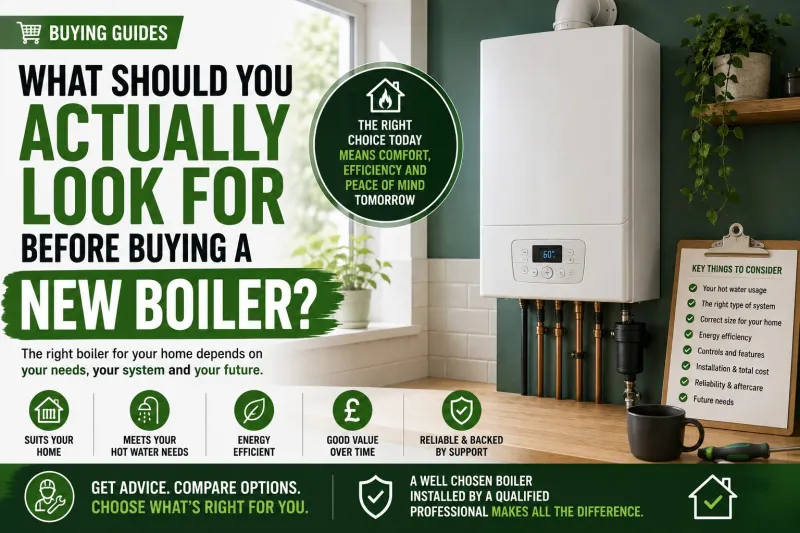
What Should You Actually Look for Before Buying a New Boiler?
A boiler can be one of the most important purchases a homeowner makes. It provides heating. It provides hot water. And when something goes wrong with the existi...
A boiler can be one of the most important purchases a homeowner makes.
It provides heating.
It provides hot water.
And when something goes wrong with the existing system, choosing a replacement can suddenly become an urgent decision.
That's where people can make expensive mistakes.
A boiler isn't like buying a television or a kitchen appliance. The "best" model isn't necessarily the one with the biggest number attached to it, the highest output or the lowest price.
The right boiler depends on the property it is being installed in and how the household actually uses heating and hot water.
Before making a decision, here are some of the things worth considering.1. Start With Your Home, Not the Boiler
It can be tempting to start by searching for:
“Best boiler 2026”
But a list of popular models can't tell you what your particular home needs.
A smaller flat and a large family house may have completely different heating and hot-water requirements.
The size of the property matters.
The number of bathrooms matters.
The number of people living there matters.
The existing heating system matters.
And the condition and layout of the property can matter too.
A boiler should therefore be selected based on the demands it will actually need to meet.
Buying something simply because it is more powerful doesn't automatically mean you're making a better investment.
In some cases, getting the right advice before choosing the boiler can be more valuable than spending hours comparing specifications yourself.2. Think About Your Hot Water Usage
One of the most important questions is:
How much hot water does your household actually use?
If several people regularly need hot water at similar times, the demands on a heating system may be very different from those of a single person living alone.
Think about your typical routine.
Do people shower at the same time?
Are there multiple bathrooms?
Does someone often run a bath while another person is using hot water elsewhere?
Do you regularly notice a drop in hot-water performance during busy periods?
Understanding how the household uses hot water can help determine what type of system is appropriate.
The goal isn't to buy the largest system possible.
It's to make sure the system can comfortably meet the demand you actually have.3. Understand the Different Types of Boiler Systems
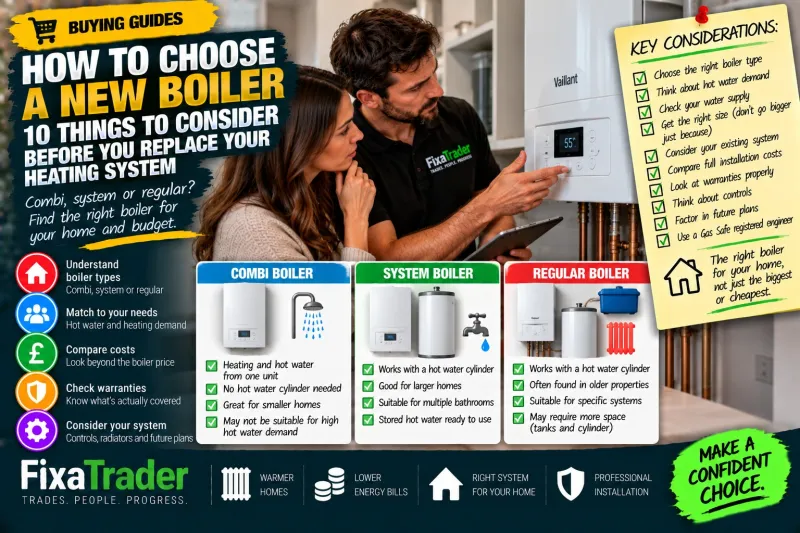
There are different types of boiler and heating arrangements, and the right choice will depend on the property.
For example, some homes use a combination boiler that provides heating and hot water directly.
Other properties use systems involving separate hot-water storage.
The advantages and limitations of each arrangement can vary depending on factors such as the size of the home, the number of bathrooms and expected demand.
This is why replacing a boiler doesn't always mean replacing it with an identical system simply because that's what the property already has.
The existing arrangement may still be the right one.
But it's worth understanding whether your needs have changed since the current system was installed.
Perhaps the household is larger.
Perhaps you've added another bathroom.
Perhaps the way you use hot water has changed.
A replacement is an opportunity to assess whether the existing setup still makes sense.4. Bigger Isn't Automatically Better
When people compare boilers, output figures can make it seem obvious that more is always better.
But a more powerful boiler isn't automatically the right choice.
Heating equipment should be appropriately matched to the property's requirements.
The size of the home, its heat loss characteristics and the demand placed on the heating and hot-water system all need to be considered.
Choosing equipment purely based on the assumption that "more power must be better" can lead to an unsuitable system.
This is one reason a proper assessment is important.
A professional should be able to explain why a particular system or output is being recommended rather than simply suggesting the most expensive option.5. Look Beyond the Boiler's Purchase Price
The price of the boiler itself is only one part of the overall cost.
Installation can involve much more than removing one unit and putting another in its place.
Depending on the property and existing system, there may be additional work involving:
Pipework
Controls
Radiators
Pumps or other components
Flues
System cleaning
Alterations to the existing installation
That's why two quotes for a "new boiler" can look very different.
One may include work that another has excluded.
One may involve a more straightforward replacement.
Another may account for improvements needed elsewhere in the system.
Before comparing prices, make sure you understand exactly what is included.
The cheapest installation isn't necessarily the cheapest overall solution if important work has been left out.6. Don't Ignore the Heating Controls
A new boiler can be an opportunity to review how you actually control your heating.
If your current controls are outdated, difficult to use or don't suit your routine, replacing the boiler alone may not solve the wider issue.
Good controls can help you manage when different parts of the home are heated and make it easier to avoid heating the property unnecessarily.
The right setup will depend on the property and how you live in it.
The important thing is not to treat the controls as an afterthought.
Ask what controls are being recommended and why.
A heating system is only useful if you can comfortably control it in a way that suits your household.7. Consider the Whole Heating System
Sometimes a boiler is blamed for a problem that involves another part of the heating system.
Perhaps some radiators aren't heating properly.
Maybe certain rooms are consistently colder.
The system may be noisy.
Or there may be recurring performance problems that a new boiler alone won't necessarily solve.
Before replacing expensive equipment, it can be useful to understand the condition of the wider system.
That doesn't mean every boiler replacement requires a complete heating-system overhaul.
But it does mean looking beyond the box on the wall.
A new boiler connected to a poorly performing system may not deliver the improvement a homeowner expects.8. Think About Reliability and Support
When choosing between models, the price and specification aren't the only things worth comparing.
Consider what happens after installation.
How straightforward is it to arrange servicing?
What warranty is available?
What are the conditions attached to it?
How easily can the system be supported if something goes wrong?
Are replacement parts readily available?
A boiler is a long-term purchase.
The experience of owning it matters as much as the experience of buying it.
An initially cheaper option may not necessarily represent better value if support, servicing or future repairs become more difficult.
That doesn't automatically mean the most expensive brand is the best choice either.
The point is to consider the whole ownership experience rather than only the initial invoice.9. Ask What Happens if Your Needs Change
A heating system may last for years.
Your circumstances can change much faster.
A household can grow.
A bathroom can be added.
An extension can change the size of the property.
Someone may begin working from home and use the heating differently throughout the day.
When choosing a new system, think not only about how the home is used today but whether there are realistic changes on the horizon.
You shouldn't necessarily pay significantly more for capacity you may never need.
But if a major change to the property is already planned, mentioning it before installation can help you make a better decision.10. Choose the Right Professional, Not Just the Right Boiler
The quality of the installation matters.
A highly rated boiler is only one part of the finished system.
The person assessing the property, recommending the equipment and carrying out the installation also plays an important role.
Before agreeing to the work, ask questions.
Why has this particular boiler been recommended?
What size or type is appropriate for the property?
What work is included in the installation?
Are the existing controls being replaced?
Does anything else in the heating system need attention?
What warranty applies?
How should the system be maintained afterwards?
You don't need to become a heating engineer before buying a boiler.
But you should feel comfortable asking why a particular recommendation is being made.
A good professional should be able to explain the options clearly.When Should You Replace a Boiler?
There isn't always one perfect moment.
Sometimes a boiler reaches the end of its working life after years of reliable service.
Sometimes repair costs begin increasing.
Sometimes performance becomes less reliable.
And sometimes a breakdown leaves the homeowner with little choice but to make a decision quickly.
Where possible, planning ahead can give you more time to compare options and choose the right installation rather than making a rushed decision during an emergency.
If your existing boiler is still working but becoming increasingly unreliable, it may be worth starting the conversation before a complete failure forces your hand.Don't Buy on Price Alone
A low price can be attractive.
But when comparing boiler quotes, ask yourself what you're actually receiving.
Is the equipment appropriate for the property?
Is the installation scope clear?
Are necessary controls included?
Has the wider heating system been considered?
Do you understand the warranty and ongoing maintenance requirements?
The cheapest quote may still be the right choice.
But you should know why it is cheaper.
Perhaps the installation is simpler.
Perhaps the equipment is different.
Perhaps less work is included.
Or perhaps one quote simply offers better value.
You can't make that distinction by looking at the final number alone.The Best Boiler Is the One That Suits Your Home
There is no single boiler that is right for everyone.
The best choice for a large household with multiple bathrooms may be completely different from the best choice for a smaller property with lower demand.
That's why the buying process should begin with the home.
Understand what you need.
Consider how you use heating and hot water.
Look at the wider system.
Ask what is included in the installation.
And make sure you understand why a particular solution has been recommended.
Don't start by asking which boiler is the best.
Start by asking which boiler is right for your home.
Because when the right system, the right installation and the right professional come together, you're far more likely to end up with something that works for years rather than simply something that looked like a good deal on the day you bought it.
0 Comments
No comments yet — be the first to share your thoughts.