Laminate, LVT or Engineered Wood? How to Choose the Right Flooring for Every Room in Your Home
Replacing the flooring in your home can completely change how a room looks and feels. But choosing the right material isn't always straightforward. You might lo...
Replacing the flooring in your home can completely change how a room looks and feels.
But choosing the right material isn't always straightforward.
You might love the appearance of natural wood.
Prefer the affordability of laminate.
Or have heard that luxury vinyl tile is a better choice for kitchens and bathrooms.
Then you start comparing products.
Some are advertised as waterproof.
Others promise exceptional durability.
Certain floors are suitable for underfloor heating, while others come with installation restrictions.
And two products that look almost identical can have very different prices.
The best flooring isn't necessarily the most expensive or the most realistic-looking. It's the one that suits the room, your household and how you intend to use it.
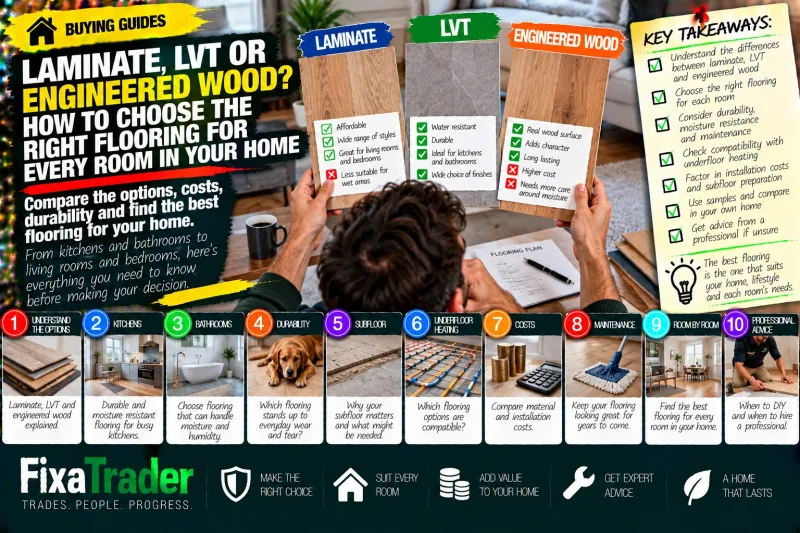
Here's what homeowners should consider before buying.1. Understand the Three Main Flooring Options
Before comparing prices, it's worth understanding what you're actually buying.
Laminate flooring
Laminate typically consists of a fibreboard-based core, a decorative image layer and a protective surface.
It's designed to imitate materials such as timber or stone without using solid wood as the visible finish.
Modern laminate can offer convincing textures and a wide choice of styles.
It's often selected for bedrooms, living rooms and hallways.
However, its performance around water depends heavily on the particular product and installation.
Luxury vinyl tile (LVT)
LVT is a manufactured flooring product designed to replicate wood, stone or other finishes.
It's available in different constructions and installation formats, including glue-down and click systems.
Many LVT products offer good resistance to everyday moisture, making them popular in kitchens and other areas where spills are likely.
However, not every LVT product is suitable for every wet environment.
Engineered wood flooring
Engineered wood has a real timber surface bonded to a layered supporting structure.
Unlike laminate or wood-effect LVT, the visible surface is genuine wood.
It offers natural grain and character, although its performance depends on the species, construction, finish and installation method.
Engineered wood can be an attractive option for living areas and bedrooms where a natural timber appearance is a priority.2. Which Flooring Is Best for Kitchens?
Kitchens are demanding environments.
Food and drink spillages, frequent cleaning, dropped utensils and heavy foot traffic all place pressure on the floor.
Moisture resistance is therefore an important consideration.
LVT is often a practical option for kitchens, particularly where the product is specifically approved for that use.
It can provide a wood or stone appearance without some of the moisture-related limitations associated with timber-based products.
Water-resistant laminate may also be suitable, but homeowners should check the manufacturer's conditions carefully.
Some products only resist surface water for a limited period.
Engineered wood can work in certain kitchens, but spills need prompt attention and standing water can cause problems.
Whatever material you choose, the quality of the subfloor and installation is critical.
Even a moisture-resistant surface can fail if water reaches vulnerable joints, edges or underlying materials.3. What About Bathrooms and Utility Rooms?
Bathrooms introduce additional challenges.
Water can escape from showers, baths and sinks.
Humidity levels fluctuate.
And floors may experience repeated wetting.
For these areas, product suitability matters more than appearance alone.
Certain LVT systems are designed for bathroom use, but installation details are particularly important.
A product described as waterproof doesn't automatically make the entire floor assembly watertight.
Water may still reach the subfloor through gaps, perimeter edges or penetrations.
Most standard laminate and engineered wood products are not ideal for environments with frequent standing water unless their manufacturers expressly approve the application.
For bathrooms with substantial water exposure, tiles or purpose-designed wet-room flooring may be more appropriate.
Always check whether the exact flooring product is approved for the intended room before purchasing it.4. Which Flooring Is Most Durable?
Durability is one of the most misunderstood aspects of flooring.
A material can resist scratches but perform poorly when exposed to moisture.
Another might tolerate water but be more vulnerable to dents.
Different types of damage need different considerations.
Laminate can offer good surface wear resistance, depending on its specification.
LVT can be durable under everyday domestic use, although its resistance to scratches, indentation and heavy loads varies between products.
Engineered wood offers a genuine timber surface but can show dents and scratches, particularly with softer wood species or certain finishes.
Consider your household.
Do you have pets?
Children?
Furniture that moves regularly?
A home office with a wheeled chair?
Or a busy entrance where grit is frequently brought indoors?
Look beyond broad marketing descriptions such as hard-wearing or premium.
Check the product's intended use, warranty conditions and relevant performance information.5. Consider the Subfloor Before Choosing the Finish
The condition of the existing floor can influence which material is suitable.
A beautiful new surface won't compensate for an unstable or unsuitable base.
Depending on the product, installation may require a subfloor that is:
Sufficiently level and flat.
Structurally sound.
Clean and properly prepared.
Within the manufacturer's moisture limits.
Compatible with the chosen adhesive or underlay.
LVT, particularly some glue-down products, can reveal imperfections beneath the finished surface.
Laminate and floating engineered wood floors also have subfloor tolerances that must be respected.
If the existing floor is uneven, additional preparation may be required.
This can involve smoothing compounds, repairs or other remedial work.
Subfloor preparation is one of the main reasons the final installation price can exceed the initial flooring estimate.
Ask your installer to assess the existing floor before you commit to a product.6. Which Flooring Works Best With Underfloor Heating?
Underfloor heating can influence your flooring decision.
Some laminate, LVT and engineered wood products are suitable for use with compatible underfloor heating systems.
But suitability depends on the exact flooring specification.
Manufacturers may set limits on surface temperatures, thermal resistance and heating procedures.
Certain products may also require particular adhesives, underlays or installation methods.
Engineered wood can be compatible with underfloor heating, but changes in temperature and moisture must be carefully managed.
Don't assume that all products within a flooring category perform identically.
Before purchasing, confirm compatibility with both the flooring manufacturer and the underfloor heating system supplier.
Your installer should also understand the required commissioning and operating conditions.7. How Much Does Each Flooring Type Cost?
Flooring prices vary considerably depending on quality, brand, construction and finish.
As a broad guide to relative costs:
Laminate: Often one of the more affordable options, particularly for standard domestic products.
LVT: Can range from relatively affordable click systems to higher-priced specialist and premium products.
Engineered wood: Often costs more because it incorporates a genuine timber surface.
However, the material price is only one part of the total.
You may also need to pay for:
Removal and disposal of existing flooring.
Subfloor repairs and preparation.
Underlay or adhesive.
Moisture-control measures where required.
Door trimming.
Thresholds and finishing trims.
Skirting removal or replacement.
Professional installation.
A cheaper product that requires substantial preparation may end up costing more than expected.
Similarly, a higher-priced material may be worthwhile if it offers the appearance, performance and lifespan you're looking for.
Compare the complete installed cost, not just the price per square metre on the packaging.8. Think About Cleaning and Long-Term Maintenance
Every flooring material requires some maintenance.
But the level of care varies.
Laminate generally benefits from regular sweeping or vacuuming and cleaning methods that avoid excessive moisture.
LVT is often straightforward to clean, although the manufacturer's guidance should be followed to protect the finish.
Engineered wood may require more careful moisture management and appropriate cleaning products.
Some engineered wood floors can be refinished, but this depends on the thickness of the real wood layer and the manufacturer's specifications.
Not every engineered wood product is suitable for sanding.
For busy households, consider how realistically you can maintain the floor.
A material that looks beautiful in a showroom may be less appealing if it requires care that doesn't fit your lifestyle.9. Don't Overlook Noise and Comfort
Flooring affects how a room sounds and feels.
Hard surfaces can create more noticeable footfall noise than carpet.
The effect depends on the floor construction, installation method and any acoustic treatment.
Floating laminate floors may produce a different sound underfoot from properly installed glue-down LVT.
Engineered wood can also vary depending on whether it is floated, glued or otherwise installed according to the manufacturer's instructions.
Underlay can influence acoustic performance, but it must be compatible with the flooring.
In flats and apartments, lease conditions or building requirements may also specify acoustic performance.
If you're replacing carpet with a hard floor in an upper-level room, consider the impact on rooms below.
Comfort matters too.
Think about how the surface feels underfoot, especially in bedrooms and living spaces.10. Choose the Flooring Around the Room, Not Just the Colour
It's easy to select flooring based on appearance.
But a product that works beautifully in one room may be unsuitable elsewhere.
Consider the practical demands of each space.
Living rooms
Laminate, LVT and engineered wood can all be suitable choices, depending on your budget and preferred appearance.
Bedrooms
Comfort, appearance and acoustic performance may matter more than extreme wear resistance.
Hallways
Prioritise durability, ease of cleaning and resistance to grit and frequent foot traffic.
Kitchens
Look carefully at moisture resistance, cleaning requirements and product suitability.
Bathrooms
Choose flooring specifically approved for the expected water exposure and installation conditions.
Home offices
Consider furniture loads, wheeled chairs and protection against scratches or indentation.
Rather than selecting one product for the entire house automatically, think about whether different rooms have different requirements.
A consistent appearance can still be achieved using complementary finishes.Should You Install Flooring Yourself or Hire a Professional?
Some flooring systems are marketed as suitable for DIY installation.
Click laminate and certain floating LVT products may be manageable for homeowners with the necessary skills and tools.
However, installation involves more than joining boards or tiles.
You may need to assess subfloor moisture, correct unevenness, plan expansion allowances, manage door clearances and install suitable transitions.
Glue-down LVT and more complex flooring installations often benefit from specialist experience.
Incorrect installation can cause movement, lifting, gaps or premature failure.
It may also affect the manufacturer's warranty.
If you're uncertain about the subfloor or installation requirements, obtaining professional advice before purchasing materials can prevent expensive mistakes.Questions to Ask Before Buying New Flooring
Before placing an order, ask the supplier or installer:
Is this exact product suitable for the room?
What are its moisture limitations?
What subfloor preparation is required?
Is it compatible with my underfloor heating?
What underlay or adhesive is recommended?
How should it be cleaned and maintained?
What does the warranty actually cover?
How much extra material should I allow for cuts and waste?
What happens if individual boards or tiles become damaged?
What is the complete installed price?
These questions can reveal differences that aren't obvious from product photographs or showroom displays.Don't Forget About Samples
A flooring sample can look very different in your home compared with a showroom.
Lighting, wall colours and surrounding furniture all influence its appearance.
Where possible, obtain samples and view them in the intended room.
Look at them during daylight and under artificial lighting.
Consider how the texture feels and whether the finish shows fingerprints, dust or scratches easily.
For wood-effect products, examine how much pattern variation exists across the range.
A single sample may not represent the appearance of an entire installed floor.Which Flooring Should You Choose?
There isn't one material that is best for every home.
Choose laminate if you want an affordable wood-effect floor for a suitable room and are comfortable with its moisture limitations.
Choose LVT if you want a versatile manufactured surface with a wide range of finishes and potentially strong moisture resistance, provided the exact product suits the environment.
Choose engineered wood if having a genuine timber surface is important and you're prepared to follow the relevant installation and maintenance requirements.
Whichever material appeals to you, don't make the decision based on appearance or headline price alone.
Think about the room, the existing subfloor, the amount of wear the floor will experience and the total cost of installation.
And if you're investing in flooring for several rooms, professional advice at the planning stage may help you avoid choosing a product that isn't suitable for the conditions.
The right flooring should do more than look good on installation day — it should continue working for your home, your household and your lifestyle for years to come.
0 Comments
No comments yet — be the first to share your thoughts.