Quartz, Granite, Laminate or Solid Wood? How to Choose the Right Kitchen Worktop
A new kitchen worktop can completely change the appearance of a room. It can make an older kitchen feel more modern, complement new cabinets or become the centr...
A new kitchen worktop can completely change the appearance of a room.
It can make an older kitchen feel more modern, complement new cabinets or become the centrepiece of a full renovation.
But choosing a worktop involves more than finding a colour you like.
The material needs to cope with everyday life.
Hot pans, spilled drinks, food preparation, cleaning products and occasional knocks can all affect how a surface performs.
Some materials are relatively inexpensive and easy to replace.
Others require specialist installation and represent a substantial investment.
And a worktop that looks beautiful in a showroom might not be the most practical choice for a busy family kitchen.
The best kitchen worktop isn't necessarily the most expensive or hardest material. It's the one that balances appearance, durability, maintenance and cost for the way you actually use your kitchen.
Here's what to consider before making your decision.1. Laminate Worktops: Affordable and Versatile
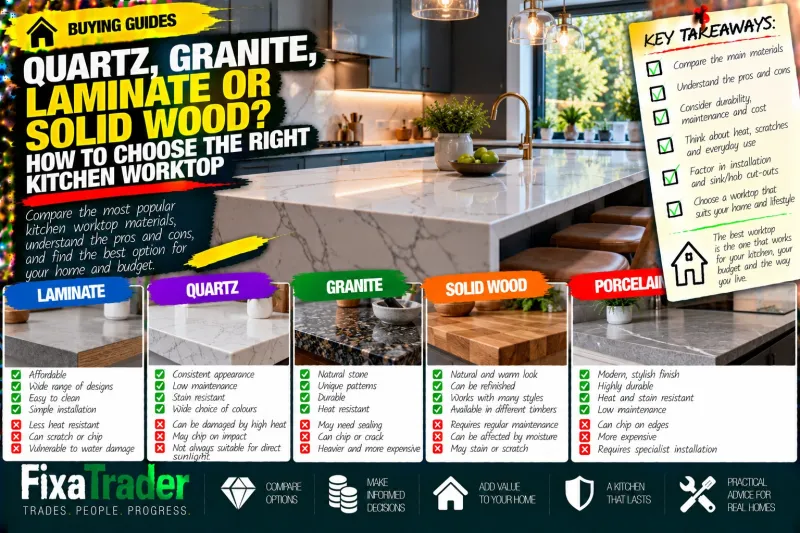
Laminate remains a popular option for homeowners who want an attractive worktop without spending heavily.
A typical laminate worktop consists of a decorative surface bonded to a supporting core, often particleboard.
Modern designs can imitate stone, wood and concrete.
Advantages of laminate
Generally more affordable than natural stone or engineered quartz.
Available in a wide range of colours and finishes.
Relatively straightforward to install.
Easy to clean when properly maintained.
Suitable for many kitchen styles.
However, laminate has limitations.
The surface can be damaged by excessive heat, sharp objects and impacts.
Water entering through poorly sealed joints or exposed edges can also damage the supporting core.
This is particularly important around sinks and cut-outs.
Best suited to: Homeowners who want a practical, cost-conscious surface and are comfortable using chopping boards, pan stands and sensible cleaning methods.2. Quartz Worktops: Consistent Appearance and Low Maintenance
Engineered quartz worktops are manufactured using mineral aggregates combined with binders and other ingredients.
The precise composition varies by product.
They are often chosen for their consistent appearance, range of colours and relatively low maintenance requirements.
Advantages of quartz
Available in many colours and patterns.
Generally resistant to everyday staining when used correctly.
Does not normally require the same routine sealing associated with some natural stones.
Offers a smooth, contemporary appearance.
Can provide good durability in a busy kitchen.
However, quartz isn't indestructible.
High temperatures can damage some products, particularly where heat affects the binders.
Edges may chip following a strong impact.
Certain chemicals and prolonged exposure to direct sunlight may also affect some finishes.
Always follow the manufacturer's instructions.
Best suited to: Homeowners looking for a consistent, premium-looking surface with relatively straightforward everyday maintenance.3. Granite Worktops: Natural Stone With Individual Character
Granite is a natural stone formed through geological processes.
Each slab has its own pattern, colour variations and mineral characteristics.
This individuality is one of its main attractions.
Advantages of granite
Distinctive natural appearance.
Good resistance to many forms of everyday wear.
Suitable for a wide range of kitchen designs.
Can remain attractive for many years when properly maintained.
But granite isn't maintenance-free.
Some products require sealing to help manage staining.
The frequency depends on the stone and the treatment used.
Granite can also chip or crack under certain impacts, particularly around vulnerable edges and cut-outs.
Because it is heavy, the supporting cabinetry and installation details need to be suitable.
Best suited to: Homeowners who appreciate natural variation and are willing to follow the care requirements of the specific stone.4. Solid Wood Worktops: Warmth and a Natural Finish
Solid wood worktops can give a kitchen a warm, traditional appearance.
They are available in different timber species, each with its own grain, colour and characteristics.
Wood is also attractive because some surface damage can be repaired through appropriate sanding and refinishing.
Advantages of solid wood
Natural appearance and texture.
Can complement traditional and contemporary kitchens.
Some scratches and marks can be refinished.
Available in different species and finishes.
However, wood reacts to moisture and changes in environmental conditions.
It can expand, contract, stain or develop damage if poorly maintained.
Areas around sinks need particular attention.
The worktop may also require periodic treatment depending on the finish.
Best suited to: Homeowners who value natural materials and are prepared to maintain the surface properly.5. Porcelain and Sintered Stone: Modern High-Performance Options
Porcelain and sintered stone worktops have become increasingly popular in contemporary kitchen designs.
These materials are manufactured using mineral-based ingredients and specialised production processes.
They can offer strong resistance to heat, staining and scratching, although performance varies between products.
Advantages
Wide range of contemporary finishes.
Good resistance to many common kitchen stains.
Often suitable for demanding kitchen environments.
Some products can be used in thin-profile designs.
However, edge damage remains possible.
Certain designs and thicknesses require careful handling and specialist fabrication.
Installation quality is particularly important.
These materials can also be expensive, especially where complex cutting or detailing is involved.
Best suited to: Homeowners seeking a contemporary finish and prepared to invest in appropriate fabrication and installation.6. Compare Heat Resistance Before You Buy
Heat resistance is one of the most misunderstood worktop characteristics.
Homeowners sometimes assume that a stone surface can safely withstand anything placed on it.
But different materials react differently to sudden or prolonged heat.
Laminate can suffer surface damage.
Solid wood can scorch.
Engineered quartz may be affected by excessive temperatures.
Natural stone and porcelain products also have limitations depending on their composition and installation.
Thermal shock, adhesives, sealants and supporting materials can all influence performance.
The safest everyday habit is to use suitable pan stands or trivets rather than placing very hot cookware directly onto the worktop.
This applies even when the material is marketed as heat resistant.7. Think About Scratches, Chips and Everyday Wear
Kitchen worktops experience frequent contact with utensils, cookware and other objects.
Some materials resist scratching better than others.
However, scratch resistance and impact resistance are not the same thing.
A hard surface may resist ordinary abrasion while still being vulnerable to chipping along its edges.
Laminate may scratch or mark.
Wood can develop dents and surface scratches.
Stone-based materials may chip if struck with sufficient force.
Consider how the kitchen is used.
A household that cooks frequently may have different priorities from someone who mainly uses the worktop for light food preparation.
And remember that cutting directly on a worktop can damage the surface or blunt knives.
Using a chopping board is sensible regardless of the material you choose.8. Consider How Much Maintenance You're Willing to Do
A worktop that requires regular attention may not suit every household.
Before choosing, ask how much maintenance you're realistically prepared to undertake.
Laminate
Usually needs routine cleaning and care around joints, edges and moisture-prone areas.
Quartz
Generally requires straightforward cleaning, but manufacturer restrictions on heat and chemicals remain important.
Granite
May need periodic sealing depending on the stone and treatment.
Solid wood
Can require ongoing care, including refinishing or re-oiling where appropriate.
Porcelain and sintered stone
Often relatively easy to clean, although product-specific instructions still apply.
Avoid assuming that any surface is completely maintenance-free.
The easiest material to live with is the one whose care requirements fit your habits.9. Pay Attention to the Sink and Hob Cut-Outs
Some of the most vulnerable areas of a worktop are around sinks, taps and hobs.
These locations involve moisture, heat and openings in the material.
Poor fabrication or installation can create problems.
For example, an inadequately sealed laminate sink cut-out may allow moisture into the supporting core.
Stone worktops require appropriate fabrication around openings to reduce the risk of damage.
Solid wood needs suitable detailing to accommodate movement and moisture.
The choice of undermount or inset sink can also affect material suitability.
Not every sink design is appropriate for every worktop.
Before ordering, confirm that your chosen material is compatible with the proposed sink, hob and tap arrangement.10. Include Installation and Fabrication in Your Budget
The advertised price of a worktop doesn't always represent the final installed cost.
Some products are sold as standard lengths or panels.
Others are measured, fabricated and installed specifically for the kitchen.
Additional costs may include:
Site measurement and templating.
Cutting and fabrication.
Sink and hob openings.
Edge profiles.
Joint preparation.
Delivery and handling.
Installation.
Removal of existing worktops.
Plumbing disconnection and reconnection.
Making good surrounding finishes.
Complex kitchen layouts can increase fabrication costs.
For example, an island with curved edges and several openings may cost more to manufacture than a simple straight run.
Compare fully specified installed quotations rather than material prices alone.Which Kitchen Worktop Is Best for a Family Home?
There isn't one universal answer.
For households prioritising affordability, laminate can provide good value.
For those seeking a consistent appearance and relatively low maintenance, quartz may be attractive.
Granite offers natural character.
Solid wood provides warmth but generally requires more attention.
Porcelain and sintered stone may appeal to homeowners looking for particular performance characteristics and contemporary designs.
Think about the people using the kitchen.
Are children regularly preparing food?
Do you cook several meals every day?
Are spills cleaned immediately?
Do you want a surface that develops natural character over time, or one that maintains a more consistent appearance?
Your daily habits matter more than which material happens to be fashionable.Can You Replace Your Worktop Without Replacing the Kitchen?
In many cases, yes.
Replacing worktops can be a way to refresh a kitchen while retaining the existing cabinets.
However, the suitability depends on the condition and construction of the units.
Heavy materials may require assessment of the supporting cabinetry.
You should also consider whether the existing cabinets are level and structurally sound.
Removing an old worktop can sometimes damage surrounding tiles, splashbacks or finishes.
Sink and hob arrangements may also need changing.
Before proceeding, ask the installer to assess whether the existing kitchen is suitable for the proposed material.
A worktop replacement can be a worthwhile upgrade, but it shouldn't be used to conceal failing cabinets or unresolved moisture damage.What About Worktop Overlays?
Some products are designed to be installed over existing worktops.
These can offer a different approach to replacement.
However, their suitability depends on the existing surface, installation method and manufacturer's requirements.
Adding another layer may affect worktop height, appliance clearances and sink detailing.
The condition of the underlying worktop also matters.
If the existing surface is damaged by moisture or structurally unsound, covering it may not resolve the problem.
Ask what preparation is required and whether the overlay system is appropriate for your kitchen.Should You Choose a Matt or Gloss Finish?
Finish can affect both appearance and everyday maintenance.
Glossy surfaces reflect more light and may create a polished appearance.
However, fingerprints, smears and certain marks can be more noticeable.
Matt finishes can provide a softer look, but some may show oils or require particular cleaning methods.
Textured finishes may help conceal some marks while being more difficult to clean in certain circumstances.
Performance varies by product.
Before deciding, request a physical sample.
Examine it under your kitchen's lighting and consider how it looks after ordinary handling.
A finish that looks excellent in a showroom may behave differently in your own home.What Should You Ask a Kitchen Worktop Installer?
Before agreeing to a purchase, ask:
Is this material suitable for how I use my kitchen?
What are its limitations regarding heat, scratches and stains?
Does it need sealing or periodic treatment?
What thickness and edge profiles are available?
Are my existing cabinets suitable?
How will sink and hob cut-outs be protected?
Where will joints be positioned?
What is included in the installation price?
What warranty or product guarantee applies?
What cleaning and maintenance instructions should I follow?
For premium materials, ask to see samples or, where relevant, the actual slab.
Natural stone can vary considerably from small display samples.
A detailed written quotation should also identify the exact product, finish and specification.Don't Choose Based on Appearance Alone
Kitchen worktops are among the most frequently used surfaces in a home.
A beautiful finish can quickly become frustrating if it doesn't suit the household.
Equally, an inexpensive material can perform well for years when properly installed and maintained.
Before buying, establish your priorities.
Is your main concern cost?
Do you want minimal maintenance?
Are you looking for a natural material?
Or is durability under frequent use the most important factor?
Compare the available products against those priorities.
And remember that good fabrication and installation can be just as important as the material itself.The Bottom Line: Choose the Worktop That Suits Your Kitchen, Not Just Your Budget
Laminate, quartz, granite, solid wood and porcelain all have their place.
Each offers a different balance of appearance, durability, maintenance and cost.
There is no single material that performs best in every situation.
The right choice depends on how you use the kitchen, what you're prepared to maintain and how much you want to spend.
Look beyond the showroom finish.
Understand the limitations.
Consider the full installed cost.
And choose a product that will remain practical long after the excitement of the renovation has passed.
The best kitchen worktop isn't simply the one that looks impressive on installation day. It's the one that still works well for your household years later.
0 Comments
No comments yet — be the first to share your thoughts.