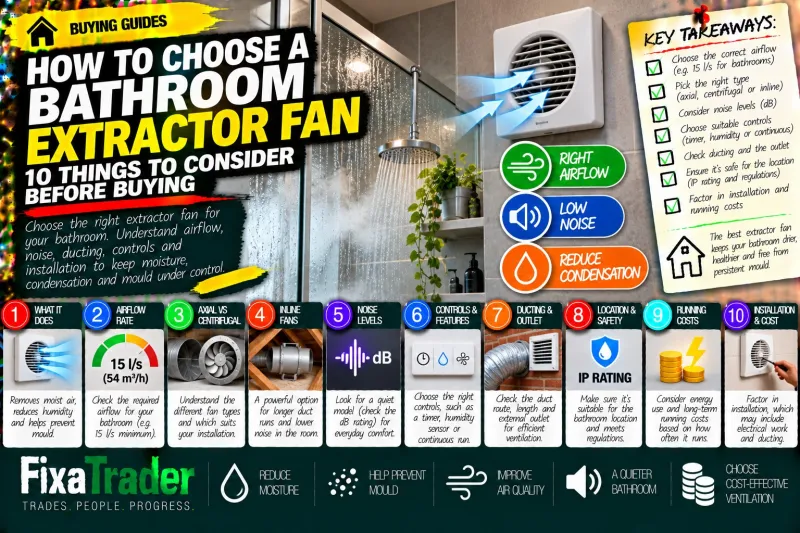
How to Choose a Bathroom Extractor Fan: 10 Things to Consider Before Buying
You've just finished having a shower. The mirror is covered in condensation, the windows are steaming up and the bathroom still feels damp twenty minutes later....
The mirror is covered in condensation, the windows are steaming up and the bathroom still feels damp twenty minutes later.
Perhaps your existing extractor fan is making a loud noise but doesn't seem to remove much moisture.
Or maybe you're renovating the bathroom and wondering which type of fan to install.
Bathroom ventilation is easy to overlook.
Compared with tiles, taps and shower fittings, an extractor fan might seem like a minor purchase.
But it performs an important job.
Bathrooms produce significant amounts of water vapour, particularly during showers and baths.
Without adequate ventilation, that moisture can linger and contribute to condensation, mould growth and deterioration of surrounding finishes.
The best bathroom extractor fan isn't necessarily the most powerful or expensive model. It's one that provides suitable ventilation for the room, works with the available ducting and is installed correctly.
Here are ten things to consider before choosing one.1. Understand What a Bathroom Extractor Fan Actually Does
An extractor fan removes moist air from a bathroom and discharges it outside.
This helps reduce humidity after bathing or showering.
It can also help remove odours and improve the overall air quality of the room.
However, a fan doesn't remove every source of moisture.
If the bathroom has a leaking pipe, defective waterproofing or water entering through the building fabric, ventilation alone won't resolve those problems.
Similarly, a fan may struggle if there isn't an adequate route for replacement air to enter the room.
A bathroom extractor works as part of a ventilation system, not as an isolated appliance.
Before replacing a fan, consider whether the existing problem is caused by the fan itself, its installation or another source of moisture.2. Check the Airflow Rate
Airflow is one of the most important specifications.
It describes how much air a fan can move over a given period.
Manufacturers commonly express airflow in litres per second (l/s) or cubic metres per hour (m³/h).
In England, Approved Document F provides ventilation guidance for dwellings.
For intermittent extract ventilation, the guidance specifies a minimum extract rate of 15 litres per second for a bathroom.
That's equivalent to 54 cubic metres per hour.
However, this figure shouldn't be treated as a universal recommendation for every installation.
The applicable requirements depend on the building, ventilation strategy and work being undertaken.
A larger bathroom, long duct run or particular installation arrangement may require a different approach.
Also remember that advertised airflow figures may be measured under conditions that differ from the installed system.
Look at the fan's performance with the intended ducting rather than relying only on the largest airflow number printed on the box.3. Decide Between an Axial and Centrifugal Fan
Two common fan types are axial and centrifugal.
Axial fans
These move air along the direction of the fan's shaft.
They are often used for relatively short, straightforward duct runs, such as extraction directly through an external wall.
Advantages can include compact designs and straightforward installation.
However, performance may be affected when the fan needs to overcome significant resistance from long ducting or multiple bends.
Centrifugal fans
These use a different airflow arrangement and can be better suited to installations involving greater duct resistance.
They may be appropriate where the fan is positioned further from the external outlet.
However, individual product performance varies considerably.
A centrifugal fan isn't automatically the best option for every bathroom.
The important factor is whether the fan can deliver the required airflow through the actual duct arrangement.4. Consider an Inline Extractor Fan
An inline fan is installed within the ducting rather than directly in the bathroom wall or ceiling opening.
These are often positioned in an accessible loft or another suitable location.
One advantage is that the motor can be located away from the bathroom itself.
This may reduce the noise heard inside the room, depending on the system design.
Inline fans can also be useful where the duct route makes a conventional wall-mounted unit less suitable.
However, they require appropriate access, electrical installation and duct connections.
The fan must be suitable for its installation environment.
If located in a loft, considerations may include condensation, insulation, support and maintenance access.
An inline fan can be a useful option, but it should be chosen as part of a properly designed extraction system rather than simply because it's marketed as more powerful.5. Think About Noise Levels
An extractor fan that is excessively noisy may be switched off or avoided.
That defeats the purpose of installing it.
Manufacturers often specify sound levels in decibels (dB).
However, noise figures can be measured under different conditions.
Two fans with similar published figures may sound different once installed.
Noise can also come from more than the motor.
Poorly supported ducting, restricted airflow, vibration and unsuitable installation details may all contribute.
Before buying, consider where the fan will be installed and how close it is to bedrooms or other living areas.
A quieter fan may be particularly valuable in an ensuite bathroom.
The best fan is one that occupants are comfortable allowing to operate for the time needed to remove moisture.6. Choose the Right Controls
Bathroom extractor fans are available with several control options.
The most appropriate choice depends on how the bathroom is used.
Light-switch operation
The fan operates when the bathroom light is switched on, subject to the wiring and control arrangement.
This can be straightforward, but it may not provide enough ventilation if the light is switched off immediately after a shower.
Timer overrun
The fan continues running for a set period after the triggering switch is turned off.
This helps remove moisture after the bathroom is no longer occupied.
Humidity sensor
A humidistat-controlled fan can respond to changes in relative humidity.
However, performance depends on settings, positioning and the surrounding conditions.
Continuous-running ventilation
Some systems operate at a low background rate and increase extraction when needed.
These need to be selected and configured as part of the dwelling's ventilation strategy.
Choose controls that suit the room and encourage effective ventilation without unnecessary noise or energy use.7. Check the Ducting Before Replacing the Fan
A new fan may perform poorly if the existing ducting is unsuitable.
Long duct runs, sharp bends and restricted outlets can increase resistance.
Flexible ducting that is crushed, sagging or poorly supported may also reduce airflow.
In colder spaces, condensation can develop within ducting if the system hasn't been designed appropriately.
Before replacing the fan, establish:
Where the extracted air is discharged.
How long the duct run is.
Whether there are unnecessary bends.
Whether the duct diameter is suitable.
Whether the duct is damaged or obstructed.
Whether insulation or condensation management is required.
Bathroom extraction should discharge outdoors through a suitable outlet.
Do not vent moist bathroom air directly into a loft or concealed roof space.
Doing so can contribute to condensation and moisture problems elsewhere in the building.8. Make Sure the Fan Is Suitable for Its Location
Bathrooms contain water and electrical equipment in close proximity.
This makes electrical safety particularly important.
The suitability of a fan depends on its location, electrical protection and installation requirements.
Products may carry an IP rating indicating their resistance to the ingress of solids and water.
However, an IP rating alone doesn't establish that a fan is suitable for every position in a bathroom.
The relevant requirements of BS 7671, including those concerning locations containing a bath or shower, must be considered.
Electrical work may also be subject to building regulations requirements.
In England, Part P addresses electrical safety in dwellings.
Don't assume that a fan described as 'bathroom suitable' can be installed anywhere near a shower or bath.
Have a competent electrician assess the proposed position and electrical arrangements.9. Consider Running Costs and Energy Efficiency
Bathroom extractor fans generally use relatively modest amounts of electricity, but running costs depend on the product and how it operates.
A fan running continuously may consume more energy over the year than one operating intermittently.
However, the comparison isn't always straightforward.
A low-power continuous system may be designed to provide background ventilation as part of a wider strategy.
A powerful intermittent fan may operate for shorter periods.
To estimate electricity consumption, use the fan's rated power and expected operating time.
For example, a hypothetical 10-watt fan operating for two hours each day would consume approximately 7.3 kWh over a year.
The actual cost depends on your electricity tariff.
But energy consumption shouldn't be the only consideration.
A fan that uses very little electricity but fails to remove moisture effectively isn't necessarily the better purchase.10. Factor Installation Into the Total Cost
The purchase price of the fan is only part of the overall expense.
Installation costs can vary depending on whether you're replacing an existing unit or creating a new extraction route.
A straightforward replacement may involve relatively limited work if the existing electrical supply, ducting and outlet are suitable.
A new installation may require:
Electrical work.
A new wall or ceiling opening.
Ducting.
An external terminal.
Access through a loft or ceiling void.
Suitable insulation and condensation control.
Making good surrounding finishes.
Testing and commissioning.
If the existing ducting is inadequate, upgrading the fan alone may not solve the problem.
Compare the total cost of a correctly installed ventilation system rather than choosing solely on the price of the fan.How Powerful Should a Bathroom Extractor Fan Be?
The required airflow depends on the installation.
As a starting point, relevant building regulations guidance can help establish minimum ventilation performance.
However, selecting a fan with a high advertised airflow rating doesn't guarantee that the installed system will achieve it.
Duct resistance, outlet design and installation quality all matter.
For example, a fan advertised at 100 m³/h under favourable test conditions may deliver less airflow through a restrictive duct system.
The appropriate fan should be selected with the actual installation conditions in mind.
For more complicated arrangements, professional design advice may be worthwhile.
Focus on delivered ventilation performance, not simply the manufacturer's headline airflow figure.Is a Humidity-Sensing Fan Better Than a Timer Fan?
Neither is automatically better.
A timer fan can provide a predictable period of ventilation after use.
This may be useful in bathrooms where showers are relatively short and moisture production is consistent.
A humidity-sensing fan can respond to changes in moisture levels.
However, high outdoor humidity, sensor settings and bathroom conditions may influence its operation.
Some products combine timer and humidity controls.
The right option depends on the room, household habits and ventilation design.
Whichever control system you choose, it should provide enough extraction after moisture-producing activities.Why Is My Bathroom Still Steamy With the Fan Running?
If your bathroom remains damp despite having an extractor fan, several factors could be responsible.
The fan may be undersized for the installed system.
The ducting could be restricted.
The external outlet might be blocked.
There may be insufficient replacement air entering the bathroom.
Or the fan may not be running for long enough after showers.
It's also possible that the room has a separate moisture problem.
Before replacing the unit, ask a suitable professional to assess the existing ventilation.
Simply installing a more powerful fan may not resolve a badly designed or obstructed duct system.
An ineffective extractor doesn't always mean the fan itself is defective.Can You Install a Bathroom Extractor Fan Yourself?
Some homeowners may be comfortable carrying out limited non-electrical preparation or maintenance.
However, installing or replacing an extractor fan can involve electrical work in a location with additional safety requirements.
The work must comply with applicable regulations and be carried out competently.
Certain electrical work in England may be notifiable under building regulations, depending on the nature and location of the work.
Requirements differ across the UK.
Drilling through external walls or altering ventilation routes can also involve building fabric and weatherproofing considerations.
For a new installation or any uncertainty about the electrical arrangements, use a suitably qualified professional.Should You Replace an Old Extractor Fan or Repair It?
Replacement isn't always necessary.
An existing fan may be underperforming because of dust, obstruction or a control problem.
Some issues can be addressed through appropriate maintenance or repair.
However, an ageing fan with a failing motor, damaged components or unsuitable performance may be better replaced.
Before deciding, consider:
Whether the fan operates reliably.
Whether it makes unusual noises.
Whether airflow appears restricted.
Whether the ducting is clear.
Whether the controls work correctly.
Whether the existing system meets the room's ventilation needs.
Always isolate electrical equipment safely before any maintenance and follow the manufacturer's instructions.
The aim is to restore effective ventilation, whether that requires cleaning, repair, duct improvements or replacement.Five Questions to Ask Before Buying a Bathroom Extractor Fan
Before ordering a replacement, consider:
What airflow is required? Check the applicable ventilation requirements and the actual installation conditions.
Where will it be installed? Confirm that the product is suitable for the location.
What ducting will it use? Consider length, bends, diameter and the external outlet.
How will it operate? Decide whether timer, humidity or continuous controls are appropriate.
Who will install and test it? Make sure the completed system performs as intended.
These questions can help prevent buying a fan that looks suitable on paper but performs poorly once installed.The Bottom Line: Choose the Ventilation System, Not Just the Fan
A bathroom extractor fan is a relatively small component, but it plays an important role in managing moisture.
Choosing the right one involves more than comparing prices and airflow ratings.
You need to consider the room, ducting, controls, noise, electrical safety and installation quality.
A powerful fan connected to unsuitable ducting may perform poorly.
A quiet fan that doesn't provide enough extraction won't solve condensation problems.
And even an effective ventilation system cannot compensate for unresolved leaks or defective waterproofing.
Before buying, establish what your bathroom actually needs.
The best bathroom extractor fan is one that removes moisture effectively, operates reliably and works as part of a properly installed ventilation system.
0 Comments
No comments yet — be the first to share your thoughts.