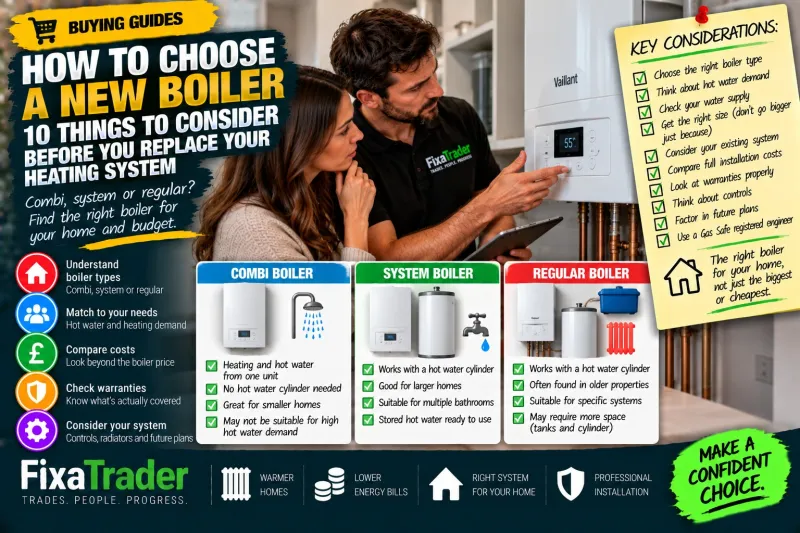
How to Choose a New Boiler: 10 Things to Consider Before You Replace Your Heating System
Your boiler has reached the end of its life. Or perhaps it still works, but repairs are becoming more frequent and you're starting to wonder whether replacing i...
Or perhaps it still works, but repairs are becoming more frequent and you're starting to wonder whether replacing it makes more sense.
Then you start looking at new boilers.
Suddenly you're confronted with:
Combi.
System.
Regular.
Different outputs.
Different warranties.
Different controls.
Different prices.
And installers recommending different options.
It's easy to reduce the decision to:
“Which boiler is best?”
But that's not really the right question.
The better question is:
“Which heating and hot-water setup is appropriate for this particular home?”
A boiler that works brilliantly in one property may be a poor choice for another.
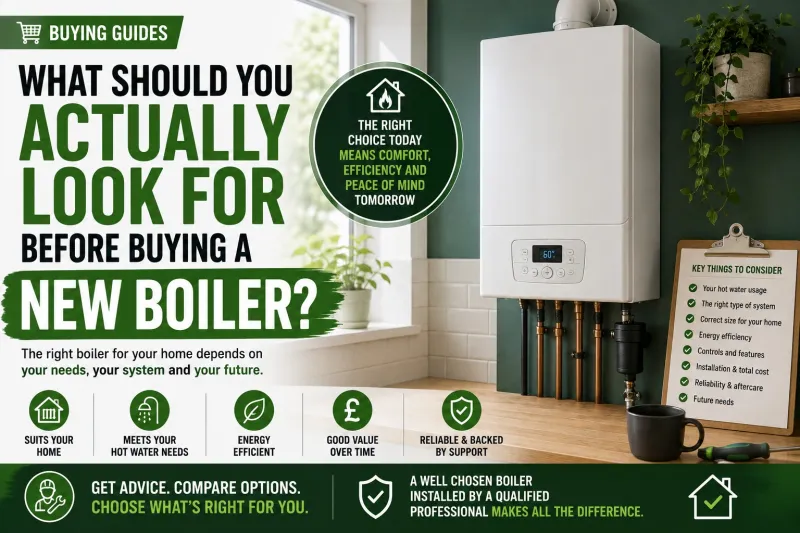
Here are ten things worth considering before making the decision.1. Understand the Three Main Boiler Types
For many UK homes considering a gas boiler replacement, you'll encounter three broad configurations.
Combi boiler
A combination boiler provides heating and produces hot water without normally requiring a separate hot-water cylinder.
They're common in UK homes and can be particularly practical where space is limited.
But the suitability of a combi depends partly on the property's hot-water requirements and available water supply.
System boiler
A system boiler works with a separate hot-water cylinder.
That stored hot water can make the arrangement suitable for homes with greater simultaneous hot-water demand.
Regular boiler
Also called conventional or heat-only boilers, these can form part of systems incorporating a hot-water cylinder and, depending on the arrangement, additional tanks.
They're often encountered in older properties and existing traditional heating systems.
One isn't automatically superior to the others.
The right configuration depends on the property and how the household uses hot water.2. Think About Hot-Water Demand
This is one of the biggest considerations.
How many people live in the property?
How many bathrooms are there?
Could two showers be used at the same time?
Does someone regularly run a bath while another person uses hot water elsewhere?
A small household with one bathroom may have very different requirements from a five-person household with three bathrooms.
Don't choose a boiler based solely on bedroom count.
Think about how the house actually uses hot water.3. Check the Incoming Water Supply
This becomes particularly important when considering a combi boiler.
A boiler can't provide unlimited hot water regardless of the water supply entering the property.
Incoming flow and pressure can influence what performance is realistically achievable.
This is why simply buying a more powerful combi doesn't necessarily transform a poor incoming supply.
A competent heating engineer can assess the relevant characteristics before recommending the system.
If strong simultaneous hot-water performance is important to you, mention that during the survey rather than after installation.4. Don't Assume Bigger Means Better
Homeowners understandably worry about buying something too small.
So the instinct can be:
“I'll get the most powerful one I can afford.”
But oversized heating equipment isn't automatically an upgrade.
The appropriate boiler output should reflect the home's heating requirements and system design.
Factors can include:
Property size.
Heat loss.
Insulation.
Number and size of radiators.
Hot-water requirements.
And the type of boiler being installed.
Proper sizing is better than simply choosing the largest number on the brochure.5. Consider the Existing Heating System
Replacing the boiler doesn't happen in isolation.
The installer needs to understand what's already there.
That includes things such as:
Radiators.
Pipework.
Controls.
Hot-water cylinder where applicable.
System condition.
Flue arrangement.
And the boiler's current location.
An older heating system may require additional work as part of the replacement.
Equally, replacing a boiler doesn't automatically mean every radiator and pipe in the property needs replacing.
The system should be assessed rather than assumptions made in either direction.6. Think Carefully Before Changing Boiler Type
Suppose you currently have a regular boiler and cylinder.
You decide you want a combi because someone told you:
“Combis are better.”
Changing configuration can involve considerably more work than a straightforward replacement.
Pipework may need altering.
Tanks or cylinders may be removed.
The water supply needs to be suitable.
The new arrangement needs to meet the household's requirements.
That doesn't mean you shouldn't change.
It means the benefits need to justify the work.
Ask the installer to explain why they recommend changing system type rather than simply accepting that newer automatically means better.7. Look Beyond the Boiler's Purchase Price
Two quotes can contain different boilers and very different prices.
But don't compare only the appliance.
An installation quote may also involve:
Labour.
Flue components.
Controls.
System cleaning or treatment.
Filters.
Pipework alterations.
Condensate arrangements.
Electrical work.
Removal of old equipment.
Commissioning.
Certification.
And warranty registration.
One quote being £500 cheaper doesn't tell you much until you know whether both installers are actually quoting for the same job.
Compare the complete installation, not just the boiler sitting inside the box.8. Compare Warranties Properly
A long warranty sounds reassuring.
But look beyond the number printed in the advertisement.
Ask:
What exactly is covered?
Who provides the warranty?
Does it require registration?
Are there servicing requirements?
Are there installation conditions?
Does coverage change depending on who installs it?
What happens if a repair is required?
And what exclusions apply?
A ten-year headline isn't very useful if you don't understand the conditions attached to it.
Keep the installation and warranty paperwork afterwards.9. Consider Controls at the Same Time
A boiler replacement is also a good opportunity to consider how you control the heating.
Depending on the system, options may include:
Programmers.
Room thermostats.
Thermostatic radiator valves.
Smart controls.
And more advanced zoning arrangements.
The fanciest control isn't automatically the right one.
A household that wants straightforward temperature control may value simplicity.
Another household may want schedules, remote access or more detailed control over different areas.
Ask what controls are compatible with the proposed system and what practical benefit they would provide in your home.10. Consider Future Plans for the Property
Don't choose solely for how the house exists today if you already know it's about to change.
Are you planning an extension?
Adding another bathroom?
Converting the loft?
Improving insulation significantly?
Changing radiators?
Or expecting more people to live in the property?
Those plans could affect future heating and hot-water requirements.
Tell the heating engineer.
It's much easier to account for known future changes during system design than to discover shortly afterwards that your requirements have changed.What About Boiler Efficiency?
Efficiency obviously matters.
Modern heating systems are subject to efficiency requirements, and boiler performance can vary depending on the appliance, controls, system design and how the property uses heating.
But don't treat a single efficiency percentage as the whole buying decision.
The boiler is only one part of the picture.
A home losing large amounts of heat through poor insulation won't suddenly become cheap to heat because the boiler has changed.
Likewise, controls, system condition and how heating is used all influence real-world performance.
Think of the boiler as part of the home's heating system, not an isolated energy-saving gadget.Should You Stay With the Same Manufacturer?
Not necessarily.
Being happy with the existing boiler is a perfectly reasonable reason to consider the same manufacturer again.
But don't assume replacing like-for-like by brand is automatically the best solution.
Ask installers why they're recommending a particular model.
A useful answer should involve things such as:
Suitability.
Performance.
Support.
Warranty.
Parts availability.
Installation requirements.
And their experience with the equipment.
“It's the one we always fit” tells you considerably less.Should You Get More Than One Quote?
For a substantial replacement, comparing more than one quotation can be useful.
But compare them properly.
If Installer A recommends a combi and Installer B recommends retaining a cylinder with a system boiler, you're not simply comparing two prices.
You're comparing two different proposed heating systems.
Ask each installer to explain:
Why they've recommended that boiler type.
Why they've selected that output.
What's included.
What existing components will remain.
What will be replaced.
What controls are included.
What warranty applies.
And whether any additional work might become necessary.
The explanation can be as valuable as the price.Don't Buy the Boiler Before the Survey
This is an easy mistake when a retailer has a sale.
You find a boiler online.
The reviews look good.
It's £300 off.
So you buy it before speaking to an installer.
Now you need someone to make your purchase work with the house.
Reverse the process.
Assess the property first.
Determine the appropriate system.
Then select suitable equipment.
Otherwise a bargain boiler can become an expensive box that isn't ideal for the installation.Remember the Installation Matters Too
Even an excellent boiler needs to be installed and commissioned correctly.
For gas boiler work, the engineer carrying out relevant gas work must be appropriately registered with the Gas Safe Register.
You can check an engineer and the categories of gas work they're registered to carry out through the official Gas Safe Register.
Don't simply rely on a Gas Safe logo appearing on a van or website.
Check the registration where appropriate.Ask What Happens to the Existing System
Before accepting a quote, understand what preparation is proposed.
Will the existing heating system be cleaned?
Is a magnetic filter being fitted or retained?
Does the existing system water appear heavily contaminated?
Are any components obviously unsuitable?
What treatment will be added afterwards?
You don't need to prescribe the technical solution yourself.
You do want the installer to have considered the condition of the system the new boiler is joining.Don't Forget the Boiler Location
Replacing a boiler in the same position can be very different from relocating it across the property.
Moving it may involve additional:
Pipework.
Flue considerations.
Condensate drainage.
Electrical work.
Making good.
And labour.
Sometimes relocation is worthwhile—perhaps it frees valuable kitchen space or makes a renovation possible.
But include the complete cost and practical implications in the decision.A Simple Checklist Before You Choose
Before accepting a boiler replacement quote, you should ideally understand:
What type of boiler is being recommended and why.
How your heating and hot-water demand has been assessed.
Whether the incoming water supply is suitable for the proposed setup.
Why that particular boiler output has been selected.
What's included in the installation price.
What happens to the existing heating system.
Which controls are included.
What warranty applies and its conditions.
Whether your future renovation plans have been considered.
What documentation you'll receive when the work is complete.
You don't need to understand every technical calculation yourself.
But you should understand why the proposed system is suitable for your home.Don't Start With “What's the Best Boiler?”
There isn't one boiler that's automatically best for every property.
A compact flat.
A three-bedroom semi.
A large house with several bathrooms.
And a property about to undergo a major extension all present different requirements.
So rather than searching for the boiler with the most impressive specification or longest list of features, start with the property.
How much heat does it need?
How does the household use hot water?
What system is already installed?
What might change in the future?
Once those questions have been answered, choosing the equipment becomes considerably easier.
The best boiler isn't necessarily the biggest, most expensive or most heavily advertised one—it's the one that's been properly matched to the home, the heating system and the people who actually use it.
0 Comments
No comments yet — be the first to share your thoughts.