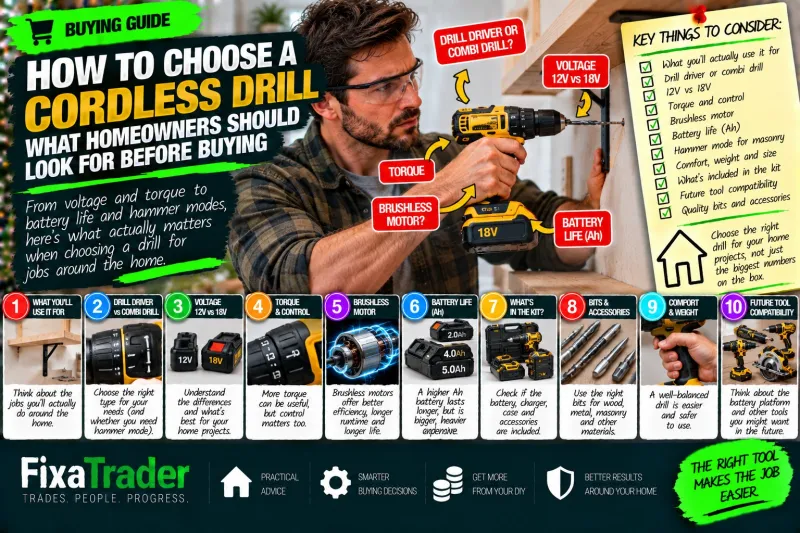
How to Choose a Cordless Drill: What Homeowners Should Look for Before Buying
Walk into the power-tool section of almost any retailer and something as simple as buying a drill suddenly becomes complicated. One box says: 12V. Another says:...
Walk into the power-tool section of almost any retailer and something as simple as buying a drill suddenly becomes complicated.
One box says:
12V.
Another says:
18V brushless.
Another promises enormous torque.
Then there are drill drivers, combi drills, impact drivers, SDS drills, batteries measured in amp-hours and dozens of kits containing tools you may never actually use.
If you only want something for putting up shelves, assembling furniture and tackling occasional DIY jobs, it's easy to end up buying far more drill than you need.
It's equally easy to buy the cheapest option available and discover that it struggles the first time you ask it to drill into masonry.
The right cordless drill isn't necessarily the most powerful.
It's the one that matches the kind of work you're realistically going to do.
Here's what to look for.1. Start With What You'll Actually Use It For
Before comparing specifications, think about the jobs.
For example:
Assembling furniture
Putting up shelves
Drilling timber
Hanging curtain poles
Fixing into plasterboard
Drilling into brick
Building decking or garden furniture
Larger renovation projects
Someone assembling flat-pack furniture occasionally has very different requirements from somebody renovating an entire house.
For light household work, compactness and control may be more useful than enormous power.
For regular DIY involving timber, masonry and larger fixings, greater capability becomes more important.
Buy for your realistic workload rather than the most demanding job you can imagine ever attempting.2. Understand Drill Driver vs Combi Drill
This distinction immediately narrows the choice.
Drill driver
A drill driver primarily drills holes and drives screws.
For timber, metal and general assembly work, it may be all many homeowners require.
Combi drill
A combi drill adds a hammer-drilling function.
That allows the drill to provide a repeated hammering action while rotating, helping when drilling into materials such as masonry.
For general household DIY in a typical UK property, the versatility of a combi drill makes it a popular all-round choice.
But don't confuse the hammer function on a combi drill with a dedicated rotary hammer or SDS drill.
They're designed for different levels of work.3. Don't Assume Higher Voltage Automatically Means Better
Cordless tools are commonly marketed around battery voltage.
You'll encounter platforms around:
12V
and
18V
along with manufacturers using slightly different marketing terminology for their battery systems.
Broadly speaking, higher-voltage platforms are commonly associated with greater capability and a larger ecosystem of tools.
But voltage alone doesn't tell you whether a drill is good.
A compact 12V drill can be excellent for:
Furniture assembly.
Cabinetry.
Smaller fixings.
Tight spaces.
Light drilling.
And general household jobs.
An 18V drill may provide more capability for demanding work but can also be larger and heavier.
If you'll hold the drill above your head while fitting something, you'll quickly discover that weight matters too.4. Pay Attention to Torque — But Don't Buy by the Biggest Number
Torque describes rotational force.
Manufacturers often advertise maximum torque prominently because large numbers look impressive.
More torque can certainly be useful when:
Driving larger screws.
Using larger drill bits.
Working with tougher materials.
Or undertaking more demanding jobs.
But maximum torque isn't the only thing that matters.
Control matters.
A hugely powerful drill isn't particularly helpful if you're trying to gently drive a small screw into a kitchen cabinet.
That's why drills commonly include an adjustable clutch.
The clutch allows you to limit the amount of torque applied when driving screws.
For everyday DIY, having usable control across different jobs is often more important than owning the drill with the largest number printed on the box.5. Two Speeds Are Worth Having
Many cordless drills have a two-speed gearbox.
You'll usually find a selector marked something like:
1 / 2
The lower gear generally provides lower rotational speed with greater torque, making it useful for jobs such as driving screws.
The higher gear provides greater speed and is useful for many drilling tasks.
It's a simple feature, but it makes a drill much more versatile.
If you're choosing a general-purpose drill, a two-speed gearbox is worth looking for.6. Brushless Motors Can Be Worth Paying For
You'll frequently see BRUSHLESS printed prominently on modern power tools.
Traditional brushed motors use components called brushes as part of the motor's operation.
Brushless motors use electronic control instead.
Potential advantages can include:
Better efficiency.
Reduced maintenance.
Improved power-to-size characteristics.
Longer runtime in some circumstances.
And potentially longer motor life.
Does every homeowner need a brushless drill?
No.
If you're using the drill twice a year to put up shelves, a decent brushed model may serve you perfectly well.
But if you're building a cordless tool collection or expect regular use, paying somewhat more for a good brushless model can make sense.7. Look at the Battery Platform Before the Drill
This is one of the most important considerations people overlook.
When you buy your first cordless power tool, you may effectively be choosing an ecosystem.
Suppose you buy an 18V drill.
Six months later, you want a:
Circular saw.
Jigsaw.
Multi-tool.
Impact driver.
Sander.
Hedge trimmer.
Or work light.
If they're available on the same compatible battery platform, you may be able to buy the additional tools without purchasing another battery and charger every time.
That can make expanding your collection significantly more economical.
Before committing to your first cordless platform, look at the other tools available within it.
You're potentially choosing your next five tools, not just today's drill.8. Understand What Ah Means on the Battery
Battery capacity is commonly expressed in amp-hours (Ah).
You might see batteries labelled:
2.0Ah
4.0Ah
5.0Ah
and so on.
Within a compatible battery system, a higher-capacity battery can generally provide longer runtime, although real-world performance depends on the tool and workload.
But there's a trade-off.
Larger batteries tend to add:
Weight.
Size.
And cost.
For a drill used around the house, a smaller battery can actually make the tool more pleasant to use.
A huge battery hanging underneath a drill may provide excellent runtime, but that's not particularly useful if your entire job involves driving twelve screws.
Consider how long you'll actually use the tool continuously.9. One Battery or Two?
Many drill kits come with either one or two batteries.
If the drill is only for occasional household jobs, one battery may be enough.
For longer projects, two batteries are useful.
You can use one while the other charges.
But again, consider the wider platform.
If you eventually own several compatible cordless tools and batteries, the issue becomes less important because your batteries can potentially be shared between them where the manufacturer's system permits it.10. Check What the Kit Actually Includes
Two boxes containing apparently identical drills can have very different prices.
Look carefully.
One might include:
Drill.
Two batteries.
Charger.
Case.
Accessory set.
Another might be tool only.
Tool-only versions are useful for people who already own compatible batteries.
For someone buying their first tool from that platform, they're potentially useless without purchasing a battery and charger separately.
Before comparing prices, compare the complete package.What About Chuck Size?
The chuck is the part of the drill that grips the drill bit.
General-purpose cordless drills commonly use keyless chucks, allowing bits to be installed by hand without a separate chuck key.
Pay attention to the range of bit sizes the chuck accepts.
For ordinary household DIY, the chuck on a mainstream drill will usually accommodate the types of bits homeowners commonly require.
But if you have a particular larger accessory in mind, check compatibility rather than assuming it will fit.Do You Need Hammer Mode?
If you expect to drill into brick or similar masonry, hammer mode can be useful.
For example, you might need to install fixings for:
Shelving.
Curtain poles.
Outdoor fixtures.
Cabinets.
Or wall-mounted accessories.
A combi drill can handle many ordinary masonry drilling tasks with the correct bit and appropriate technique.
But there's a limit.
If you're regularly drilling larger or deeper holes into hard masonry or concrete, a dedicated rotary hammer/SDS-type tool may be much more appropriate.
Trying to make a small combi drill perform heavy construction work can be frustrating and hard on the tool.What Is an Impact Driver?
People frequently confuse impact drivers with drills.
They look similar.
They aren't the same tool.
An impact driver is primarily designed around driving fixings using rotational impacts.
They can be extremely useful for jobs involving lots of screws or larger fixings.
Tradespeople commonly carry both:
Drill + impact driver.
The drill creates the holes.
The impact driver handles much of the fixing work.
For occasional household DIY, you don't necessarily need both.
A decent drill driver or combi drill can drill and drive screws.
If you start doing larger projects—decking is a good example—you may begin to appreciate why people buy an impact driver as well.Don't Ignore Weight and Balance
Specifications don't tell you how a tool feels.
If possible, physically hold the drill before buying it.
Grip it normally.
Imagine working overhead.
Try the trigger.
Check whether the forward/reverse selector is comfortable.
Feel the balance with a battery fitted.
A slightly less powerful drill that feels comfortable may be much more useful to you than a powerful machine you hate holding.
This becomes especially important for people with smaller hands or anyone expecting longer periods of use.A Built-In Light Is More Useful Than It Sounds
Many cordless drills have an LED work light.
It can seem like a minor feature until you're trying to drive a screw:
Inside a cupboard.
Under a sink.
Inside a loft.
Behind furniture.
Or in a poorly lit corner.
Don't choose a drill solely because it has a light.
But it's a genuinely useful feature for household work.What About Cheap Drill-Bit Sets?
A £150 drill with a poor-quality or inappropriate drill bit can still perform badly.
The accessory matters.
Different materials require appropriate bits.
For example:
Wood.
Metal.
Masonry.
Tile.
And specialist materials may require different designs.
Don't force the wrong bit through something simply because it happens to fit in the chuck.
Sometimes spending a little more on the correct bit will make a bigger difference than spending another £50 on the drill itself.Should You Buy a Huge 100-Piece Kit?
Those giant cases containing dozens of drill bits, screwdriver bits, sockets and accessories can look like excellent value.
Sometimes they are useful starter kits.
But ask yourself how much of it you'll actually use.
A smaller collection of good-quality commonly used bits may ultimately be more useful than 100 accessories where 70 never leave the case.
For household DIY, you can build your collection gradually.
Buy accessories when you actually need them.Think About Where You'll Store It
Power tools tend to multiply.
First you buy a drill.
Then a multi-tool.
Then a saw.
Then another battery.
Then several chargers.
Eventually an entire cupboard has disappeared.
A case can make sense for someone with only one or two tools because everything stays together.
If you're building a larger tool collection, a modular storage system or dedicated shelving may become more practical.
Either way, batteries and chargers should be stored and used according to the manufacturer's instructions.Don't Buy Professional Equipment Just Because Professionals Use It
Tradespeople may use tools every day.
Their drill might:
Travel around in a van.
Work for hours.
Drill hundreds of holes.
Survive demanding environments.
And form part of a large battery platform used across numerous tools.
Their purchasing priorities are therefore different.
A professional may happily spend substantially more because reliability and productivity directly affect their income.
For a homeowner using a drill once every few months, the same calculation doesn't necessarily apply.
Professional-grade equipment can be excellent.
You simply don't automatically need it.But Avoid Buying Something You'll Immediately Outgrow
Going too cheap creates the opposite problem.
You buy a basic drill.
Then attempt one slightly more demanding project.
It struggles.
So you buy another drill.
The original purchase becomes wasted money.
Think one or two steps ahead.
If you know you're about to renovate several rooms, build garden structures and undertake regular DIY, buying a capable platform at the beginning can make more sense.A Sensible First Cordless Setup
For someone who expects to do regular DIY around the home, a practical starting point might be:
A good-quality drill driver or combi drill
with
A suitable battery and charger
plus
A small collection of quality drill and driver bits appropriate for the materials you'll work with.
Then stop.
Use it.
See what jobs you actually undertake.
Your second tool should be determined by a problem you repeatedly encounter—not by which enormous bundle happens to be on sale.When a Drill Isn't the Answer
Owning the tool doesn't automatically make every job appropriate DIY.
Be particularly cautious around work involving:
Electrical installations.
Gas.
Structural components.
Asbestos-containing materials or suspected asbestos.
Waterproofing systems.
And other work where drilling into the wrong place could cause serious damage or danger.
Before drilling into a wall, consider what could be concealed behind the surface, including electrical cables and pipework.
A £100 drill can create a considerably more expensive problem remarkably quickly.The Best Drill Is the One That Fits Your Actual Jobs
Power-tool marketing naturally focuses on bigger numbers.
More torque.
More power.
Bigger batteries.
More modes.
More accessories.
But homeowners usually benefit more from asking simpler questions:
What am I going to use this for?
Do I need to drill masonry?
How often will I use it?
Do I want other cordless tools later?
Is it comfortable to hold?
Does the kit include the battery and charger?
Can I easily buy compatible batteries and tools in the future?
Answer those first and the specification sheet becomes much easier to understand.
Don't buy the drill with the biggest numbers on the box. Buy the one that handles the work you actually intend to do—and, if you're going cordless, choose the battery platform as carefully as you choose the tool.
0 Comments
No comments yet — be the first to share your thoughts.