How to Choose Replacement Windows: 10 Things to Consider Before You Buy
Replacing the windows in your home isn't something you do very often. For many homeowners, it might happen once during the entire time they own the property. Th...
Replacing the windows in your home isn't something you do very often.
For many homeowners, it might happen once during the entire time they own the property.
That creates a problem.
You're potentially spending thousands of pounds on something you don't regularly buy, using terminology you may never have encountered before.
Double glazing.
Triple glazing.
U-values.
Trickle vents.
uPVC.
Aluminium.
Timber.
Safety glass.
Window Energy Ratings.
Then several companies provide quotations that look completely different.
How do you actually compare them?
The answer isn't simply to find the cheapest price or the window with the most impressive specification.
A good replacement window needs to suit your property, your priorities and the opening it's being installed into.
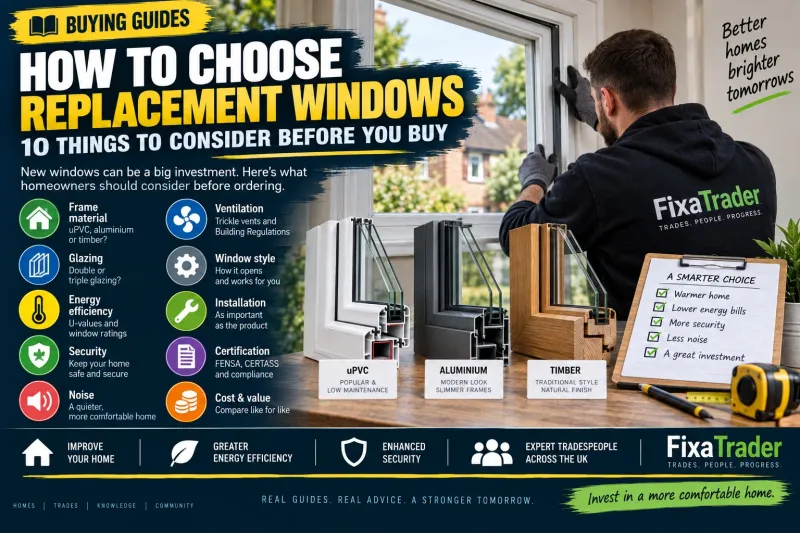
Here are ten things worth considering before you buy.1. Start With Why You're Replacing Them
Before comparing products, establish what you're trying to improve.
Are your existing windows:
Draughty?
Difficult to open?
Rotten or deteriorating?
Letting in excessive outside noise?
Poor at retaining heat?
Misting between the panes?
Difficult to secure?
Or do you simply want to change their appearance?
Different problems can lead to different priorities.
If road noise is your biggest frustration, your considerations may be different from somebody primarily trying to improve thermal performance.
If only one sealed glazing unit has failed, replacing every window in the house may not necessarily be the first solution either.
Understand the problem before buying the replacement.2. Choose the Frame Material Carefully
Three of the most familiar choices for domestic replacement windows are uPVC, aluminium and timber.
Each has its own characteristics.
uPVC
uPVC is widely used in UK homes and is generally relatively low maintenance.
It is available in numerous colours and finishes and can provide good thermal performance when part of a well-designed window system.
Aluminium
Aluminium frames can provide a slimmer appearance and are commonly used in contemporary designs.
Modern aluminium window systems incorporate thermal breaks to reduce heat transfer through the frame.
They can be particularly attractive where homeowners want larger areas of glazing and narrower-looking frames.
Timber
Timber provides a traditional appearance that can be particularly suitable for certain period properties.
Good timber windows can perform extremely well, but they generally require more ongoing maintenance than uPVC or aluminium.
There isn't one universally “best” material.
Consider appearance, maintenance, cost, lifespan and the character of the property.3. Understand Double vs Triple Glazing
More panes of glass sounds automatically better.
But the decision deserves more thought.
Double-glazed units use two panes separated by a sealed cavity.
Triple glazing adds another pane and cavity.
A well-designed triple-glazed window can provide improved thermal performance compared with an otherwise comparable double-glazed product.
But that doesn't automatically mean every UK homeowner should choose triple glazing.
You also need to consider:
Cost.
Weight.
The performance of the complete window.
Solar gain.
Noise requirements.
The property itself.
And the quality of the installation.
For some homes, high-quality double glazing may be entirely appropriate.
For others, triple glazing could be worthwhile.
Don't make the decision based purely on the number of panes.4. Look at the Whole Window's Energy Performance
Glass gets a lot of attention, but a window isn't only glass.
The frame, glazing, spacers, seals and overall construction all influence performance.
One term you may encounter is the U-value.
In simple terms, U-values describe the rate of heat transfer through a building element.
Generally, a lower U-value indicates better thermal performance.
You may also see Window Energy Ratings, which provide another way of communicating the overall energy performance of a window.
When comparing quotations, make sure you're comparing equivalent figures.
A salesperson saying:
“This glass has an excellent U-value”
isn't necessarily telling you the performance of the complete installed window.
Ask what the quoted figure actually refers to.5. Think About Ventilation
Homeowners understandably want windows that eliminate draughts.
But making a property more airtight also changes how it ventilates.
Moisture is continuously generated inside homes through:
Cooking.
Showering.
Drying clothes.
Breathing.
And everyday living.
Without adequate ventilation, that moisture can contribute to condensation and mould.
Current Building Regulations can require background ventilation provisions in circumstances involving replacement windows, and trickle ventilators are one solution you may encounter.
Don't assume vents are simply an unnecessary hole somebody has added to your new window.
Ask the installer what ventilation requirements apply to your property and how they're being addressed.6. Consider Security
Windows are also part of your home's security.
When comparing products, look beyond whether the handle has a lock.
Consider the complete system.
Depending on the window, that may include:
Multi-point locking.
Hinges.
Handles.
Frame construction.
Glazing retention.
And relevant security standards.
Ground-floor and easily accessible windows may deserve particular attention.
If security is one of the main reasons you're replacing your windows, tell the installer.
That allows them to recommend an appropriate specification rather than assuming your only priority is energy efficiency.7. Think About How the Window Opens
This is easy to overlook when looking at samples in a showroom.
How will you actually use the window?
Where will the handles be?
Can you comfortably reach them?
How far does it open?
Will furniture interfere with it?
How will you clean the outside?
Does the opening provide appropriate ventilation?
Could it need to provide an escape route in an emergency?
A replacement window doesn't necessarily need to copy the opening arrangement of the existing one.
But changes should be considered carefully, particularly where Building Regulations requirements are relevant.
A beautiful window that is frustrating to use every day isn't a great purchase.8. Don't Ignore Noise
If you live beside a busy road, railway, flight path or other persistent noise source, acoustic performance may be a significant priority.
It is tempting to assume:
Triple glazing = quieter.
The reality is more complicated.
Acoustic performance can depend on factors including glass thickness, the combination of panes, cavity dimensions, seals, frame construction and installation.
If noise reduction matters to you, say so explicitly when requesting quotations.
Ask what acoustic performance the proposed specification is designed to provide.
Don't simply assume the most expensive glazing option will automatically provide the best result for your particular noise problem.9. Installation Matters as Much as the Product
You can buy an excellent window and still be disappointed if it is poorly installed.
The finished performance depends on more than the unit leaving the factory.
The existing opening needs to be assessed.
The window needs to be positioned and fixed appropriately.
Sealing and weatherproofing matter.
Finishing around the opening matters.
And any damage created during removal of the old window needs to be dealt with properly.
How clearly the installation process is explained.
And what is included in the quotation.10. Understand the Certification and Building Regulations Position
Replacement windows can fall within Building Regulations requirements.
One common route is using an installer registered with an authorised competent person scheme, allowing qualifying replacement work to be self-certified.
Homeowners may recognise schemes such as FENSA or CERTASS in this area.
Alternatively, compliance can be dealt with through the appropriate building control route.
The important thing is to establish the process before work begins.
Ask:
How will the installation be certified?
What documentation will I receive?
Then keep that documentation with your property records.
It may become particularly useful when you eventually sell the home.What Should a Window Quote Include?
A quotation becomes much easier to compare when the specification is clear.
Depending on the project, useful information might include:
Number and location of windows
Frame material and finish
Glazing specification
Opening configuration
Handles and hardware
Ventilation provisions
Removal of existing windows
Disposal
Internal and external making-good
Scaffolding or access requirements
Certification
Guarantees or warranties
Total price and VAT position
If one quotation is dramatically cheaper, check whether it actually includes the same work.
Sometimes the difference isn't the price of the window.
It's what's missing from the specification.What About Guarantees?
A long guarantee sounds reassuring.
But ask what it actually covers.
The frame?
Glass units?
Hardware?
Installation?
Seals?
Labour?
Different components may have different terms.
Also consider who is providing the guarantee and what happens if the installation company stops trading.
Some businesses may offer insurance-backed guarantees or other protections depending on the installation and scheme involved.
Don't judge a guarantee purely by the number of years printed in large letters.
Read what is actually guaranteed.Should You Replace Every Window at Once?
Not necessarily.
Replacing the whole property at once may produce a consistent appearance and can make sense when most windows are reaching the end of their useful life.
But if only a small number are defective, phased replacement could be worth considering.
There can also be occasions where a window doesn't need complete replacement at all.
A failed sealed glazing unit, damaged hardware or another repairable component may potentially be replaceable while the rest of the window remains serviceable.
A reputable professional should be able to explain the available options.Be Careful With High-Pressure Sales
Windows can be a substantial purchase.
You should have enough time to understand what you're buying.
Be cautious if the conversation relies heavily on:
“This price is only available today.”
“I need to call my manager to approve the discount.”
“The normal price is £20,000, but we can do £9,000 if you sign now.”
A genuine quotation should allow you to understand the product, specification and total cost.
You don't need to make a major home-improvement decision while somebody is sitting at your kitchen table waiting for an answer.Compare Specifications, Not Just Prices
Suppose you receive three quotes:
£5,800
£7,000
£8,200
It's tempting to treat them as three prices for the same thing.
They may not be.
One could include a different frame system.
Different glazing.
Different hardware.
Different ventilation.
More making-good.
Scaffolding.
Different certification arrangements.
Or a substantially different guarantee.
Before deciding which is best value, make the quotations comparable.
Ask questions where something isn't clear.Good Windows Should Become Boring
Once replacement windows are installed, you shouldn't have to think about them very often.
They should open when you need them to.
Close properly.
Keep the weather outside.
Provide appropriate ventilation.
Help keep the property comfortable.
Offer suitable security.
And complement the building.
That's why the buying decision deserves more attention than simply choosing a colour and asking:
“How much for double glazing?”
You're not just buying panes of glass.
You're buying part of your home's weather protection, ventilation, security, appearance and thermal envelope — so compare the complete window and the quality of the installation, not just the price.
0 Comments
No comments yet — be the first to share your thoughts.