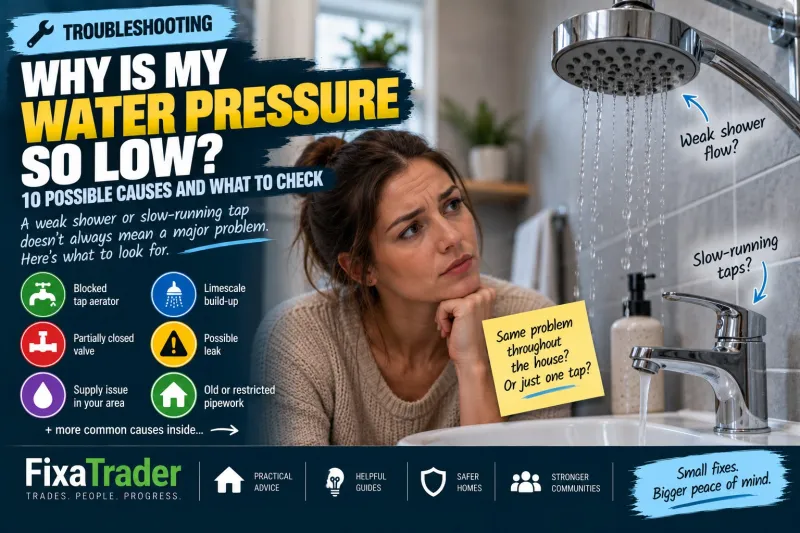
Why Is My Water Pressure So Low? 10 Possible Causes and What to Check
You turn on the shower and barely get more than a trickle. The kitchen tap suddenly seems weaker than usual. Or perhaps the water pressure has never been partic...
You turn on the shower and barely get more than a trickle.
The kitchen tap suddenly seems weaker than usual.
Or perhaps the water pressure has never been particularly good, but recently it has become noticeably worse.
The natural conclusion is:
“Something must be wrong with the water pressure.”
Possibly.
But several different problems can produce similar symptoms.
The issue could be limited to one tap.
It could affect one part of the house.
It could involve your internal plumbing.
Or there could be something happening with the incoming water supply.
Before replacing taps, showers or pipework, it helps to establish what has actually changed.First: Is It One Outlet or the Whole House?
This is one of the most useful questions you can answer.
Turn on several outlets around the property.
Check:
Kitchen tap
Bathroom basin
Bath
Shower
Upstairs and downstairs outlets, if applicable
Both hot and cold water
You're looking for a pattern.
If one tap is weak but everything else is normal, the problem is probably relatively localised.
If every cold tap has suddenly lost performance, the incoming supply becomes more relevant.
If the cold water seems fine but the hot water is poor, the issue may be somewhere within the hot-water system.
You don't need to diagnose the fault yourself.
You're simply narrowing down where to look.1. A Blocked Tap Aerator
Start with one of the simplest possibilities.
Many taps have an aerator fitted at the end of the spout.
Over time, debris or limescale can accumulate there and restrict the flow.
The result can look surprisingly dramatic.
One tap becomes weak while the rest of the property remains perfectly normal.
Depending on the tap design, an accessible aerator may be removable for inspection and cleaning in accordance with the manufacturer's instructions.
If only one tap has lost flow, checking the outlet itself is a sensible starting point.2. A Shower Head Clogged With Limescale
The same principle applies to showers.
Water passing through numerous small openings means mineral deposits can gradually restrict them, particularly in hard-water areas.
You might notice:
Uneven spray patterns.
Water firing sideways.
Some holes producing no water.
Or the entire shower feeling weaker.
If the taps elsewhere are performing normally, inspect the shower head before assuming the whole property has a pressure problem.
Cleaning or replacing a heavily scaled shower head may make a substantial difference.3. A Valve Isn't Fully Open
Sometimes the explanation is surprisingly mundane.
A valve controlling part of the water supply may not be completely open.
Perhaps plumbing work has recently been carried out.
Someone isolated the supply.
A valve was subsequently reopened but not fully.
Or a service valve beneath a basin has been disturbed.
If the problem began immediately after work was carried out, tell the plumber.
That timing can be an extremely useful clue.
Avoid forcing unfamiliar valves or dismantling components you don't understand.4. There Could Be a Leak
A leak somewhere in the plumbing system can potentially affect water performance.
The difficult part is that not every leak announces itself with water pouring through the ceiling.
Some are obvious.
Others may be concealed beneath floors, behind walls or underground.
Possible warning signs can include:
Unexpected damp patches.
Water staining.
Sounds of running water when outlets aren't being used.
An unexplained increase in metered water use.
A sudden change in water performance.
Or visible water where it shouldn't be.
Low pressure alone doesn't prove you have a leak.
But a sudden unexplained change combined with other signs of escaping water deserves investigation.5. The Problem May Be Outside Your Property
If the entire house suddenly experiences weaker cold-water performance, don't immediately assume your plumbing has failed.
Your water supplier may be carrying out work.
There could be a burst main.
A local supply issue may be affecting multiple properties.
Ask a neighbour whether they've noticed the same thing.
You can also check your water company's service information for known incidents in your area.
If several nearby properties experience the same sudden change, that points in a very different direction from one blocked bathroom tap.6. Demand Can Affect What You Experience
Try this experiment.
Run the shower.
Then have somebody turn on another significant water outlet.
Does the shower noticeably weaken?
Homes don't necessarily maintain identical flow at every outlet regardless of how many are being used simultaneously.
The available supply, plumbing arrangement and demand within the property all influence what you experience.
If the problem only appears when several outlets operate at once, mention that when speaking to a plumber.
Again, the pattern matters.7. Old or Restricted Pipework Could Be Contributing
Not every low-flow problem appears overnight.
Some properties have struggled with poor performance for years.
Older plumbing may contain pipework that has deteriorated, become restricted or simply isn't particularly well suited to the demands now being placed upon it.
Properties also change.
A house that once had a simple bathroom arrangement may now contain:
Multiple bathrooms.
Larger showers.
Additional appliances.
An extension.
A loft conversion.
Different hot-water equipment.
What was adequate for the original property isn't necessarily ideal for the way the home is used today.
Determining whether pipework itself is contributing usually requires proper assessment rather than guesswork.8. The Hot-Water System May Be the Clue
Suppose your cold kitchen tap performs well.
But hot outlets around the house are consistently poor.
That's valuable information.
It suggests the problem may not simply be the incoming water supply.
Different homes use different methods of producing and distributing hot water, and the appropriate diagnosis depends on the system installed.
This is where homeowners can waste money by searching:
“Best shower for low water pressure”
and buying a new shower before understanding why the existing one performs badly.
Establish whether the issue is hot, cold or both first.9. The Shower Itself May Be the Problem
A weak shower doesn't automatically equal poor household water pressure.
Depending on the type of shower, there can be components within the shower or its supply arrangement that affect performance.
Filters can become restricted.
Valves can develop problems.
Shower heads can scale.
Hoses can deteriorate or become restricted.
And different types of showers behave differently depending on the plumbing system supplying them.
If every other outlet works normally, investigate the shower as a shower problem before treating it as a whole-house problem.10. What Feels Like Low Pressure May Actually Be Low Flow
People often use pressure and flow interchangeably.
They're related, but they're not exactly the same thing.
Pressure describes the force pushing the water.
Flow describes how much water is being delivered over a period of time.
You can therefore experience disappointing performance at an outlet without the underlying explanation simply being “the pressure is too low”.
Pipe size, restrictions, valves, fittings, the outlet itself and simultaneous demand can all influence how much water reaches you.
For a homeowner, the terminology isn't the important part.
The important lesson is:
Don't assume you know the solution simply from the symptom.When Did the Problem Start?
This can dramatically narrow the possibilities.
Ask yourself whether the change was:
Sudden
or
Gradual.
A sudden drop might make you think about things such as a local supply problem, recent plumbing work, a valve position, a new fault or a leak.
A gradual deterioration at one outlet might be more consistent with something such as accumulating scale or a developing restriction.
And if the property has always behaved this way, the plumbing arrangement itself may need assessing.
When you speak to a tradesperson, “It started yesterday” is much more useful than simply saying “the pressure is bad.”Did Anything Change Before It Happened?
Think backwards.
Was a new bathroom installed?
Did somebody work on the plumbing?
Was the water recently turned off?
Did you replace a shower?
Was a new appliance installed?
Has building work taken place?
Did the problem begin after a period when the property was empty?
Changes immediately preceding a problem aren't proof of the cause.
But they're useful evidence.
Tell whoever investigates.Can You Test the Water Pressure Yourself?
Simple consumer gauges exist, but interpreting a single measurement without understanding the plumbing system can be misleading.
For most homeowners, you can gather useful information without becoming the plumber.
Establish:
Which outlets are affected.
Whether hot and cold behave differently.
Whether the problem changes when multiple outlets operate.
When it started.
Whether neighbours are affected.
Whether recent plumbing work took place.
Whether there are signs of leakage.
That information can be far more useful than saying:
“My shower pressure is terrible.”Don't Immediately Buy a Pump
A common reaction to poor water performance is:
“I'll install a pump.”
But a pump isn't a universal solution to every low-pressure or low-flow problem.
The correct approach depends on the plumbing and hot-water system, the underlying cause and what you're trying to achieve.
There can also be restrictions on how water-supply systems may be configured.
Adding equipment without diagnosing the underlying problem can leave you with an expensive solution to the wrong problem.
Get the system assessed first.Don't Ignore a Sudden Significant Change
A shower that has always been mediocre is one thing.
A property that had perfectly normal water yesterday and suddenly has dramatically reduced performance today is another.
If the change is significant and unexplained, investigate it.
Check whether your water supplier is reporting an issue.
Look for obvious signs of leakage.
See whether neighbouring properties are affected.
And if the problem appears to be within your property, arrange for a competent plumber to investigate.Give the Plumber Useful Information
Instead of:
“I've got low water pressure.”
Try:
“Since yesterday morning, the hot and cold taps upstairs have become much weaker. The kitchen cold tap still seems normal, and it gets worse when the shower is running.”
Now the tradesperson has something to work with before they even arrive.
Photos and videos can sometimes help too, particularly where the problem involves one specific outlet.
Good information can make fault-finding more efficient.Don't Diagnose From One Weak Tap
This is the main takeaway.
One poor-performing tap doesn't necessarily mean your house has low water pressure.
One weak shower doesn't automatically mean you need a pump.
And a sudden whole-house problem doesn't necessarily mean you need a plumber to replace anything.
Start by finding the pattern.
One outlet or several?
Hot, cold or both?
Sudden or gradual?
Constant or only when other water is being used?
Just your property or the neighbours too?
Those answers help turn a vague symptom into a much more useful problem to investigate.
Before trying to increase your water pressure, find out where the water is actually being restricted — because the right fix depends on the real cause.
0 Comments
No comments yet — be the first to share your thoughts.