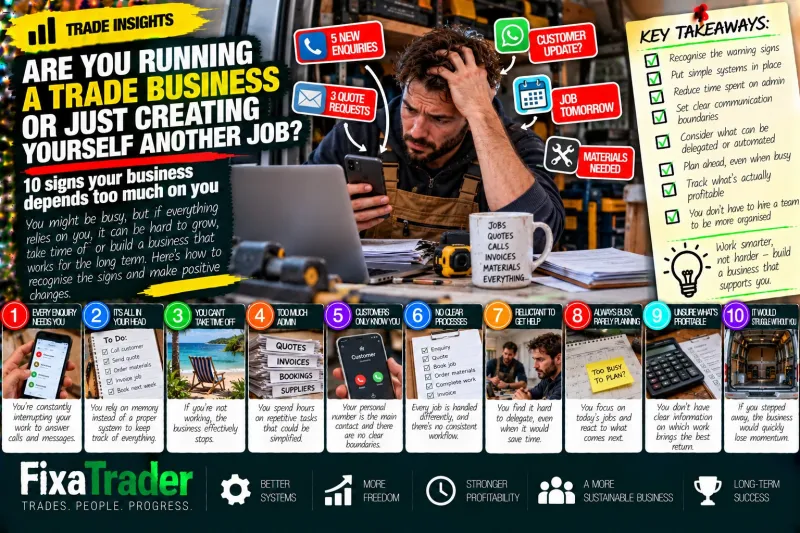
When Should a Tradesperson Hire Their First Employee? 10 Signs Your Business Might Be Ready to Grow
You've spent years building your trade business. Your diary is full, customers are recommending you and enquiries keep arriving. But there's a problem. You can...
Your diary is full, customers are recommending you and enquiries keep arriving.
But there's a problem.
You can only complete so much work yourself.
Every additional job means longer days, more weekends or pushing customers further into the future.
Eventually, you start wondering whether it's time to bring someone else into the business.
Perhaps an apprentice could help with everyday tasks.
Maybe an experienced tradesperson could take on jobs independently.
Or you need someone to manage the administration that's consuming your evenings.
Hiring your first employee can be an important milestone.
But it can also introduce financial commitments, legal responsibilities and management challenges that don't exist when you're working alone.
The question isn't simply whether you have enough work for another person today. It's whether your business can support that person consistently while remaining profitable.
Here are ten signs that hiring might be worth considering.1. You're Consistently Turning Away Suitable Work
One of the clearest signs of potential growth is having more suitable work than you can reasonably complete.
Perhaps customers are waiting several weeks for appointments.
You regularly decline profitable enquiries because your diary is full.
Or existing customers are going elsewhere because you can't accommodate their timescales.
However, a busy fortnight doesn't necessarily justify hiring someone.
Demand can fluctuate because of seasonal patterns, temporary projects or unusual circumstances.
Look at the previous six to twelve months.
Are you regularly turning away the same types of work?
Are those jobs profitable?
Would an additional person allow you to complete more of them?
Consistent demand is a stronger foundation for recruitment than a temporary period of being overwhelmed.2. Your Workload Is Becoming Predictable
A full diary is useful.
A predictable diary is even more valuable when you're considering employment.
An employee represents an ongoing commitment.
You'll need to pay them during quieter periods, not just when the business is exceptionally busy.
Review your workload across different months.
Consider whether you have regular maintenance contracts, repeat customers or a dependable flow of enquiries.
Also look at how far ahead customers are booking.
If work arrives in unpredictable bursts, hiring a permanent employee may create financial pressure.
You might first explore whether better scheduling, subcontracting or a different mix of services could smooth out demand.3. You Can Afford the Full Cost of Employment
A common mistake is calculating whether the business can afford someone's wages without considering the additional costs.
An employee can cost substantially more than their basic salary.
Depending on the circumstances, you may need to budget for:
Employer National Insurance contributions.
Workplace pension contributions.
Paid annual leave.
Statutory payments where applicable.
Employers' liability insurance.
Tools, equipment and protective clothing.
Training and qualifications.
Payroll administration.
Additional vehicles, fuel or travel costs.
There may also be time when the employee isn't generating chargeable revenue.
For example, they might be attending training, travelling between jobs or helping with preparation.
Before recruiting, estimate the realistic annual cost rather than focusing only on the advertised wage.
If your business can only afford the employee when every working hour is chargeable, your calculations may be too optimistic.4. You Have Enough Cash Flow to Handle Quiet Periods
Profitability and cash flow aren't the same thing.
Your business might be profitable on paper while still experiencing periods when money is tight.
Customers may pay invoices late.
Materials might need purchasing before payment arrives.
Larger projects can tie up substantial amounts of working capital.
But employee wages still need to be paid on time.
Consider how the business would cope if several invoices were delayed or an important project was postponed.
Do you have sufficient reserves or dependable working capital?
Could you continue meeting payroll and other obligations without relying on customers paying immediately?
There's no universal cash reserve that guarantees a business is ready to hire.
But modelling several realistic scenarios can reveal whether the decision is financially sustainable.5. You're Spending Too Much Time on Work Someone Else Could Do
Hiring doesn't always mean recruiting another qualified tradesperson.
Sometimes the biggest constraint on growth is how you spend your own time.
You may be spending hours each week:
Answering routine enquiries.
Organising appointments.
Preparing paperwork.
Ordering materials.
Following up invoices.
Updating customers.
Completing basic site preparation.
These tasks matter.
But they may not all require your personal attention.
Before recruiting, identify which activities are preventing you from completing higher-value work.
An administrator, trainee or appropriately supervised assistant may be more useful than another experienced tradesperson.
The right first hire is the person who removes your biggest operational bottleneck, not necessarily someone who does exactly what you do.6. Your Business Has Clear Processes
When you work alone, much of your business knowledge exists in your head.
You know how you prefer jobs to be completed.
You remember which suppliers to use.
You understand how customers should be updated.
But a new employee won't automatically know these things.
Hiring becomes easier when you have repeatable processes for common activities.
These might include:
Preparing for a job.
Checking materials and equipment.
Recording work completed.
Taking project photographs.
Communicating with customers.
Reporting unexpected problems.
Following safety procedures.
Completing end-of-job checks.
You don't need a large operations manual.
Simple checklists and clear expectations can make a significant difference.
Without them, you may spend more time correcting misunderstandings than benefiting from the extra capacity.7. You're Ready to Supervise and Manage Someone
Being a skilled tradesperson doesn't automatically make someone an experienced manager.
You'll need to provide appropriate supervision, communicate expectations and address performance concerns.
You may also need to manage attendance, holidays, training and workplace issues.
This takes time.
If you're already struggling to manage your own workload, consider how recruitment will affect your schedule.
A new employee may initially reduce your productivity while they learn how the business operates.
That's normal, but it needs to be planned for.
Hiring someone doesn't eliminate management work. It creates a different type of work that you must be prepared to handle.8. You Can Provide Suitable Tools, Equipment and Working Conditions
An employee needs more than a place in your van.
They need the equipment, training and working conditions required to perform their duties safely.
Depending on their role, this may involve:
Suitable tools and equipment.
Appropriate personal protective equipment.
Relevant training and instruction.
Safe systems of work.
Access to welfare facilities.
Proper supervision.
Suitable transport arrangements.
Health and safety responsibilities become particularly important when other people are working under your direction.
You should also consider whether existing vehicles, storage arrangements and insurance cover remain suitable.
If an employee will work independently, you'll need to assess whether they have the necessary competence and authorisation for the tasks involved.
Don't assume that someone with previous trade experience automatically meets every requirement of your business.9. You Know What the Employee Will Actually Do
Before advertising a position, define the role.
Will the person assist you on site?
Complete smaller jobs independently?
Manage customer enquiries?
Or learn a trade through an apprenticeship?
These are very different positions.
A vague job description can attract unsuitable applicants and create confusion after recruitment.
Think about the skills required, typical working hours, location, pay arrangements and level of responsibility.
Also consider how you'll measure whether the role is delivering value.
For a qualified tradesperson, that might involve additional completed work and consistent quality.
For an administrator, it could involve improved response times and reduced time spent on paperwork.
You should be able to explain what success looks like before someone starts the job.10. Hiring Supports a Clear Business Goal
Recruitment shouldn't become a goal in itself.
Some tradespeople want to build a business with several employees.
Others prefer remaining independent and maintaining direct control over their work.
Neither approach is automatically better.
Ask what hiring would help you achieve.
Perhaps you want to:
Increase the number of jobs completed.
Take on larger projects.
Reduce excessive working hours.
Offer a wider range of services.
Improve customer response times.
Build a business that doesn't depend entirely on you.
Then consider whether employment is the most effective way to reach that goal.
A successful business doesn't necessarily need a large team. It needs a structure that supports the owner's objectives.Should Your First Hire Be an Apprentice or an Experienced Tradesperson?
This depends on what the business needs.
Hiring an apprentice
An apprentice may be suitable if you want to develop someone over time and have the capacity to provide training and supervision.
However, apprenticeships involve structured learning, employment requirements and an approved training arrangement.
An apprentice shouldn't be viewed simply as inexpensive labour.
You'll need to consider training commitments, eligibility, funding arrangements and the time required to support their development.
Hiring an experienced tradesperson
An experienced worker may be able to contribute more independently, depending on their skills and the work involved.
However, their employment costs may be higher.
You'll also need to assess competence, qualifications and how they work with customers.
Hiring administrative support
If paperwork and communication are limiting your productivity, administrative assistance may offer better value than another person on site.
The right choice depends on where your business is losing the most time or opportunity.Would a Subcontractor Be Better Than an Employee?
Before committing to permanent recruitment, some businesses consider using subcontractors.
This may provide flexibility for specialist work or fluctuating demand.
However, employment status is determined by the actual working relationship, not simply what the contract calls someone.
A person described as self-employed may still be an employee or worker for certain legal purposes.
Tax status can also involve separate considerations.
Factors such as control, personal service, financial risk and how the relationship operates may be relevant.
You should not use a subcontracting arrangement simply to avoid employment obligations where the relationship is genuinely one of employment.
If you're uncertain, obtain appropriate advice and review HMRC's employment status guidance.What Legal Responsibilities Come With Your First Employee?
Taking on your first employee introduces several important obligations.
Depending on the circumstances, these include:
Right-to-work checks
Employers must carry out the appropriate checks before employment begins.
PAYE and payroll
You may need to register as an employer with HMRC and operate PAYE.
Written employment particulars
Employees and workers are entitled to specified written information about their employment terms.
Minimum wage requirements
Pay must comply with the applicable National Minimum Wage or National Living Wage rules.
Workplace pensions
Eligible workers may need to be automatically enrolled into a qualifying workplace pension scheme.
Employers' liability insurance
Most employers must hold appropriate employers' liability insurance unless an exemption applies.
Health and safety
You must assess relevant risks and take suitable measures to protect employees and others affected by the work.
Holiday entitlement and other employment rights
Statutory entitlements must be accounted for when planning staffing costs.
Requirements vary according to the circumstances, so check current official guidance before recruiting.
Start by estimating the additional revenue the employee could realistically help generate.
Then subtract the additional costs.
For example, consider a hypothetical business where an employee costs £40,000 annually once wages and associated expenses are included.
If their contribution enables the business to generate £60,000 in additional annual revenue, that doesn't automatically mean the business gains £20,000 in profit.
You must also account for the materials, subcontractors, transport, supervision and other costs associated with delivering that work.
The relevant measure is the additional contribution after those costs, compared with the full cost of employment.
Be conservative about chargeable hours.
Allow for holidays, training, travel, quieter periods and non-billable tasks.
A realistic forecast is more useful than calculating profitability on the assumption that every hour will be sold.Five Questions to Ask Before Advertising the Job
Before committing to recruitment, consider the following:
Is demand consistent? Do you have evidence that additional capacity will be needed beyond the next few weeks?
Can the business afford the full cost? Have you included employment costs beyond wages?
What problem will the hire solve? Is the role clearly defined?
Can you support the employee? Do you have the time, equipment and processes needed?
Is employment the best option? Could better scheduling, outsourcing or subcontracting address the problem more effectively?
If several answers remain uncertain, that doesn't necessarily mean you should abandon the idea.
It may mean the business needs more preparation before recruiting.The Bottom Line: Hire When the Business Is Ready, Not Just When You're Busy
Hiring your first employee can create opportunities that are difficult to achieve alone.
It may allow you to complete more work, improve customer service and build a business with greater capacity.
But it also introduces commitments that continue when the diary isn't full.
Wages, supervision, training, equipment and employment responsibilities all need to be considered.
The strongest reason to hire isn't simply that you're exhausted or turning away the occasional enquiry.
It's that you have consistent demand, a clear role, realistic finances and a plan for how the additional person will contribute.
And if your goal is to remain a profitable one-person business, that's a valid choice too.
Growth isn't measured by how many people you employ. It's measured by whether your business becomes more sustainable, profitable and capable of delivering the work you want to do.
0 Comments
No comments yet — be the first to share your thoughts.