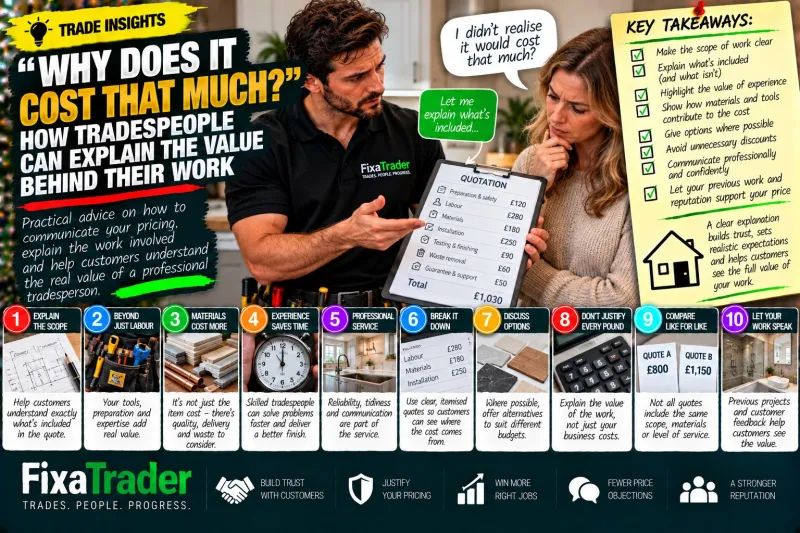
“Why Does It Cost That Much?”: How Tradespeople Can Explain the Value Behind Their Work
You send the quote. The customer replies: “I didn't realise it would cost that much.” Sometimes they're simply surprised. Sometimes they've compared your price...
Sometimes they've compared your price with something they found online.
Sometimes they're looking at a job that might take you three hours and calculating the price as though they're paying for three hours of labour.
From the tradesperson's side, the calculation looks completely different.
You're thinking about:
Travel.
Materials.
Tools.
Insurance.
Experience.
Preparation.
Waste disposal.
Administration.
Time spent quoting.
The risk of something going wrong.
And the responsibility for leaving behind work you're prepared to put your name to.
The problem is that most of that is invisible to the customer.
That doesn't mean you need to deliver a lecture about your overheads every time someone questions a quote.
But being able to explain the value behind professional work can make price conversations considerably easier.1. Don't Become Defensive When Someone Questions the Price
A customer saying:
“That's more than I expected.”
isn't necessarily accusing you of overcharging.
They may genuinely have had no idea what the work costs.
If you immediately respond defensively, an ordinary question can become an argument.
Instead, find out what they actually mean.
You might say:
“No problem — is there anything in the quote you'd like me to explain?”
Now the conversation is about the work rather than defending yourself personally.
Sometimes the customer simply wants reassurance that they've understood what is included.2. Explain the Scope Before Defending the Number
A price makes more sense when the customer understands what they're buying.
Imagine a quotation says:
Bathroom repair — £650.
The customer sees £650.
Now imagine it explains that the work includes:
Removing the affected fittings.
Accessing the failed section.
Replacing damaged components.
Reinstalling.
Testing.
Making good where agreed.
Removing waste.
And supplying specified materials.
The number hasn't changed.
The customer's understanding has.
This doesn't mean writing a three-page specification for every small job.
It means making the scope clear enough that the customer can connect the price with actual work.3. Remember That Customers Usually See the Visible Task
A tradesperson sees the whole process.
The customer often sees the final action.
They might think:
“You're only replacing one socket.”
“It's only three tiles.”
“You're just fitting a new tap.”
“It's only a small hole.”
But the visible repair may be the final 20 minutes of a much longer process.
There may be:
Diagnosis.
Isolation.
Preparation.
Access.
Protection.
Removal.
Cleaning.
Adjustment.
Testing.
Reassembly.
And travel.
You don't need to list every movement you make.
But where a job appears deceptively simple, explaining the broader process can help.4. Experience Often Makes Difficult Work Look Easy
This is one of the strange things about skilled work.
The better someone becomes, the easier the job can look.
A tradesperson walks in.
Recognises the problem quickly.
Uses the correct tool.
Completes the repair cleanly.
And leaves.
The customer sees:
45 minutes.
What they don't see is the experience that allowed the correct diagnosis to happen in five minutes rather than two hours.
Customers aren't only paying for physical effort.
They're paying for the ability to reach the right result efficiently.
You don't need to tell customers:
“You're paying for my 20 years of experience.”
But don't undervalue expertise simply because expertise made the job quicker.5. Tools Have Value Even When the Customer Never Notices Them
A professional may arrive with thousands of pounds worth of equipment.
Some of it gets used every day.
Some exists for one specific situation.
The customer doesn't need an itemised charge for every drill bit.
But those tools are part of the capability they're hiring.
They allow work to be:
Completed accurately.
Diagnosed properly.
Performed efficiently.
Tested where necessary.
And undertaken to a professional standard.
Buying, maintaining, replacing and sometimes calibrating equipment is part of running a trade business.
The customer isn't hiring a pair of hands.
They're hiring an equipped professional service.6. Materials Aren't Always the Price Someone Found Online
This causes plenty of confusion.
A customer searches for something you've included in the quote.
They find a similar-looking product for £60.
Your materials allowance appears considerably higher.
“I can buy it online for less than that.”
Maybe they can.
But check whether they're actually comparing the same thing.
Differences can include:
Specification.
Quality.
Size.
Finish.
Compatibility.
Included components.
Delivery.
Quantity.
Warranty.
And whether additional consumables are required.
If you're applying a margin to supplied materials, that's also part of your business model.
The important thing is being comfortable explaining what you're supplying rather than pretending materials cost something they don't.7. Reliability Is Part of the Product
Customers don't only buy the physical work.
They're also buying the experience around it.
Did you:
Respond?
Turn up?
Communicate delays?
Provide a clear quotation?
Protect their property?
Work tidily?
Keep records?
Send the invoice properly?
Return if there's a genuine problem with your work?
Those things cost businesses time and money to provide.
A cheaper quote isn't necessarily offering the same overall service.
This is where reputation becomes valuable.
If your previous work demonstrates that customers can rely on you, you're offering something beyond the lowest possible price.8. Avoid Explaining Price Entirely Through Your Costs
There is a trap here.
When challenged, some tradespeople start listing every business expense:
“My van costs this, insurance costs that, fuel has gone up…”
Those costs are real.
We've previously covered how much a trade business must absorb before the owner actually earns anything.
But the customer isn't responsible for making your business profitable.
They care about what they receive.
So instead of making the conversation:
“Here's why I need this money.”
make it:
“Here's what this price includes and what you'll receive.”
That's a much stronger explanation of value.9. Break Large Quotes Into Logical Sections
A single large number can be difficult to understand.
For larger jobs, consider dividing the quotation into meaningful parts where appropriate.
For example:
Preparation
Labour
Materials
Installation
Finishing
Waste removal
Or use stages of the project.
The exact structure depends on the work.
You don't necessarily need to disclose your internal cost calculations or hourly margin.
The purpose is simply to make the quotation understandable.
A customer should be able to see what they're agreeing to.10. Explain What Isn't Included Too
Value becomes clearer when scope has boundaries.
Suppose you quote to repair a section of damaged flooring.
The customer might assume that includes:
Moving every item of furniture.
Replacing skirting.
Repainting.
Removing unrelated damaged material.
And disposing of furniture.
If those things aren't included, say so.
Exclusions aren't negative.
They make the agreement clearer.
A professional quote explains both:
what you're doing
and
where your responsibility ends.
That reduces the chance of the price conversation returning later as a scope dispute.Don't Automatically Discount Because Someone Questions the Price
The customer says:
“Can you do anything on the price?”
Your immediate reaction might be to knock £100 off.
But what changed?
The job hasn't become smaller.
The materials haven't become cheaper.
The travel hasn't disappeared.
Before reducing the price, understand the objection.
If the issue genuinely is budget, perhaps the scope can change.
There may be:
A different specification.
Optional work that can be removed.
A project that can be completed in stages.
Or another legitimate way to reduce the cost.
That's different from performing exactly the same work for less simply because somebody asked.Give Customers Options Where They Genuinely Exist
Or there may be different material or finish choices.
Options help customers understand that price follows decisions.
But don't manufacture artificial packages purely to make the expensive option look attractive.
And don't offer a cheaper option you wouldn't be comfortable standing behind.Don't Compete With an Unknown Quote
A customer tells you:
“Someone else said they'd do it for £400.”
Your quote is £700.
That doesn't automatically mean you're expensive.
You don't know whether the other quotation includes the same:
Scope.
Materials.
Preparation.
Waste.
Finishing.
Guarantees.
Or even the same understanding of the job.
Ask the customer to compare like with like.
If another competent tradesperson genuinely offers equivalent work for substantially less, the customer may reasonably choose them.
You don't have to win every job.Your Profile and Previous Work Can Explain Value Before You Do
Price becomes more difficult when the customer has nothing else to judge.
Imagine two unfamiliar names and two numbers:
£1,400
and
£1,750.
The cheaper number has an obvious advantage.
Now give the customer:
Previous projects.
Clear photographs.
Customer feedback.
Relevant credentials.
A complete professional profile.
Evidence of similar work.
And a visible track record.
They have more information with which to evaluate the difference.
This is why documenting completed work matters.
Your reputation can answer part of the “Why should I choose you?” question before the quotation arrives.Know When to Stop Explaining
There is also a point where the conversation isn't really about understanding.
You explain the scope.
Clarify the materials.
Answer the questions.
Discuss alternatives.
And the customer continues trying to push the price lower.
That's their right.
It's also your right to decline.
You don't need to convince every potential customer that your price is correct.
Sometimes the appropriate response is simply:
“That's the price I'm able to offer for the work described.”
Then let them decide.Make Your Quote Do More of the Talking
If customers repeatedly question the same things, look at your quotation process.
Are you clearly explaining:
What will be done?
What materials are included?
What isn't included?
How additional work is handled?
How long the quotation remains valid?
Payment arrangements?
Expected timescale?
You may discover the problem isn't your price.
It's that the customer receives a number without enough context.
A better quotation can prevent questions before they appear.You Don't Need to Justify Every Pound
Professional pricing isn't about proving that every £1 of the quote corresponds to one visible action.
A business has to price work sustainably.
Some jobs will go perfectly.
Others will take longer.
Some quotations won't convert.
Tools will break.
Vehicles need maintaining.
Insurance needs paying.
Time will be spent doing work that never appears on an invoice.
Your customer doesn't need your entire profit-and-loss account.
What they do deserve is clarity about what they're paying for.
Explain the work.
Explain the result.
Explain the scope.
Answer reasonable questions.
Show evidence of your capability.
Then allow the customer to decide whether the value works for them.
Because the strongest response to:
“Why does it cost that much?”
isn't a defensive explanation of how expensive your business is to run.
It's a clear demonstration of what professional work actually involves.
Customers don't have to see every cost behind your business—but they should be able to understand the work, responsibility and value behind the price you've quoted.
0 Comments
No comments yet — be the first to share your thoughts.