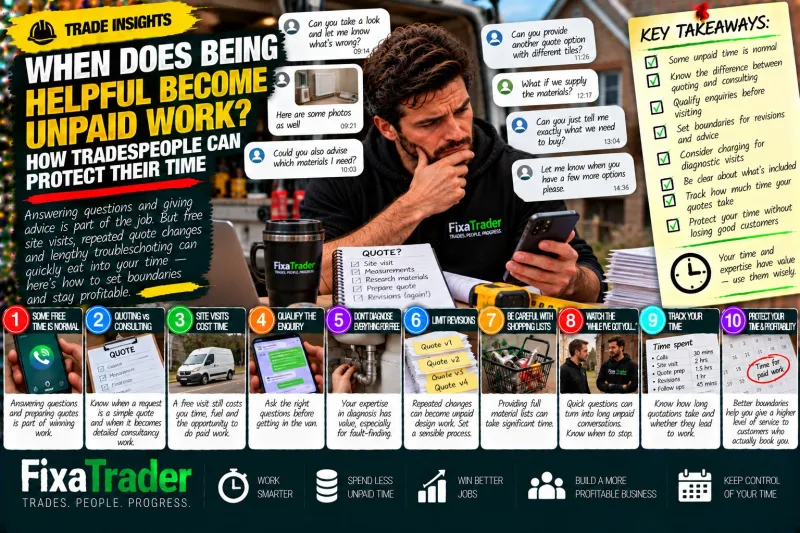
When Does Being Helpful Become Unpaid Work? How Tradespeople Can Protect Their Time
A customer calls about a problem. You spend 15 minutes talking them through it. They send six photos. You reply with a few possibilities. Then another video arr...
“Could you tell me exactly which products you'd use?”
Eventually, the customer disappears.
No job.
No payment.
And several hours of your working week have gone with them.
Some unpaid time is a normal part of running a trade business. You can't charge somebody every time you answer the phone.
But when helpfulness becomes unlimited access to your time and expertise, it can quietly damage the profitability of an otherwise busy business.
The challenge is knowing where to draw the line.1. Accept That Some Unpaid Time Is Part of Winning Work
Not every activity needs its own invoice.
Tradespeople naturally spend time:
Answering enquiries.
Discussing potential work.
Looking at photographs.
Preparing quotations.
Following up.
And explaining basic options.
That time is part of acquiring customers.
A business that refuses to answer anything until payment arrives may struggle to convert enquiries at all.
The objective isn't eliminating unpaid activity.
It's making sure the amount of unpaid effort is proportionate to the opportunity.
Spending ten minutes qualifying a £5,000 project can make perfect sense.
Spending two hours remotely diagnosing a £70 repair for someone who hasn't even decided whether they want you to attend may not.2. Learn the Difference Between Quoting and Consulting
A customer asking:
“How much would you charge to replace this?”
is asking for a price.
A customer asking you to visit, investigate several possible solutions, explain the technical advantages of each and produce a detailed specification they can use elsewhere may be asking for considerably more.
That's where quoting can begin turning into consultancy.
The boundary varies by trade.
For some straightforward work, a site visit and quotation can be relatively quick.
For complex projects, producing an accurate proposal may require:
Measurements.
Investigation.
Design decisions.
Calculations.
Product research.
Supplier conversations.
Or substantial technical knowledge.
If preparing a quote itself requires significant professional work, consider whether your existing process still makes commercial sense.3. A Free Site Visit Isn't Actually Free
You might not send an invoice for the visit.
But it still costs you.
Imagine a quotation visit involves:
20 minutes travelling there.
45 minutes at the property.
20 minutes travelling back.
15 minutes reviewing prices.
30 minutes preparing the quotation.
That's more than two hours.
Complete three unsuccessful visits like that in a week and you've lost most of a working day.
There may also be:
Fuel.
Parking.
Vehicle costs.
And the opportunity cost of work you could have been doing instead.
This doesn't mean free quotations are bad.
They can be an effective way of winning valuable work.
But treat them as a business cost and track whether they're actually producing enough work to justify the time.4. Qualify the Enquiry Before Getting in the Van
One of the easiest ways to protect time is deciding whether a visit is worthwhile before travelling.
Ask enough to understand the basics.
What work is required?
Where is the property?
When does the customer want it done?
Can they provide photographs?
Has anyone already investigated the problem?
Is there useful information about access?
Are they looking for a quotation, diagnosis or general advice?
We've previously covered the questions tradespeople can ask before booking a site visit.
The purpose isn't to make customers pass an interview.
It's to avoid driving 40 minutes to discover something that could have been established during a five-minute conversation.5. Photographs Can Save Time — but Don't Diagnose Everything From Them
Photos and videos are extremely useful.
They can help you establish whether:
The job suits your trade.
The location is accessible.
A particular component is involved.
The customer needs a different specialist.
Or a visit is clearly necessary.
But there's a trap.
The customer sends a photograph.
You ask for another angle.
Then a video.
Then a picture of the surrounding area.
Forty minutes later, you're effectively carrying out a remote investigation for free.
Know when to stop.
A perfectly reasonable response can be:
“There are a few possible causes, but I'd need to inspect it properly before I could tell you which one it is.”
Professionalism includes recognising the limits of remote advice.6. Decide When a Diagnostic Visit Should Be Chargeable
Some jobs can't meaningfully be quoted until somebody works out what is wrong.
That's particularly relevant to fault-finding and troubleshooting.
The customer may think they're asking:
“How much to fix this?”
But the first job is actually:
“Find out what's causing this.”
Diagnosis has value.
It uses time, experience and sometimes specialist equipment.
Depending on your trade and business model, a chargeable diagnostic or investigation visit may therefore make more sense than promising free fault-finding in the hope of winning the eventual repair.
If you charge, make it clear before attending.
Explain what the fee covers and, where relevant, whether any part is treated differently if further work is subsequently booked.
No surprises.7. Put a Limit on Endless Quote Revisions
A customer wants one change.
That's normal.
They've decided on different tiles.
Or removed one part of the project.
You update the quote.
Then another change arrives.
And another.
Eventually you've produced version six for a job that hasn't been booked.
At some point, quotation revisions can become unpaid design work.
You don't necessarily need a rigid:
“One revision only.”
But you do need a process.
For substantial projects, make it clear when repeated redesign, specification work or further visits go beyond the initial quotation process.
Customers can still change their minds.
Your time simply doesn't have to be unlimited.8. Be Careful About Producing a Free Shopping List
This happens when a customer wants to supply materials themselves.
They ask:
“Can you just tell me everything I need?”
That sounds simple.
But producing an exact specification may involve:
Quantities.
Dimensions.
Compatible components.
Fittings.
Consumables.
Product research.
And responsibility for whether the list is correct.
You can reasonably explain the broad materials required without necessarily spending an hour building somebody's online basket for free.
If customers are supplying products, clearly establish who is responsible for:
Selecting them.
Checking compatibility.
Ordering the correct quantities.
Dealing with missing parts.
And handling returns.
Otherwise, “I'll buy the materials” can still leave you doing all the procurement work without being paid for it.9. Watch Out for the “While I've Got You…” Conversation
You're already on site.
The customer says:
“While I've got you, can I quickly ask about this?”
Usually that's completely harmless.
You look at something and offer a quick opinion.
Good customer service matters.
The problem is when one quick question becomes an inspection of five unrelated issues.
Suddenly the original job has finished but you're still there 45 minutes later discussing future projects.
You don't have to shut the conversation down immediately.
But it's reasonable to say:
“I'm happy to take a proper look at that, but we'll need to book some time for it because I'll need to investigate it rather than guess.”
That is a professional boundary, not poor service.10. Track How Much Time Your Quotes Actually Consume
Most tradespeople know roughly how many jobs they win.
Fewer know how much time was spent winning them.
Suppose you prepare ten quotations.
Three convert.
That doesn't automatically mean your process is poor.
The value and profitability of those three jobs matter.
But if those ten quotations required 25 hours of visits, measurements and administration, you should know that.
Track:
Number of enquiries.
Site visits.
Quotes sent.
Time spent quoting.
Jobs won.
Average job value.
And where successful customers came from.
Patterns will emerge.
You may discover certain types of enquiry consume huge amounts of time but rarely convert.
That information can change how you handle them.Charging for Your Time Doesn't Mean Charging for Everything
There is a danger of overcorrecting.
You realise you've been giving too much away and suddenly every conversation becomes transactional.
Five-minute phone call? Fee.
Simple quotation? Fee.
One question? Fee.
That's unlikely to create a great customer experience.
Instead, identify the point where ordinary sales activity becomes substantial professional input.
For example:
A basic quote may remain free.
A detailed survey may be chargeable.
A quick initial conversation may be free.
An hour of fault-finding may not be.
A straightforward revision may be included.
Repeated redesign may not be.
The boundary should reflect your trade and the type of work you undertake.Make Charges Clear Before Doing the Work
If something is chargeable, say so first.
Don't spend three hours preparing detailed plans and then unexpectedly send the customer an invoice.
Explain the arrangement.
For example:
“The initial conversation is free. To investigate the fault properly I'd need to attend, and my diagnostic visit is £X.”
Or:
“I'm happy to revise the quotation based on that change. If you'd like me to redesign the whole specification and produce alternative options, I charge for that additional planning work.”
The exact wording is less important than the clarity.
Customers should know when they've moved from an enquiry into a paid service.Better Boundaries Can Actually Improve Customer Service
Protecting your time isn't only about money.
If your week is filled with unlimited unpaid requests, something eventually suffers.
You answer paying customers late.
Quotes take longer.
You rush paperwork at night.
You arrive home exhausted.
Important enquiries get missed.
By controlling how much time disappears into speculative work, you can give better attention to customers who have actually booked you.
That's good business and good service.Your Expertise Is Part of What Customers Are Buying
Tradespeople sometimes underestimate the value of knowing what to do.
A customer sees you look at something for ten minutes and identify the likely problem.
Because it was quick, it can feel difficult to charge for.
But the speed may come from years of experience.
You knew:
What to inspect.
What questions to ask.
What possibilities to rule out.
And what needed testing next.
Expertise doesn't lose value because it produces an answer efficiently.
The same principle applies before the job begins.
Your measurements, recommendations, specifications and diagnosis can all have value even though nothing has physically been installed yet.Be Helpful — Just Make It Sustainable
Good tradespeople are helpful.
They answer questions.
Explain things.
Give customers options.
And sometimes spend a little extra time helping someone without charging for every minute.
None of that needs to disappear.
The problem begins when generosity becomes the default business model.
If you're regularly spending evenings producing quotations, driving to speculative visits, troubleshooting remotely and creating detailed specifications for people who never book, look at the process.
Qualify enquiries earlier.
Use photos intelligently.
Charge for genuine diagnosis where appropriate.
Put sensible boundaries around repeated revisions.
Track the time you're investing.
And be clear when a request has moved beyond a normal quotation.
Because protecting your time doesn't mean becoming less helpful.
It means making sure you can continue being helpful without giving away so much of the working week that the business pays for it.
Your advice might take five minutes to give, but the knowledge behind it may have taken years to build — being professional means knowing when you're quoting for work and when you're already doing it.
0 Comments
No comments yet — be the first to share your thoughts.