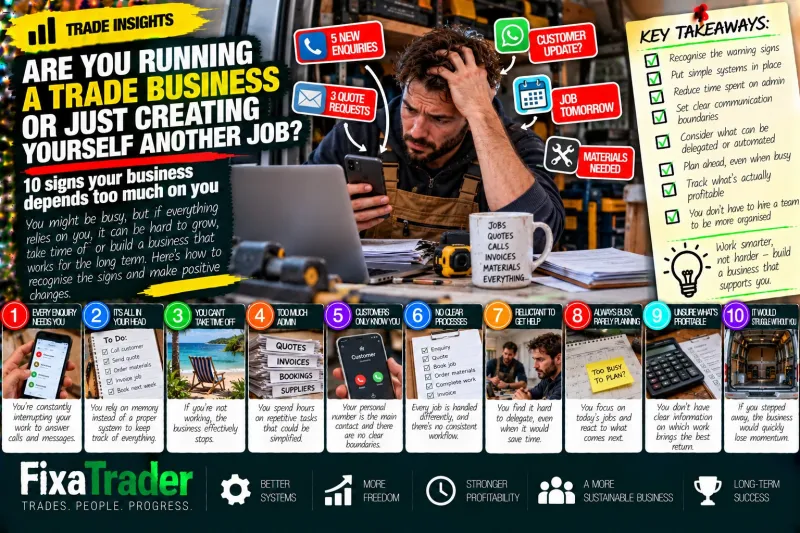
Are You Running a Trade Business or Just Creating Yourself Another Job? 10 Signs Your Business Depends Too Much on You
You started your own trade business for a reason. Perhaps you wanted more control over your working hours. The freedom to choose your customers. Better earning...
Perhaps you wanted more control over your working hours.
The freedom to choose your customers.
Better earning potential.
Or simply the opportunity to build something of your own.
And in many ways, it's working.
The phone rings.
Customers recommend you.
The diary stays busy.
You're completing good work.
But there's a problem.
Everything depends on you.
If a customer calls, you answer.
If a quote needs preparing, you write it.
If materials need ordering, you arrange them.
If something goes wrong, you're the person who sorts it out.
And if you take a week off, the entire business effectively stops.
There's nothing inherently wrong with being a sole trader. Many tradespeople deliberately choose that model and build successful, profitable careers around it.
The issue arises when the business becomes so dependent on your constant attention that you no longer have the freedom you originally wanted.
Here are ten signs worth recognising.1. Every Customer Enquiry Needs Your Immediate Attention
You're halfway through an installation.
The phone rings.
You stop working.
Answer it.
Discuss another job.
Return to the installation.
Ten minutes later, another customer messages.
Then someone wants an update on a quotation.
By lunchtime, you've spent an hour responding to interruptions.
The problem isn't that customers are contacting you.
That's generally a positive sign.
The problem is that every enquiry interrupts the work you're already being paid to complete.
Consider creating a more consistent enquiry process.
That might involve a business voicemail, a structured contact form, automated acknowledgements or designated times for returning calls.
Customers should know what to expect.
You shouldn't need to abandon the current job every time someone wants to discuss the next one.2. You Keep the Entire Business in Your Head
You know which customer needs a callback.
Which materials have been ordered.
Which quotation hasn't been sent.
Which invoice remains unpaid.
And which job is booked for next Thursday.
But where is that information recorded?
If the answer is "I just remember it", the business has a vulnerability.
As work increases, memory becomes an unreliable management system.
A missed message can mean a lost customer.
A forgotten order can delay a project.
An overlooked invoice can affect cash flow.
You don't necessarily need expensive software.
A shared calendar, simple spreadsheet or suitable job-management system may be enough.
The important thing is that essential information exists somewhere other than your memory.3. You Can't Take Time Off Without Everything Stopping
For many sole traders, income depends directly on the hours they work.
That's a normal characteristic of the business model.
But there's a difference between temporarily stopping paid work and losing control of everything else.
Can customers still submit enquiries?
Can existing customers find out when you'll return?
Are appointments recorded?
Can urgent messages be identified?
Are outstanding invoices already organised?
If taking five days away means returning to dozens of confused customers and forgotten tasks, your processes may need attention.
You don't have to employ someone to solve every problem.
Sometimes clearer communication and basic automation are enough to make time away less disruptive.4. You're Doing Administrative Work That Could Be Simplified
Think about the tasks you repeat every week.
Sending similar quotation emails.
Confirming appointments.
Requesting photographs.
Explaining your service area.
Sending payment details.
Answering the same customer questions.
Chasing missing information.
Individually, these tasks may take only a few minutes.
Collectively, they can consume hours.
Start by identifying the most repetitive activities.
Could you create a quotation template?
A standard enquiry checklist?
A booking confirmation message?
A simple process for recording expenses?
The objective isn't removing the personal touch from your business.
It's reducing unnecessary repetition so you have more time for the work that actually requires your expertise.5. Customers Only Know How to Contact You Personally
Your personal mobile number may be the main contact point for your business.
That's common among sole traders.
But problems can develop when business communication becomes completely mixed with personal life.
Customers message late at night.
Call during family time.
Send photographs across several different apps.
And expect immediate replies because they've contacted you directly.
You don't necessarily need a separate office or receptionist.
But establishing clearer communication boundaries can help.
Consider business contact channels, stated response times and consistent ways of recording enquiries.
The customer should still feel supported.
You simply shouldn't need to be personally available every hour of the day.6. You Can't Explain Your Own Processes
Imagine someone asks:
"What happens after a customer accepts your quote?"
Can you describe the steps?
Perhaps you:
Confirm the scope.
Agree a date.
Order materials.
Send a booking confirmation.
Complete the work.
Record any variations.
Issue the invoice.
And follow up where appropriate.
That's a process.
But if every job is handled differently depending on what you happen to remember, mistakes become more likely.
Try documenting your main workflows.
They don't need to become complicated manuals.
A short checklist can be enough.
The purpose is consistency.
A repeatable process helps you deliver a reliable service even when the diary becomes busy.7. You're Reluctant to Let Anyone Else Help
This is a common challenge for experienced tradespeople.
You've built your reputation around doing things properly.
You know how you want the work completed.
And you worry that someone else won't meet your standards.
Those concerns aren't necessarily unreasonable.
But they can create a situation where you refuse help even when you're overwhelmed.
Delegation doesn't have to mean handing over skilled work to someone who isn't competent.
It could involve:
An accountant managing appropriate financial tasks.
Administrative support handling routine enquiries.
A specialist completing work outside your expertise.
Or a trusted supplier managing recurring deliveries.
The important distinction is between tasks that genuinely require your personal involvement and those that don't.
You remain responsible for ensuring work is appropriately managed.
But that doesn't mean personally performing every activity.8. You're Always Busy but Rarely Planning Ahead
When the diary is full, it can feel unnecessary to think about future work.
You've got enough to do today.
But eventually the current projects finish.
Then you realise you haven't followed up quotations, maintained customer relationships or considered what work you want next.
This creates a cycle.
Busy periods are spent completing jobs.
Quiet periods are spent trying to find more.
A more resilient business makes time for planning even when work is plentiful.
That might mean setting aside an hour each week to review:
Upcoming bookings.
Outstanding quotations.
Cash flow.
Customer enquiries.
And longer-term opportunities.
You don't need a complicated business strategy.
You need enough visibility to avoid constantly reacting to whatever happens next.9. You Don't Know Which Parts of the Business Are Actually Working
You may know how much money entered your bank account this month.
But do you know which services generated the best return?
Which customers produced repeat work?
Which enquiries converted into jobs?
Which projects consumed more time than expected?
Or how much unpaid administration you're doing?
Without basic information, decisions become guesswork.
You might continue accepting work that's consistently unprofitable because the invoices look attractive.
Or spend money advertising a service that rarely converts.
Start tracking a few useful measures.
Revenue alone isn't enough.
Look at costs, time, profitability and the sources of worthwhile work.
The goal isn't creating reports for their own sake.
It's understanding where your effort produces the greatest value.10. You're Afraid the Business Would Struggle Without You
Ask yourself a simple question.
"If I couldn't work for two weeks, what would happen?"
For a sole trader, losing two weeks of labour income may be unavoidable without suitable financial protection or alternative arrangements.
But would the business also lose track of its customers?
Would nobody know which invoices were outstanding?
Would bookings be forgotten?
Would suppliers continue delivering materials to unattended sites?
Would customers receive no explanation?
These are operational problems that can often be reduced.
A business doesn't need to function entirely without its owner to be well organised.
But it should be able to withstand ordinary interruptions without everything descending into confusion.Does This Mean You Need to Hire Employees?
Not necessarily.
This is where discussions about business growth often become misleading.
There's an assumption that moving beyond doing everything yourself requires building a team.
You may also need more consistent work to support the additional costs.
If your goal is simply to spend less time on administration, employing another tradesperson might not solve the problem.
You could be better served by improving your systems or obtaining targeted professional support.
The right solution depends on what's actually consuming your time.Start by Separating Your Roles
Even if you're the only person in the business, you perform several different roles.
You're the tradesperson.
The estimator.
The customer service representative.
The scheduler.
The purchasing department.
The accounts administrator.
And the business owner.
Try listing what you do during an ordinary week.
Then divide the activities into three groups.
Work only you should do: Tasks requiring your particular expertise, judgement or personal involvement.
Work that could be simplified: Repetitive tasks suitable for templates, checklists or appropriate automation.
Work that could be delegated: Activities another competent person or service could handle effectively.
You may discover that the biggest improvements don't require hiring anyone.
They require changing how work moves through the business.Build Systems Before You Become Desperate for Them
The worst time to create a new process is often when you're already overwhelmed.
If you're working twelve-hour days, answering messages late at night and constantly rearranging bookings, you have little time to rethink how the business operates.
Start while things are manageable.
Choose one recurring problem.
Perhaps enquiries are being missed.
Create a better enquiry process.
Maybe materials are frequently ordered late.
Introduce a simple ordering checklist.
Perhaps customers repeatedly ask when you'll arrive.
Improve booking confirmations.
Make one change, use it consistently and see whether it helps.
Small operational improvements can accumulate into a significant reduction in wasted time.Don't Automate Away the Things Customers Value
Efficiency matters.
But not every interaction should become automated.
Customers may appreciate speaking directly with the person carrying out their work.
They may need reassurance about an unexpected problem.
Or a complex enquiry may require a proper conversation.
Use systems to support communication, not replace professional judgement.
An automated acknowledgement can confirm that an enquiry has been received.
It shouldn't pretend that someone has personally assessed a problem when they haven't.
Likewise, a quotation template can improve consistency, but the actual scope and price still need to reflect the job.
The aim is to remove unnecessary work without reducing service quality.You Can Stay Small and Still Build a Strong Business
Not every tradesperson wants multiple employees, several vans and a management role.
Some prefer working independently.
They enjoy the hands-on work.
They value control over their diary.
And they don't want the additional responsibilities that come with a larger operation.
That's a perfectly valid business model.
But staying small doesn't mean staying disorganised.
A well-run sole-trader business can still have:
Reliable booking systems.
Clear quotations.
Organised customer records.
Consistent invoicing.
Documented processes.
Healthy financial reserves.
And boundaries around working hours.
Those systems don't make the business less personal.
They make it more dependable.Measure Success Beyond How Busy You Are
Being constantly busy can feel like evidence of success.
But activity isn't the same as progress.
A business might generate more revenue while leaving its owner with less free time and greater stress.
Another might deliberately accept fewer jobs, improve its margins and create a more manageable working week.
Which one is more successful?
That depends on what the owner wants.
Consider measuring progress through:
Profitability.
Customer satisfaction.
Repeat business.
Working hours.
Financial stability.
And the amount of control you have over your schedule.
A full diary is useful.
But it shouldn't be the only measure of whether the business is moving in the right direction.Build a Business That Supports You
Starting a trade business often means taking on more responsibility than you had as an employee.
That's part of the independence.
But responsibility shouldn't automatically mean handling every task personally forever.
If your business depends on you remembering every detail, answering every message and solving every problem, growth may simply create more pressure.
The answer isn't necessarily hiring a team or becoming a large contractor.
It may be much simpler.
Document the important information.
Create repeatable processes.
Reduce unnecessary interruptions.
Use appropriate tools.
Delegate selectively.
And make time to review how the business is operating.
Because the ultimate goal isn't necessarily building a company that can run completely without you.
It's building one that doesn't require you to be available every minute just to keep everything moving.
Being self-employed should give you more control over your working life — not create a business where you're the only person, system and solution holding everything together.
0 Comments
No comments yet — be the first to share your thoughts.