Why Is Your Double Glazing Misting Up? 10 Things Homeowners Should Know Before Replacing Their Windows
You wake up on a cold morning and notice that one of your windows looks cloudy. At first, you assume it's ordinary condensation. You wipe the inside of the glas...
You wake up on a cold morning and notice that one of your windows looks cloudy.
At first, you assume it's ordinary condensation.
You wipe the inside of the glass.
Nothing changes.
You try cleaning the outside.
The cloudy patch is still there.
Then you realise the moisture appears to be trapped between the two panes of glass.
It's a common problem with double glazing, particularly as windows get older.
But what does it actually mean?
And more importantly, does it mean the entire window needs replacing?
The good news is that misted double glazing doesn't always require a completely new window. In many cases, the sealed glass unit can be replaced while keeping the existing frame.
However, the right solution depends on the cause, the condition of the window and whether other components have deteriorated.
Here are ten things every homeowner should understand before paying for repairs or replacement.1. Understand How Double Glazing Works
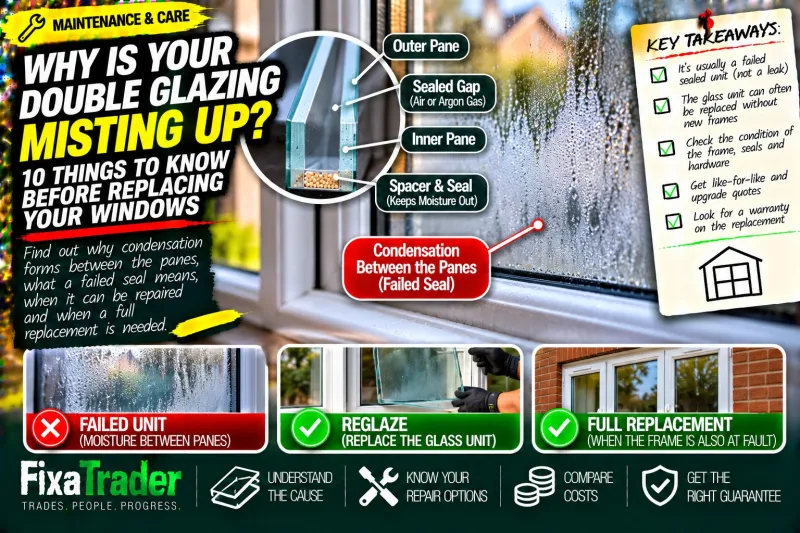
Double-glazed windows typically contain two panes of glass separated by a sealed space.
This assembly is called an insulated glass unit, or IGU.
The gap between the panes is designed to reduce heat transfer compared with a single pane of glass.
Depending on the specification, it may contain air or an insulating gas such as argon.
The unit also includes components such as spacers, seals and materials that help manage moisture within the sealed cavity.
When the unit is functioning correctly, the space between the panes should remain sufficiently dry to prevent persistent internal condensation.
But the seals and other components can deteriorate over time.
If the sealed cavity becomes exposed to moisture, condensation may eventually form between the panes.
Understanding the difference between the glass unit and the surrounding window frame is important because they don't always need replacing together.2. Identify Where the Condensation Is Forming
Not all condensation on double glazing means the window has failed.
There are three main places moisture can appear.
Condensation on the inside surface
This occurs on the glass facing the room.
It is often associated with indoor humidity, ventilation and surface temperature.
You can usually wipe it away.
Condensation on the outside surface
This appears on the external face of the window.
It can occur when the outside glass becomes colder than the surrounding air's dew point.
In some circumstances, external condensation can be a normal feature of well-insulated glazing.
Condensation between the panes
This occurs inside the sealed glass unit.
You generally cannot wipe it away from either side.
Persistent moisture in this location usually indicates that the sealed unit is no longer performing as intended.
Before arranging repairs, establish which surface the moisture is actually on.3. Recognise the Signs of a Failed Sealed Unit
A failed double-glazed unit doesn't always develop heavy condensation immediately.
The earliest signs can be subtle.
You may notice a faint haze that becomes more obvious during certain weather conditions.
Over time, the cloudiness may become persistent.
Common signs include:
Mist or condensation trapped between the panes.
Cloudy patches that cannot be wiped away.
Water droplets inside the sealed cavity.
Staining or marks between the glass surfaces.
A window that appears permanently foggy.
These symptoms strongly suggest a problem with the sealed unit.
However, a professional assessment can help distinguish sealed-unit failure from other glazing defects.
A misted window isn't necessarily structurally dangerous, but it is a sign that the glazing unit may no longer be functioning as designed.4. Understand Why Double-Glazed Seals Fail
The seals around an insulated glass unit are designed to maintain the integrity of the cavity.
Over time, they may deteriorate.
Several factors can contribute to failure.
These include ageing, manufacturing defects, installation problems, environmental exposure and movement affecting the glazing assembly.
Repeated temperature changes can also place stress on materials.
However, it's important not to assume that every failed seal is caused by poor workmanship.
Even correctly manufactured and installed glazing has a finite service life.
Possible contributing factors include:
Natural ageing.
Prolonged weather exposure.
Inadequate installation support.
Excessive movement or stress.
Defective components.
Problems with drainage around the glazing.
The precise cause may not always be identifiable from appearance alone.
A failed unit doesn't automatically mean the original installer did something wrong, but repeated failures deserve investigation.5. Know That the Glass Can Often Be Replaced Separately
This is one of the most important points for homeowners.
A double-glazed window generally consists of several separate components.
These include the frame, opening mechanism, seals and insulated glass unit.
If the frame is sound and the main problem is moisture between the panes, it may be possible to replace only the sealed glass unit.
This is often called sealed-unit replacement or reglazing.
A glazing professional measures the existing opening and orders a suitable replacement unit.
The old unit is removed and the new one installed using appropriate glazing components and methods.
Potential advantages include:
Retaining the existing frame.
Avoiding unnecessary replacement of surrounding finishes.
Less disruption than a complete window replacement.
Potentially lower overall cost.
An opportunity to improve the glazing specification where compatible.
However, not every frame can accommodate every modern glass specification.
Replacing the sealed unit can be a practical solution when the frame remains in good condition.6. Check the Condition of the Window Frame
Replacing the glass won't solve problems caused by a deteriorating frame.
Before deciding on reglazing, inspect the rest of the window.
For example, timber frames may develop rot.
uPVC frames can experience distortion, damaged joints or other deterioration.
Aluminium frames may have problems with seals, drainage or hardware.
Warning signs include:
Difficulty opening or closing the window.
Significant frame movement.
Visible timber decay.
Damaged or distorted sections.
Persistent water ingress around the frame.
Loose or failing glazing components.
Repeated problems with the same opening.
Not every stiff window needs replacing.
Hinges, handles and locking mechanisms can sometimes be repaired.
But if the frame itself has deteriorated substantially, replacing only the glass may offer limited value.
The right decision depends on the condition of the complete window, not just whether the glass has misted.7. Be Careful With Claims About Defogging Repairs
You may encounter services that advertise the removal of condensation from existing double glazing.
Some involve drilling small openings, removing moisture or installing ventilation components.
These methods may improve the appearance of the glass in certain circumstances.
However, they don't necessarily restore the original sealed cavity, insulating gas or thermal performance.
That distinction matters.
A window that looks clearer isn't automatically performing like a newly manufactured insulated glass unit.
Before paying for such a service, ask what is actually being repaired.
Questions worth asking include:
Will the original sealed-unit performance be restored?
Is the repair permanent?
What warranty is offered?
Will insulating gas be replaced?
Is there evidence of the expected thermal performance?
How does the cost compare with replacing the sealed unit?
If the goal is to restore the performance of failed double glazing, replacing the insulated glass unit is generally the more established approach.8. Consider the Effect on Energy Efficiency
Double glazing helps reduce heat transfer through windows.
Its performance depends on several factors, including the glass coating, cavity width, gas fill, spacers and overall design.
When the sealed unit fails, its thermal performance may be affected.
For example, loss of insulating gas or moisture entering the cavity can reduce the unit's effectiveness.
However, the impact on household energy bills varies.
One failed unit in a large property won't necessarily produce an obvious increase in heating costs.
Several failed units may have a more noticeable effect.
It's also important to recognise that the window frame, installation and surrounding building fabric influence overall performance.
Replacing a failed sealed unit can restore the glazing's intended function, but don't assume it will produce a dramatic reduction in energy bills on its own.9. Understand When a Full Window Replacement Makes Sense
Sometimes replacing the entire window is the better long-term option.
This may be the case when the frame is damaged, inefficient or approaching the end of its useful life.
It may also make sense if several components need substantial repairs.
For example, imagine a window with failed glazing, deteriorated seals, damaged hinges and a distorted frame.
Replacing the glass alone could leave several other problems unresolved.
A full replacement may be worth considering when:
The frame is significantly damaged.
Multiple components are failing.
The window is difficult to operate safely.
Water ingress is affecting surrounding materials.
The existing design no longer meets your needs.
You want to upgrade the entire window system.
However, replacing all the windows in a property because one sealed unit has failed may be unnecessary.
The aim should be to replace what needs replacing, not automatically the most expensive component.10. Compare Quotations and Check Guarantees
Before agreeing to work, obtain a clear explanation of what the contractor proposes.
Two quotations may appear similar while covering different work.
One might involve replacing a sealed glass unit.
Another might include a completely new sash or window frame.
A third may propose a cosmetic defogging treatment.
These aren't equivalent services.
Ask the contractor to confirm:
What has failed.
Whether the frame is suitable for reuse.
The exact work included.
The replacement glazing specification.
Whether existing hardware will be retained.
Any required safety glazing.
The guarantee provided.
The expected installation time.
Whether disposal of the old unit is included.
Where complete replacement windows are being installed, applicable Building Regulations and certification requirements should also be considered.
In England, relevant replacement window work may be handled through building control or an authorised competent person scheme, depending on the circumstances.
A good quotation should make it clear exactly what you're buying and why that solution is appropriate.Can You Fix Misted Double Glazing Yourself?
Cleaning the glass won't remove condensation trapped inside a failed sealed unit.
The moisture is within the glazing assembly, not on an accessible surface.
Attempting to drill, dismantle or modify the unit yourself can create safety risks and may damage the glass.
Glazing can also be heavy and difficult to handle safely.
Certain locations require safety glass, and replacement units must be correctly specified and installed.
For persistent condensation between panes, professional assessment and replacement are generally preferable to attempting a DIY repair.How Long Should Double Glazing Last?
There isn't one guaranteed lifespan for every double-glazed window.
Performance depends on the quality of the product, installation, exposure and maintenance.
The sealed glass unit and the surrounding frame may also have different service lives.
A sound frame may remain usable after its original glazing unit fails.
Equally, a damaged frame may need replacing even if the glass itself is still clear.
Manufacturer warranties can provide useful information, but they vary in duration and coverage.
Rather than assuming a window must be replaced after a particular number of years, assess its actual condition and performance.Does Misted Double Glazing Mean Water Is Leaking Into Your Home?
Not necessarily.
Moisture trapped between the panes usually indicates a problem within the insulated glass unit.
That is different from rainwater entering the room around the frame.
However, the two problems can occur together.
If you notice wet plaster, damp window reveals, water on the sill or damage around the frame, investigate the source separately.
Potential causes may include defective external seals, drainage problems, installation defects or surrounding building issues.
Condensation between the panes and water entering the property are different symptoms that may require different repairs.Can You Replace Just One Pane of Double Glazing?
A standard double-glazed sealed unit is manufactured as an assembly.
If one pane is damaged or the sealed cavity has failed, the usual solution is to replace the complete insulated glass unit rather than replacing one individual pane while retaining the original seal.
This doesn't necessarily mean replacing the entire window.
The surrounding frame can often remain in place.
When a glazier says the glass needs replacing, ask whether they mean the sealed unit or the complete window assembly.
That distinction can make a substantial difference to the quotation.Is It Worth Upgrading the Glass When Replacing a Failed Unit?
Potentially.
If you're already replacing a sealed unit, it may be worth asking whether a more efficient specification is compatible with the existing frame.
Options can include different low-emissivity coatings, gas fills and spacer systems.
However, the replacement must suit the frame, glazing thickness, safety requirements and relevant standards.
Some upgrades may not be practical without changing other components.
Also consider the likely benefit.
A modest improvement in one window may not justify a substantial price increase.
Ask for a clear comparison between a like-for-like replacement and any proposed upgrade before deciding.How Much Does It Cost to Replace Misted Double Glazing?
Costs vary according to the size and specification of the glass, accessibility and the work required.
For example, replacing a small, accessible sealed unit may be substantially simpler than replacing a large glazed panel at height.
Factors affecting the price include:
Glass dimensions.
Unit thickness.
Toughened or laminated safety glass requirements.
Decorative or specialist glazing.
Accessibility.
Labour.
Glazing beads and seals.
Disposal of the old unit.
Any additional frame repairs.
A full window replacement generally involves more components and labour than replacing a sealed unit alone.
However, the most economical option depends on the condition of the existing window.
Compare quotations based on the same scope of work rather than relying on headline prices.Five Questions to Ask Before Replacing Misted Double Glazing
Before agreeing to repairs, ask:
Is the condensation definitely between the panes? Surface condensation may have a different cause.
Has the sealed glass unit failed? Establish the actual problem.
Is the existing frame still in good condition? A sound frame may be reusable.
Can the sealed unit be replaced separately? This may avoid unnecessary work.
What guarantee comes with the replacement? Understand the coverage and exclusions.
These questions can help you make a more informed decision.The Bottom Line: Misted Glass Doesn't Always Mean You Need New Windows
Condensation between double-glazed panes is a common sign that an insulated glass unit has failed.
It can affect visibility, appearance and the intended thermal performance of the glazing.
But it doesn't automatically mean the entire window needs replacing.
If the frame remains sound, replacing the sealed glass unit may be a practical and cost-effective solution.
If the frame or other components are also deteriorating, a complete replacement may offer better long-term value.
The important thing is to establish what has actually failed.
Don't confuse ordinary surface condensation with moisture trapped inside the glazing.
Don't assume that cosmetic defogging restores the original insulating performance.
And don't agree to replace an entire window without understanding whether a more targeted repair is possible.
Sometimes the best home improvement decision isn't replacing everything. It's identifying the failed component and fixing the problem properly.Useful UK Guidance