Does Your House Need Repointing? 10 Signs Your Brickwork and Mortar Need Attention
Brick walls can look almost permanent. They're solid, heavy and capable of surviving decades of British weather. But look closely at an older brick property and...
They're solid, heavy and capable of surviving decades of British weather.
But look closely at an older brick property and the bricks themselves aren't necessarily the first thing showing their age.
Often, it's the material between them.
The mortar.
Mortar joints help bind masonry together while protecting the edges and spaces between individual bricks or blocks.
Over time they can deteriorate.
Rain.
Frost.
Wind.
Previous repairs.
Movement.
And simple age can all leave their mark.
At first, the changes may look cosmetic.
A few crumbly joints.
A small crack.
One patch where the mortar seems slightly recessed.
But deteriorated pointing can eventually allow greater exposure to moisture and contribute to problems with the surrounding masonry.
That doesn't mean every imperfect mortar joint requires the whole house to be repointed.
The important thing is recognising what you're actually looking at.
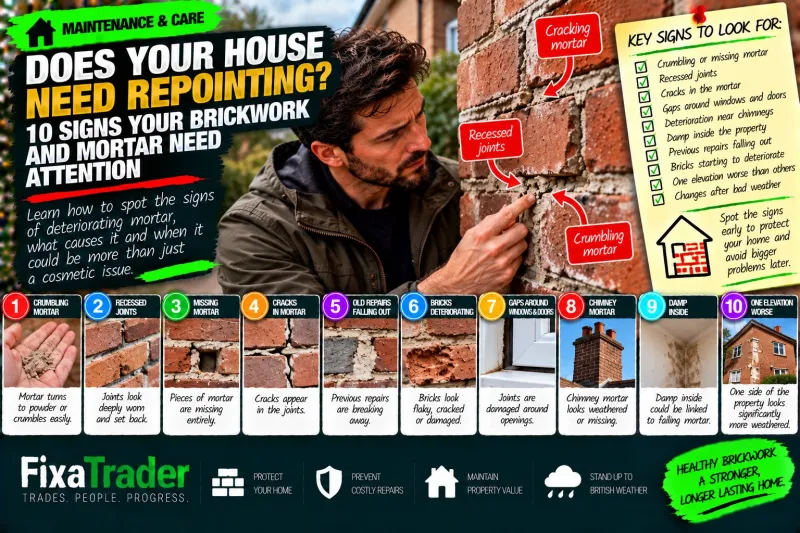
Here are 10 signs worth checking.1. The Mortar Is Crumbling When You Touch It
Healthy mortar shouldn't simply turn to loose powder under light contact.
If accessible joints appear particularly soft, sandy or crumbly, deterioration may be taking place.
You might notice material collecting:
On window sills.
At the bottom of walls.
On paths immediately beside the property.
Or underneath particularly exposed sections of brickwork.
Don't start aggressively scraping joints to test them.
You can damage otherwise serviceable mortar and make the problem worse.
Instead, look for areas where deterioration is already visible.
If the surface is naturally breaking away, that's worth investigating.2. The Joints Have Become Deeply Recessed
Mortar doesn't always fail dramatically.
Sometimes it gradually erodes.
The face of the mortar becomes further and further recessed behind the brick.
Compare different parts of the wall.
You may find sheltered areas where the joints remain relatively full while exposed elevations have noticeably worn back.
Particularly vulnerable locations can include walls exposed to persistent wind and rain.
Once joints have significantly deteriorated, water can sit or penetrate further into areas that were previously protected.
The question isn't whether every joint is perfectly flush.
Different buildings and pointing styles legitimately have different joint profiles.
You're looking for deterioration from the original condition, rather than judging every recessed joint as defective.3. Pieces of Mortar Are Missing Entirely
Small isolated gaps can appear for various reasons.
But widespread missing mortar deserves attention.
Look particularly around:
Window openings.
Doorways.
Corners.
Parapets.
Chimneys.
Low-level brickwork.
And highly exposed elevations.
A few isolated damaged joints may only require local repair.
If deterioration extends across a large proportion of the elevation, broader repointing may be more appropriate.
This is one reason inspecting the whole wall matters.
A close-up photograph of one joint doesn't tell you what's happening across the building.4. Cracks Are Appearing Through the Mortar
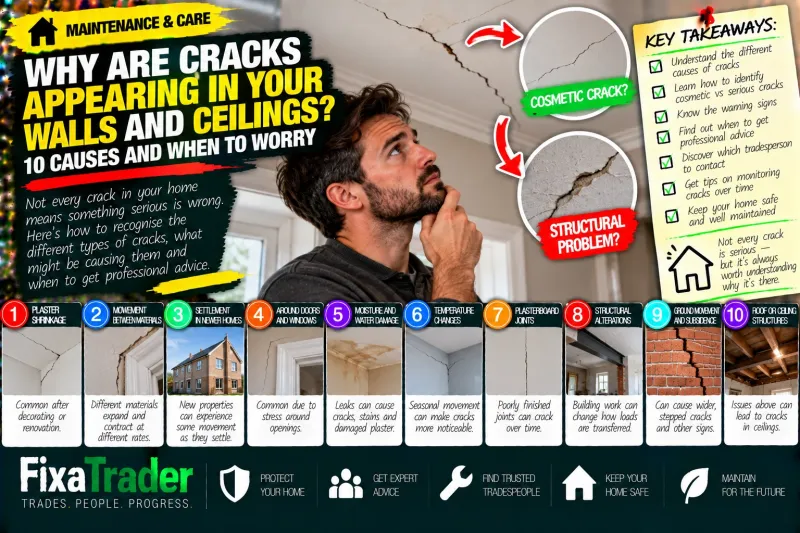
Not every crack means structural movement.
Mortar can crack because of:
Thermal movement.
Shrinkage.
Weathering.
Previous poor repairs.
Localised movement.
Or deterioration around openings.
But the pattern matters.
A small isolated surface crack is different from a pronounced stepped crack running through multiple mortar joints.
If cracking appears to be:
Growing.
Repeated.
Wide.
Associated with distorted openings.
Accompanied by displaced brickwork.
Or affecting other parts of the building,
it may need investigation beyond simply filling the mortar.
Repointing the visible crack doesn't solve an underlying movement problem.5. Previous Repairs Are Falling Out
Older properties often contain generations of repairs.
You may see several different mortar colours across the same wall where individual areas have been patched over time.
If those repairs are:
Cracking.
Separating from the surrounding masonry.
Falling out.
Or deteriorating much faster than the original mortar,
the repair material or technique may not have been suitable for the wall.
This becomes particularly important on traditional buildings.
The characteristics of the mortar need to be compatible with the masonry.
Simply choosing the strongest-looking modern product isn't automatically the right approach.6. The Bricks Are Starting to Deteriorate Around the Joints
Sometimes the problem appears to be mortar—but the brick faces are suffering too.
Look for:
Flaking.
Spalling.
Cracking.
Broken edges.
Or surfaces breaking away.
Moisture, frost and inappropriate previous repairs can all contribute to masonry deterioration.
If the bricks themselves are damaged, repointing alone may not address everything.
Individual bricks may need assessment and, in some situations, replacement.
More importantly, you want to understand why they're deteriorating.
Otherwise new pointing can leave the underlying cause untouched.7. You Can See Gaps Around Windows and Doors
Pay attention where masonry meets:
Window frames.
Door frames.
Sills.
Lintels.
And other openings.
These areas contain different materials meeting each other and can be particularly susceptible to movement and weather exposure.
A deteriorated joint beside a window isn't necessarily part of the general pointing.
Some junctions require appropriate flexible sealing rather than ordinary mortar.
That's why identifying the type of joint matters before repairing it.
Filling every gap around a property with the same material isn't good maintenance.8. The Chimney Mortar Looks Particularly Weathered
Chimneys live in a harsh environment.
They're exposed on multiple sides.
They're high above much of the surrounding building.
And they receive plenty of:
Wind.
Rain.
Temperature change.
And frost.
From ground level, look for obvious signs such as:
Missing joints.
Loose-looking masonry.
Cracked mortar.
Deteriorated haunching or other visible defects around the chimney structure.
But don't climb onto the roof to investigate it yourself.
If the chimney needs close inspection, use someone with the appropriate access equipment and experience.
Small defects at roof level can be difficult to judge accurately from the garden.9. Damp Appears on the Inside of an External Wall
Damp has many possible causes.
Deteriorated pointing is only one of them.
Internal moisture could relate to:
Condensation.
Plumbing.
Roof defects.
Gutters.
Downpipes.
Window details.
Ground levels.
External render.
Cavity issues.
Or other building defects.
But if damp appears after prolonged wind-driven rain on a wall where the external mortar is visibly deteriorated, the condition of the masonry deserves investigation.
Don't jump straight from:
“There's damp inside.”
to:
“The whole house needs repointing.”
The source should be identified first.10. One Elevation Looks Much Worse Than the Others
This is an extremely useful clue.
Walk around the property.
Does one side look significantly more weathered?
Perhaps the front elevation is fine while the side wall has badly eroded joints.
Or the upper storey is considerably worse than the sheltered brickwork below.
Buildings aren't exposed evenly.
Orientation, neighbouring properties, trees, roof overhangs and prevailing weather can all affect how much exposure a wall receives.
This can mean the property doesn't necessarily need complete repointing.
The repair may be concentrated in the most affected areas.What Does Repointing Actually Involve?
Repointing isn't simply spreading fresh mortar over the surface of old joints.
Proper repointing generally involves removing deteriorated mortar to an appropriate depth and replacing it with suitable new mortar.
The details matter.
The existing masonry needs to be considered.
The mortar needs to be appropriate.
The joints need to be prepared correctly.
And the finished profile should suit the building.
Smearing a thin layer of new mortar over failing material may make the wall look better temporarily without creating a durable repair.
If the material underneath is loose, the new surface has little sound material to rely on.Does the Whole House Need Repointing?
Not necessarily.
This is one of the biggest assumptions homeowners make.
If most of the pointing remains sound and only certain areas have deteriorated, localised repointing may be sufficient.
Other properties genuinely have widespread deterioration and may benefit from larger-scale work.
Assess:
How much of the wall is affected?
How deep is the deterioration?
Are several elevations involved?
Is the mortar failing consistently?
Are bricks also damaged?
What caused the deterioration?
The answer should come from the condition of the building rather than automatically choosing the largest possible job.Why Mortar Compatibility Matters
Mortar isn't simply glue between bricks.
Its properties influence how the wall behaves.
This is particularly important with older and traditional masonry.
Historic buildings may have been constructed using lime-based mortars that behave differently from harder modern cement-rich mixes.
Using an inappropriate mortar can potentially create problems.
For example, if a repair mortar is substantially harder or less permeable than the surrounding masonry, moisture and weathering may affect the bricks differently.
This doesn't mean:
“Old house = use this one particular mortar.”
Traditional buildings vary considerably.
It means the existing construction should be understood before specifying the repair.
For older, listed or historically significant properties, specialist knowledge may be particularly important.Can You Repoint Over Old Mortar?
Simply covering the face of failing mortar with a thin new layer is generally not the same as properly renewing the joint.
If the existing surface is loose or deteriorated, it needs appropriate preparation.
Otherwise the new material may:
Crack.
Separate.
Fall away.
Or hide deterioration without actually addressing it.
A neat-looking surface isn't necessarily evidence of a sound repair.Does Repointing Stop Damp?
Sometimes deteriorated external masonry can contribute to rain penetration.
But repointing is not a universal damp treatment.
If moisture inside the property is caused by:
A leaking gutter.
Defective roof.
Plumbing leak.
Condensation.
Poor ventilation.
Faulty window detail.
Or another problem,
repointing unrelated brickwork won't solve it.
Diagnose the moisture source before commissioning large amounts of work.Look Up Before Hiring Anyone
Homeowners naturally inspect walls at eye level.
But deterioration may be worse higher up.
From a safe position on the ground, look at:
Upper-storey brickwork.
Areas beneath gutters.
Around roof junctions.
Chimneys.
Parapets.
And other exposed sections.
Binoculars or a camera with zoom can sometimes help with a preliminary visual check.
Don't climb ladders or access roofs purely to investigate pointing unless you have the appropriate equipment, skills and safe working arrangements.
A professional survey may require scaffolding, a tower or another suitable access method.Access Can Be a Significant Part of the Cost
Repointing costs aren't determined only by the number of square metres of brickwork.
Consider what is required to safely reach it.
Ground-floor wall?
Very different from a three-storey elevation.
Chimney?
Different again.
Other cost factors can include:
Extent of mortar removal.
Condition of the masonry.
Mortar type.
Brick repairs.
Architectural detailing.
Protection of windows and surrounding surfaces.
Waste.
Scaffolding.
Location.
And finishing requirements.
That's why two apparently similar houses can receive very different quotations.Ask What the Quote Actually Includes
When comparing repointing quotations, check the scope.
Ask:
Which elevations are included?
Is it full or localised repointing?
How will existing mortar be removed?
What mortar is proposed?
Why is that mortar appropriate?
What joint finish will be used?
Are damaged bricks included?
Is scaffolding included?
How will windows, paths and surrounding areas be protected?
How will debris be managed?
Will the brickwork be cleaned afterwards if necessary?
The cheapest price may simply contain less work.
Compare scope before comparing totals.Be Cautious With Aggressive Mortar Removal
Removing old mortar is part of repointing, but the surrounding masonry shouldn't be unnecessarily damaged in the process.
Poor technique can damage brick edges and alter the appearance of the wall.
This can be particularly problematic with softer or historic masonry.
If you're hiring someone for a substantial repointing project, ask how they intend to remove the existing mortar and whether their approach is appropriate for your type of brickwork.Don't Judge New Mortar Colour Immediately
Fresh mortar can look dramatically different from older surrounding joints.
It may initially appear:
Darker.
Lighter.
More uniform.
Or simply much newer.
Its appearance can change as it cures and dries.
If matching existing masonry matters—particularly on visible elevations—discuss the expected finished colour and texture beforehand.
For patch repairs, compatibility isn't only technical.
Appearance matters too.
A perfectly functional bright-grey rectangle in the middle of an otherwise warm traditional brick wall may not be the finish you expected.Check Whether Other Work Should Happen First
Before repointing, look for problems that could immediately expose the repaired wall to more water.
For example:
Leaking gutters.
Defective downpipes.
Roof drainage issues.
Broken copings.
Damaged flashing.
Or overflowing drainage.
If a gutter has been pouring water down the same section of wall for years, repairing the pointing while leaving the gutter defective is addressing the consequence before the cause.
Fix the water-management problem as part of the overall plan.Timing and Weather Matter
Mortar needs suitable conditions to cure properly.
Extremes of temperature and weather can affect masonry work.
The contractor should plan around the conditions and protect fresh work where necessary.
This is another reason repointing an entire property isn't simply a matter of:
“How quickly can someone rake it out and fill it back in?”
The quality of preparation, application and curing all contribute to the result.When Should You Get the Brickwork Looked At?
Consider professional assessment if you notice:
Widespread missing mortar.
Deeply eroded joints.
Loose bricks.
Significant cracking.
Brick faces deteriorating.
Problems around a chimney or high-level masonry.
Repeated internal damp associated with an exposed wall.
Or deterioration that appears to be getting noticeably worse.
If there are signs suggesting structural movement—such as significant progressive cracking, distortion or displacement—the appropriate next step may involve someone able to assess the structural issue rather than treating it simply as a repointing job.Make Brickwork Part of Your Annual Exterior Check
You don't need to inspect every mortar joint with a magnifying glass.
Once or twice a year, walk around the outside of the property and look for changes.
Pay particular attention after winter or prolonged periods of severe weather.
Look at:
Mortar.
Bricks.
Gutters.
Downpipes.
Roof edges.
Window junctions.
Doors.
External cracks.
And areas where water regularly collects.
Take photographs of anything you're unsure about.
If you inspect the same area six months later, you'll have something to compare it with.
That makes it much easier to distinguish an old stable imperfection from something actively deteriorating.Mortar Is Supposed to Be There for a Reason
Pointing is easy to overlook because it isn't usually the part of a brick house people admire.
You notice the brick colour.
The windows.
The roof.
The front door.
Not thousands of small mortar joints.
But those joints are part of the wall's weather protection and overall performance.
The aim isn't to make every old wall look brand new.
Older masonry naturally develops character and variation.
The aim is to recognise when normal ageing has become genuine deterioration and repair it appropriately before greater damage develops.
If the mortar between your bricks is disappearing, don't just look at the gap—look at why it's happening, how much of the wall is affected and whether the repair being proposed is actually suitable for the building.
0 Comments
No comments yet — be the first to share your thoughts.