Is Your House Render Failing? 10 Warning Signs and When It Needs Repairing
From the street, your home's exterior might look perfectly fine. But take a closer look and you may notice a thin crack running across the wall. Perhaps the ren...
From the street, your home's exterior might look perfectly fine.
But take a closer look and you may notice a thin crack running across the wall.
Perhaps the render has started bubbling near the ground.
Or there's a patch that sounds hollow when tapped.
It's tempting to dismiss these changes as normal ageing, particularly if the rest of the wall still looks presentable.
However, exterior render does more than improve the appearance of a property.
Depending on the wall construction and render system, it can help protect the underlying surface from weather exposure while forming part of the building's moisture-management system.
When render begins to deteriorate, the consequences can extend beyond appearance.
Water may enter through defects, sections may become detached and underlying problems can remain hidden.
The important question isn't simply whether the render looks damaged. It's why the damage has appeared and whether the underlying wall is being affected.
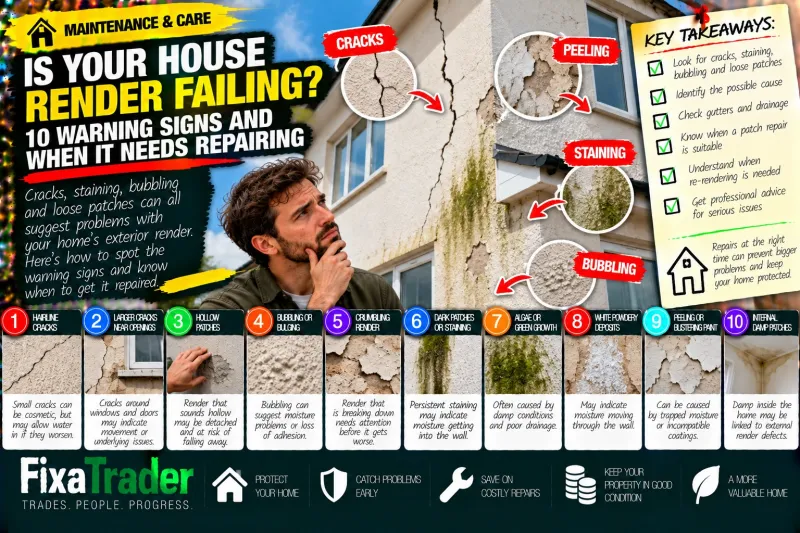
Here are ten warning signs worth investigating.1. Hairline Cracks Are Appearing Across the Surface
Small cracks are among the most common defects homeowners notice in rendered walls.
They may appear as fine lines, sometimes forming a network across the surface.
Possible causes include:
Shrinkage as materials dry.
Thermal expansion and contraction.
Minor movement in the underlying structure.
Poor preparation or application.
Incompatibility between the render and substrate.
Not every hairline crack indicates a serious problem.
Some are superficial and may be addressed through an appropriate repair system.
However, cracks can provide pathways for moisture, particularly on exposed elevations.
Pay attention to whether they are widening, spreading or repeatedly returning after repairs.
A crack that continues to develop deserves more investigation than one that remains stable.2. Larger Cracks Are Developing Around Windows and Doors
Cracks near window corners, door openings and other changes in wall geometry can be particularly noticeable.
These areas may experience concentrated stresses.
Sometimes the issue is limited to the render.
In other cases, cracking reflects movement in the underlying masonry or structural elements.
Warning signs that deserve further assessment include:
Cracks that continue through the masonry.
Openings that become difficult to operate.
Distortion around window or door frames.
Cracks that progressively widen.
Similar cracking visible inside the property.
Don't assume that covering the crack with fresh render will solve the cause.
If underlying movement is suspected, an appropriate building professional may need to investigate before cosmetic repairs begin.3. Sections of Render Sound Hollow
Render should remain adequately bonded to its supporting surface.
If that bond deteriorates, sections can become detached while still appearing relatively intact.
This is sometimes described as blown render.
A hollow sound when a professional lightly taps an accessible area may suggest that the render has separated from the substrate.
Possible causes include moisture, inadequate preparation, movement or unsuitable materials.
Detached render may eventually crack or fall away.
This is especially concerning above entrances, footpaths and areas where people regularly walk.
Don't strike, pull or disturb loose render yourself, particularly at height.
If a section appears unstable, keep people away from the affected area and arrange an assessment.4. The Surface Is Bubbling or Bulging
Bubbling, swelling or bulging can indicate that the render is losing adhesion or that moisture is affecting the wall.
You might notice a raised patch that wasn't there previously.
Alternatively, a previously flat surface may appear distorted.
Potential causes include:
Moisture trapped behind the finish.
Poor adhesion.
Incompatible coatings.
Water entering through cracks or junctions.
Deterioration of the underlying surface.
The correct repair depends on the cause and the type of render.
Simply smoothing over the bulge or applying another coating may conceal the problem without addressing it.
A professional may need to remove a small affected section to establish what's happening underneath.5. Render Is Crumbling or Falling Away
Render that breaks down into loose particles or falls from the wall is no longer performing as intended in the affected area.
You might notice fragments accumulating near the base of the property.
Corners and exposed edges can be particularly vulnerable.
Possible explanations include prolonged weathering, repeated moisture exposure, frost damage or an unsuitable render specification.
The age of the finish may also be relevant.
However, deterioration shouldn't automatically be attributed to age alone.
If relatively new render is crumbling, workmanship, substrate preparation or material compatibility may need investigation.
Loose material above ground level should be treated as a potential falling-debris hazard.6. Dark Patches or Persistent Staining Are Appearing
Exterior walls naturally become wet during rainfall.
The important distinction is how they dry afterwards.
If one section remains noticeably darker than surrounding areas long after the rain has stopped, moisture may be accumulating or drying more slowly.
Possible sources include:
Leaking gutters.
Defective downpipes.
Poorly sealed wall penetrations.
Cracked render.
Faulty flashings.
Water collecting at the base of the wall.
The staining pattern can provide useful clues.
For example, a vertical mark beneath a gutter joint may suggest water is escaping from the rainwater system.
Before repairing the render, investigate whether another building defect is responsible.
Fixing the water source is often more important than covering the visible stain.7. Green Growth or Algae Keeps Returning
Green or dark biological growth on render can be unsightly.
It commonly develops where surfaces remain damp and receive limited sunlight.
North-facing walls, shaded elevations and areas close to vegetation may be more susceptible.
Algae doesn't automatically mean the render has failed.
However, persistent growth can indicate conditions that encourage prolonged surface moisture.
Look for contributing factors such as overhanging vegetation, poor drainage or leaking gutters.
Cleaning methods should suit the render system.
Aggressive pressure washing can damage certain finishes, force water into defects or remove protective coatings.
Always follow the manufacturer's maintenance guidance where available.8. White Powdery Deposits Are Appearing
White crystalline deposits on masonry or rendered surfaces may be efflorescence.
This can occur when moisture transports soluble salts through a material and leaves them behind as the water evaporates.
The deposits themselves don't necessarily indicate structural damage.
But they may suggest that moisture is moving through the wall.
Possible contributing factors include recent construction moisture, water penetration or ground-related moisture.
The significance depends on the wall construction, materials and surrounding conditions.
Avoid repeatedly applying coatings without understanding why the deposits are forming.
If they return after cleaning, further investigation may be worthwhile.9. Paint Is Peeling or Blistering on Rendered Walls
Sometimes the render remains intact while its decorative coating begins to fail.
You may notice paint flaking, blistering or separating from the surface.
This can happen because of poor preparation, weather exposure or incompatible coatings.
Moisture trapped behind a relatively impermeable finish may also contribute.
The distinction matters because repainting alone won't correct every problem.
Older solid-wall properties can be particularly sensitive to inappropriate combinations of render and paint.
Materials that restrict drying may worsen existing moisture issues in some constructions.
Before repainting, establish whether the problem is limited to the coating or involves the render and wall beneath it.10. Damp Patches Are Appearing Inside the Property
One of the more concerning situations is when exterior render defects coincide with internal dampness.
For example, you might notice a damp patch on an internal wall after periods of wind-driven rain.
However, the render isn't necessarily responsible.
Internal moisture can result from several different causes, including condensation, plumbing leaks and defects elsewhere in the building envelope.
The location and timing of the dampness matter.
If the affected internal area corresponds with damaged render outside, that connection is worth investigating.
But avoid assuming the cause without a proper assessment.
A reliable diagnosis should consider the whole wall and surrounding building details, not just the visible render.Why Does Exterior Render Fail?
Render can deteriorate for several reasons, often involving more than one factor.
Moisture exposure
Water entering through defects or becoming trapped behind unsuitable coatings can contribute to deterioration.
Movement
Buildings and materials expand, contract and move. Render needs to accommodate the conditions for which it was designed.
Poor preparation
An inadequately prepared or unsuitable substrate can prevent proper adhesion.
Incorrect materials
A render system that is too rigid, too impermeable or otherwise incompatible with the underlying wall may develop problems.
Application conditions
Temperature, moisture and curing conditions can affect the finished result.
Age and weathering
Repeated exposure to rain, frost, sunlight and temperature changes can gradually affect performance.
Understanding the cause helps determine whether a local repair is likely to last.Can Damaged Render Be Patched?
Yes, some defects can be repaired locally.
However, the suitability of patch repairs depends on the render system, extent of deterioration and condition of the substrate.
A small isolated defect may be straightforward to address.
But widespread cracking, poor adhesion or recurring moisture problems can indicate that more extensive work is required.
Matching the existing finish may also be difficult.
Even a technically sound repair can remain visible because of differences in texture, colour or weathering.
For proprietary systems, including some silicone and external wall insulation finishes, manufacturer-approved repair methods may be necessary.
A patch is only worthwhile if the surrounding render is sound enough to support a lasting repair.When Does a Whole Wall Need Re-Rendering?
A complete replacement may be considered where deterioration is widespread or the existing system is fundamentally unsuitable.
Examples include extensive loss of adhesion, repeated failure across large areas or serious incompatibility with the underlying wall.
But replacing all the render shouldn't be the automatic recommendation.
If most of the surface is sound, targeted repairs may be sufficient.
The decision should consider:
The proportion of the wall affected.
The cause of the deterioration.
The condition of the underlying masonry.
The type of existing render.
Moisture-management requirements.
Access and scaffolding costs.
The likely durability of local repairs.
Where extensive work is proposed, ask the contractor to explain why repair isn't considered appropriate.Is Silicone Render Better Than Traditional Render?
Different render systems have different properties and intended applications.
Silicone-based finishes are often selected for their water-repellent characteristics and appearance.
Traditional lime-based renders may be appropriate for certain older buildings because of their compatibility with historic masonry and moisture movement.
Cement-based and other proprietary systems have their own uses and limitations.
No single render type is automatically best for every property.
The correct specification depends on the wall construction, exposure, substrate and overall system design.
Using an unsuitable product can create problems even when the workmanship appears good.What Should Homeowners Check Before Hiring a Renderer?
Before agreeing to significant repair or replacement work, establish what the contractor intends to do.
Useful questions include:
What is causing the existing render to fail?
Is the underlying wall sound?
Can the affected areas be repaired locally?
What render system is being proposed, and why?
How will cracks, junctions and openings be treated?
Will existing damp or drainage problems need correcting first?
What preparation and removal work is included?
Are scaffolding, waste removal and finishing included in the quotation?
What maintenance will the new finish require?
Are any planning, building regulation or conservation restrictions relevant?
If the property is listed or located in a conservation area, additional permissions or restrictions may apply.
External wall insulation and other substantial alterations may also involve building regulations requirements.
Clarify these matters before work begins.How Often Should You Inspect Your Render?
You don't need to inspect every centimetre of your exterior walls each week.
But a visual check once or twice a year, and after particularly severe weather, can help identify developing problems.
Look from ground level for new cracks, loose sections, staining and areas that aren't drying normally.
Pay particular attention to locations beneath gutters, around openings and near the base of the wall.
Take photographs of suspicious areas so you can compare them over time.
Don't climb ladders or approach unstable sections to investigate.
If an area is difficult to inspect safely, arrange professional assistance.The Bottom Line: Repair the Cause, Not Just the Appearance
Exterior render can deteriorate gradually, making it easy to overlook the early signs.
A small crack might remain cosmetic.
A dark patch could simply reflect a shaded, slow-drying wall.
But repeated cracking, hollow sections, bulging and persistent moisture deserve closer attention.
The key is establishing whether the problem is superficial or connected to a wider defect.
A suitable local repair may be all that's required.
In other cases, correcting drainage, repairing the underlying wall or replacing an unsuitable render system may be necessary.
Good render maintenance isn't about keeping every wall looking brand new. It's about recognising when a change matters and dealing with the underlying problem before it becomes more expensive.
0 Comments
No comments yet — be the first to share your thoughts.