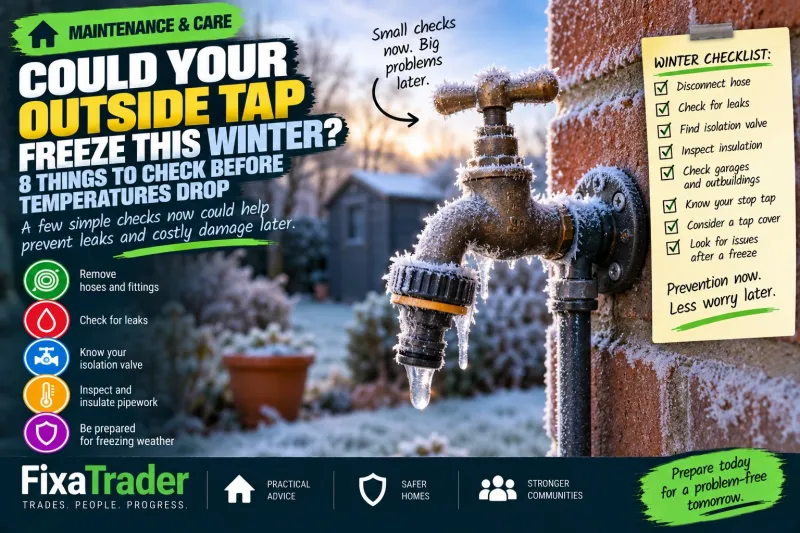
Could Your Outside Tap Freeze This Winter? 8 Things to Check Before Temperatures Drop
During summer, the outside tap gets plenty of attention. It's used for watering the garden, filling paddling pools, washing cars and connecting hoses. Then autu...
During summer, the outside tap gets plenty of attention.
It's used for watering the garden, filling paddling pools, washing cars and connecting hoses.
Then autumn arrives.
The hose gets left in the garden.
The tap is forgotten.
And eventually the temperature falls below freezing.
That's when something as ordinary as an outside tap can potentially become a much bigger problem.
Water expands when it freezes. If water becomes trapped inside vulnerable pipework or fittings, the pressure created can damage them.
Sometimes the problem becomes obvious immediately.
Other times, you don't discover it until temperatures rise again and the ice thaws.
Before colder weather arrives, here are eight things worth checking.1. Disconnect the Garden Hose
This is probably the easiest place to start.
If a hose remains permanently attached to an outside tap, water can remain trapped within the hose and fittings.
Once you're no longer regularly using it, disconnect it.
Drain the water from the hose before storing it somewhere appropriate for winter.
Also remove accessories such as:
Spray guns.
Splitters.
Timers.
Connectors.
And irrigation attachments where appropriate.
It takes a couple of minutes and gives you an opportunity to inspect the tap itself.2. Check Whether the Tap Already Drips
A small drip may not seem urgent during warmer weather.
But it's worth dealing with before winter.
Look for water escaping from:
The spout.
Handle or spindle area.
Connections.
Pipework leading to the tap.
Or the wall around the installation.
A dripping tap also continually introduces fresh water into an area you're trying to protect from freezing.
Don't wait until January to investigate something you could already see in September or October.3. Find Out Whether You Can Isolate the Outside Tap
Some outside taps have an internal isolation valve on the pipe supplying them.
If yours does, it's useful to know:
Where it is.
Whether it's accessible.
And whether it actually operates.
Depending on how the installation is designed, isolating the supply and appropriately draining the external section may form part of winter preparation.
But don't randomly operate valves if you don't understand what they control.
If you're unsure how your outside tap is supplied, a plumber can identify the arrangement.
The important thing is not discovering for the first time where the isolation valve is after a pipe has started leaking.4. Look for Exposed Pipework
The tap itself isn't necessarily the only vulnerable part.
Look at the pipe feeding it.
Does pipework run externally along the wall?
Through an unheated garage?
Inside a shed?
Under a suspended floor?
Or through another particularly cold area?
Pipework in unheated spaces can be more exposed to low temperatures than pipes running through the heated parts of the home.
Appropriate insulation may help reduce the risk, depending on the installation.
But insulation isn't magic.
Poorly positioned pipework or particularly exposed installations may need more than simply wrapping something around the pipe.5. Check Existing Pipe Insulation
Already insulated?
Don't automatically assume the job is done.
Insulation can deteriorate.
Sections can become loose.
Animals can damage it.
Previous work may have disturbed it.
Some sections may never have been covered properly in the first place.
Look for obvious gaps or damage in accessible areas.
Pay particular attention around fittings, bends and transitions where coverage can sometimes be incomplete.
And use products suitable for the particular location and application rather than improvising with whatever happens to be in the garage.6. Don't Forget Garages, Lofts and Outbuildings
Frozen pipes aren't exclusively an outdoor problem.
Parts of the plumbing system can pass through areas of the property that receive little or no heating.
Garages.
Lofts.
Utility spaces.
Outbuildings.
And other cold areas may contain pipework worth checking.
This becomes particularly important if you've previously experienced freezing in one part of the property.
If you know an area gets extremely cold every winter, don't wait for the same problem to repeat before considering whether the pipework is adequately protected.7. Know Where Your Main Stop Tap Is
Every homeowner should ideally know how to shut off their water supply in an emergency.
Not just because of winter.
A pipe can leak at any time.
Find the internal stop tap or appropriate main isolation control for your property and make sure household members know where it is.
Don't bury it behind storage until it's impossible to reach.
If you discover that a valve is inaccessible, seized or you aren't confident which control isolates the property, that's worth resolving before an emergency.
When water is escaping, the last thing you want to be doing is searching the internet for:
“Where is my stop tap?”8. Pay Attention After a Freeze
Suppose you've had several very cold nights.
The weather warms again.
That's a good time to remain alert.
A frozen pipe may have been damaged while frozen, but escaping water can become much more obvious as the ice thaws.
Look and listen for anything unusual.
Reduced water flow.
Visible dripping.
Water staining.
Unexpected dampness.
Sounds of running water when outlets are closed.
Or unexplained water appearing around the affected area.
If you suspect a pipe has been damaged, isolate the supply where appropriate and get the problem assessed.What If the Outside Tap Freezes?
Don't attack it with a naked flame.
And don't use improvised high-temperature methods that could damage pipework, fittings or surrounding materials.
If you suspect a frozen section, first consider whether there's any sign the pipe has already split or been damaged.
The appropriate response depends on the location, material and installation.
If you're uncertain—or the frozen pipe is inaccessible—getting a plumber involved is safer than experimenting with something you don't fully understand.Are Outside Tap Covers Worth Using?
Insulated tap covers are commonly used as an additional layer of protection for exposed taps.
They can be useful, particularly where the fitting is vulnerable to cold weather.
But don't treat a cover as a guarantee that the entire installation can't freeze.
The pipe behind the tap matters too.
So does whether water remains trapped in vulnerable sections.
Think of a cover as one part of winter preparation, not a substitute for checking the plumbing arrangement.What About Properties Left Empty?
A home that's occupied and regularly heated behaves differently from one left empty for an extended period during winter.
If you're going away, own an empty property or manage a property that will be unoccupied, think about the plumbing before cold weather.
Heating settings, water isolation and winter preparation depend on the property and its systems.
Insurance policies may also contain conditions relating to properties left unoccupied, so check the requirements of your own cover rather than assuming one approach applies everywhere.Don't Ignore a Pipe That Froze Last Winter
If the same pipe freezes repeatedly, the freeze itself is telling you something.
Perhaps the insulation is inadequate.
Perhaps the location is unusually exposed.
Perhaps cold air is reaching the pipe.
Or the installation would benefit from alteration.
Thawing it every winter treats the event.
It doesn't necessarily address why that section keeps freezing.
Repeated problems are worth investigating properly.Five Minutes Now Is Better Than an Emergency Later
Preparing for winter doesn't have to mean turning your home into a major project.
Start with the obvious:
Disconnect the hose.
Check the outside tap.
Look at exposed pipes.
Inspect existing insulation.
Find your isolation valves.
Then deal with anything that doesn't look right while the weather is still relatively mild.
Most homeowners will hopefully get through winter without ever having to think about their outside tap.
That's exactly the point.
The best time to think about vulnerable pipework isn't when it's frozen — it's while the temperature is still comfortably above zero.
0 Comments
No comments yet — be the first to share your thoughts.