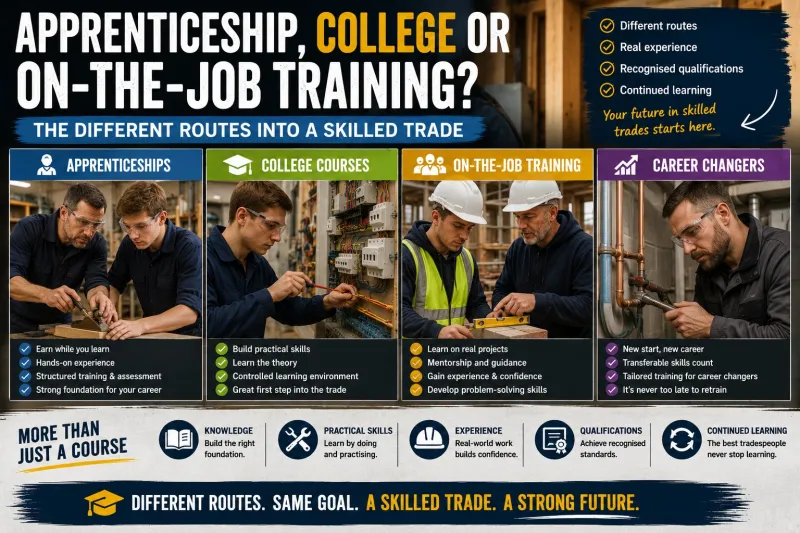
What Should You Learn Next? How Tradespeople Can Build a Training Plan That Actually Moves Their Career Forward
There is almost always another course you could take. Another certificate. Another manufacturer training day. Another qualification. Another specialist skill. A...
There is almost always another course you could take.
Another certificate.
Another manufacturer training day.
Another qualification.
Another specialist skill.
Another piece of equipment that requires training before you can use it properly.
For ambitious tradespeople, continued learning is generally a good thing. The problem is that training can consume significant amounts of time and money without necessarily changing anything about your career or business.
You can spend £1,000 on a course, lose several working days and come away with another certificate for the folder—but still be doing exactly the same work for exactly the same customers six months later.
So instead of asking:
“What qualification should I get next?”
A better question is:
“What do I want to be able to do next that I can't do now?”
Once you know that, training becomes much easier to evaluate.1. Start With the Opportunity, Not the Course
It's easy to work backwards.
You see a course advertised. It looks interesting. The provider explains all the benefits. You start wondering whether you should take it.
Reverse that process.
First identify what you actually want to achieve.
Perhaps you want to:
Move into a specialist area.
Take on larger projects.
Work on different systems.
Qualify for certain contracts.
Move into supervision or management.
Employ apprentices.
Reduce your reliance on subcontractors.
Improve a weakness in your existing work.
Or simply become better at the trade you already perform.
Then investigate what training supports that objective.
The course should follow the opportunity—not create the objective for you.2. Look at the Work You're Currently Turning Away
Your enquiries contain useful information.
Think about the jobs you've declined over the last six months.
Why did you say no?
Sometimes the reason will simply be capacity, distance or poor fit.
But sometimes you'll notice a pattern:
“We get asked about that all the time, but I don't offer it.”
That's worth investigating.
If customers repeatedly ask for a related service and you're regularly sending that work elsewhere, additional training might allow you to capture more value from enquiries you're already generating.
That doesn't automatically mean you should add the service.
You still need to consider equipment, insurance, regulation, demand and profitability.
But repeated enquiries are stronger evidence of an opportunity than a training provider telling you a skill is “in demand”.3. Decide Whether You Need a Qualification or a Skill
These aren't always the same thing.
Sometimes a recognised qualification, certification, registration or formal assessment is necessary or commercially important for the work you want to pursue.
Other times, the real gap is practical ability.
You might need to become better at:
Fault finding.
Estimating.
Reading technical drawings.
Using particular equipment.
Installing a specific product.
Managing projects.
Communicating with customers.
Or running the financial side of the business.
Don't assume every professional-development problem needs a formal qualification.
Sometimes the best investment is structured practical training.
Sometimes it's mentoring.
Sometimes it's manufacturer training.
Sometimes it's simply more supervised experience.
And sometimes a formal qualification genuinely is the appropriate route.
Identify which problem you're trying to solve first.4. Check Whether the Training Actually Enables You to Do Anything New
A certificate can look impressive without materially changing what you're competent, authorised or insured to do.
Before paying for training, ask:
What will completing this actually enable me to do?
Will it:
Meet a recognised requirement?
Help satisfy a registration or scheme requirement?
Demonstrate competence valued by customers or contractors?
Provide access to a new type of project?
Develop a genuine technical skill?
Create a pathway to further qualifications?
Or mainly provide a certificate of attendance?
A certificate of attendance isn't necessarily useless. Manufacturer courses and short technical sessions can contain valuable knowledge.
The important thing is understanding what the certificate actually represents.
Don't confuse attending training with automatically becoming competent to undertake every type of work related to the subject.5. Research Who Recognises the Qualification
Not every certificate carries the same weight.
Before enrolling, find out:
Who awards it?
Is it nationally recognised where that matters?
Is it accepted by the organisations or schemes relevant to the work?
Do employers or contractors actually ask for it?
Does it form part of a recognised progression route?
Does it expire or require renewal?
Are there additional assessments or experience requirements afterwards?
This becomes particularly important when training is marketed using phrases such as:
“Become fully qualified.”
or:
“Start earning immediately.”
The reality of becoming competent in a skilled trade is often more complicated than completing a short course.
Investigate what the qualification means rather than relying solely on the provider's marketing.6. Calculate the Real Cost of Training
The course fee isn't the full cost.
Suppose training costs £800.
You attend for four working days.
Those are four days you aren't earning your normal income.
You might also need:
Travel.
Accommodation.
Assessment fees.
Books.
Equipment.
Registration.
Renewal fees.
Additional insurance.
Or further training before you can actually offer the service.
Your £800 course could represent a considerably larger investment.
That doesn't make it a bad decision.
It means you should evaluate the complete cost.7. Ask How the Training Will Pay for Itself
Not every piece of education needs an immediate financial return.
Some training improves safety.
Some maintains competence.
Some is required.
Some simply makes you better at your profession.
But for optional commercial training, it's reasonable to think about the return.
Imagine a new skill costs £2,000 to acquire once you include training, lost working time and equipment.
What happens afterwards?
If it allows you to earn an additional £300 of profit each month, the investment may make sense fairly quickly.
If customers ask for the service twice a year and each job makes £100, the calculation looks very different.
Don't just ask:
“Can I afford the course?”
Ask:
“What happens after I've completed it?”8. Factor in the Equipment You'll Need Afterwards
Some training opens the door to work that requires significant additional investment.
You complete the course.
Great.
Now you discover you need £4,000 of specialist equipment before you can offer the service properly.
That should have been part of the decision from the beginning.
Investigate:
Tools.
Testing equipment.
Software.
Vehicles.
Consumables.
Calibration.
Maintenance.
Personal protective equipment.
And anything else the new work requires.
The cost of learning a service and the cost of delivering that service are two separate numbers.
You need both.9. Check Your Insurance Before Expanding Your Services
If training leads you into a new type of work, don't assume your existing business insurance automatically covers everything.
The activities you've declared to your insurer matter.
Before offering materially different services, check whether your existing cover remains appropriate and whether the insurer needs to know about the change.
The same principle applies to other professional requirements relevant to your trade.
Completing a course is one part of expanding a service.
Making sure the business is actually set up to provide that service properly is another.10. Don't Neglect Business Skills
Ask tradespeople what training they need and the answer usually focuses on the trade itself.
That's understandable.
But technical ability isn't the only skill limiting a business.
A highly skilled tradesperson can still lose money because they struggle with:
Quoting.
Pricing.
Scheduling.
Cash flow.
Customer communication.
Record keeping.
Managing employees.
Delegation.
Marketing.
Or understanding which jobs are profitable.
At a certain point, another technical qualification may improve the business less than learning how to manage the business you already have.
If you're excellent at the trade but overwhelmed by everything surrounding it, that's a training need too.Build Depth Before Constantly Adding Width
There's a temptation to keep adding services.
You currently do A.
Training lets you add B.
Another course adds C.
Then D.
Eventually your business advertises 27 different services.
But are you genuinely excellent at all of them?
Sometimes the best next step isn't expanding into something new.
It's becoming significantly better at something you already do.
That could mean advanced diagnostic training, specialist techniques or deeper manufacturer knowledge.
There's commercial value in becoming the person other people call when the straightforward solution hasn't worked.
Breadth creates opportunity.
Depth can create expertise.Manufacturer Training Can Be Extremely Useful—But Understand What It Is
Manufacturers frequently provide training around their own products and systems.
This can be valuable.
You may learn correct installation procedures, commissioning, fault diagnosis, product selection and technical requirements directly from people familiar with the equipment.
But manufacturer training and independent trade qualifications serve different purposes.
Completing a manufacturer's course doesn't necessarily mean you've gained a broad qualification covering the entire trade.
Treat it as what it is: specialised knowledge about a particular product, system or technology.
That can still be enormously useful if you regularly work with it.Think About Where the Industry Is Moving
Training doesn't only need to solve today's problem.
It can prepare you for tomorrow's work.
Ask what is changing within your trade.
New technologies.
Different materials.
New installation methods.
Changing customer expectations.
New equipment.
Energy-efficiency measures.
Digital tools.
Updated technical standards.
You don't need to chase every trend.
In fact, doing so can waste considerable money.
But ignoring meaningful changes for ten years can eventually leave a skills gap that's much harder to close.
The objective is to distinguish temporary hype from structural change.Learn From the People Doing the Work Already
Before investing heavily in a new specialism, speak to tradespeople already doing it if you can.
Ask what the work is actually like.
Is demand genuinely strong?
What equipment do they use?
What surprised them?
What are the margins like?
What qualifications do customers or contractors actually care about?
What are the difficult parts nobody mentions in the course brochure?
The person selling training has an obvious reason to be enthusiastic about the opportunity.
Someone who has spent five years actually doing the work can give you another perspective.Create a 12-Month Skills Plan
Instead of randomly booking courses throughout the year, create a simple development plan.
It doesn't need to be complicated.
For example:
Current weakness: Diagnostic ability on a particular system.
Training: Advanced fault-finding course.
Reason: Reduce time spent diagnosing and increase confidence taking complex work.
Target: Complete by February.
Then:
Business weakness: Estimating larger projects.
Training: Estimating/project-costing development.
Reason: Improve quote accuracy and understand job margins.
Target: Complete by June.
Then perhaps:
Future opportunity: New specialist service.
Action: Research demand, qualification requirements, insurance and equipment before committing to training.
Now training is part of a strategy rather than a collection of unrelated certificates.Leave Room to Practise What You Learn
There's little value in completing five courses in six months if you never properly apply any of them.
Training creates knowledge.
Experience develops it.
After learning something new, give yourself an opportunity to consolidate it through appropriate practical experience.
Review what worked.
Identify where you're still weak.
Ask questions.
Refer back to technical guidance.
Continue developing.
The objective isn't to finish the course.
The objective is to become better at the work.Keep a Record of Your Development
As your career progresses, maintain an organised record of relevant:
Qualifications.
Certificates.
Training.
Renewals.
Expiry dates.
Assessments.
Manufacturer courses.
Continuing professional development.
Registrations.
And specialist competencies.
This becomes increasingly useful as the list grows.
It also makes it easier to keep your professional profile current and accurately demonstrate your experience to customers, employers, contractors or other organisations when relevant.Don't Collect Certificates. Build Capability.
There is nothing wrong with being proud of qualifications.
They can represent substantial work, knowledge and professional development.
But the strongest training plan isn't necessarily the one that produces the thickest folder of certificates.
It's the one where each investment has a purpose.
Maybe the next course allows you to enter a specialist market.
Maybe it makes you safer.
Maybe it helps you diagnose problems faster.
Maybe it opens the door to larger contracts.
Maybe it improves how you manage your business.
Or maybe it simply deepens a skill you've spent years developing.
All of those can be worthwhile.
The important thing is knowing why you're doing it.
Don't start with the question “What course should I take next?” Start with “Where do I want my career or business to be next?”—then choose the training that actually helps you get there.
0 Comments
No comments yet — be the first to share your thoughts.