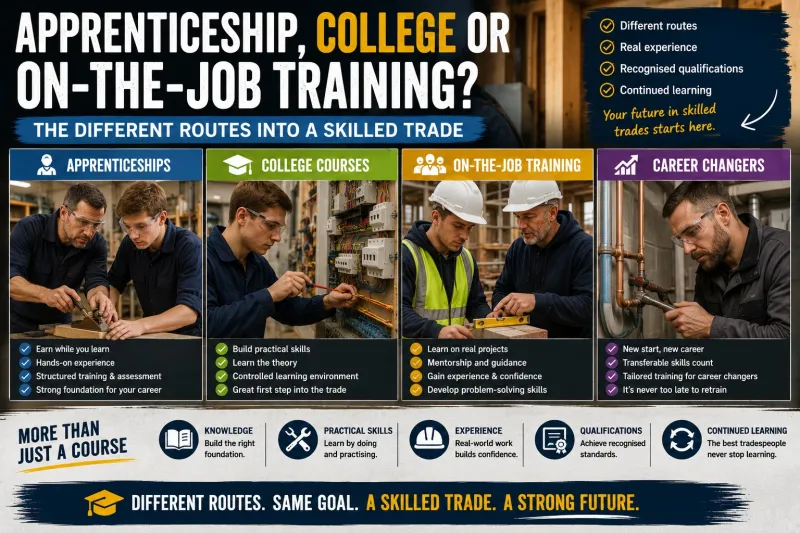
Apprenticeship, College or On-the-Job Training? The Different Routes Into a Skilled Trade
Ask ten experienced tradespeople how they entered their trade and you may get ten different answers. One might have started an apprenticeship straight from scho...
Ask ten experienced tradespeople how they entered their trade and you may get ten different answers.
One might have started an apprenticeship straight from school.
Another completed a college course before finding an employer.
Someone else may have spent years working alongside an experienced tradesperson before gaining formal qualifications.
And increasingly, people are entering the industry later in life after leaving completely different careers.
There is no single route into skilled trade work.
But there is an important distinction that anyone considering a trade career should understand:
Completing a course and becoming competent at a trade aren't necessarily the same thing.
Qualifications matter.
Training matters.
But so do experience, supervision and the ability to apply what you've learned in real working environments.1. Apprenticeships
For many trades, an apprenticeship remains one of the most established ways to enter the industry.
The basic idea is straightforward.
You are employed while learning the trade, combining practical workplace experience with structured training and assessment.
That combination is one of the biggest advantages.
You're not only learning how something should be done in theory.
You're seeing what happens on actual jobs.
Real properties aren't always straightforward.
Previous work may have been altered.
Access can be difficult.
Customers change their minds.
Materials don't always behave exactly as expected.
Problems need diagnosing.
An apprenticeship exposes someone to those realities while they are still developing their skills.
The downside is that apprenticeships require commitment from both the apprentice and the employer, and finding the right opportunity can sometimes be competitive.
But for someone who wants to learn while working within the industry, they can provide a strong foundation.2. College and Further Education Courses
Another common route is studying a trade through a college or training provider.
Courses can introduce the underlying knowledge and practical skills associated with areas such as:
Plumbing
Electrical installation
Carpentry and joinery
Bricklaying
Painting and decorating
Construction
Engineering
Welding
The exact qualification and level will depend on the subject and course.
College can be particularly useful for someone who wants to develop foundational skills before entering employment.
Training environments also allow learners to practise techniques without the same pressures that exist on a customer's property.
But there's an important limitation.
A training workshop isn't a building site.
Completing a practical exercise in a controlled environment isn't necessarily the same as carrying out the work independently in a real property.
That's why workplace experience remains important.3. Learning Through Employment
Not everybody enters a trade through a traditional apprenticeship.
Some people begin working for a trade business in a supporting role and gradually develop their skills.
A labourer might begin learning aspects of groundworks.
A decorator's assistant may gradually take on more preparation and finishing work.
Someone working for a maintenance company might develop experience across several areas before specialising.
This type of learning can be extremely valuable because it happens in real working conditions.
However, informal experience shouldn't automatically be treated as a substitute for qualifications, assessments or registrations where these are required for particular work.
The right combination depends heavily on the trade.4. Career-Changer Courses
Not everyone decides what they want to do at 16.
Someone might spend ten years working in an office before deciding they want to become an electrician.
Another person may leave the Armed Forces.
Someone working in retail might decide to retrain as a plumber.
Others may have worked around construction for years before choosing a specialist trade.
As a result, there are training routes specifically attractive to adult career changers.
The important thing is to be realistic about what a course can achieve.
Be cautious of any training offer that makes becoming a fully competent tradesperson sound extraordinarily quick or easy.
Learning the underlying theory and practical techniques is one part of the process.
Developing the judgement that comes from encountering hundreds of different real-world situations takes considerably longer.5. Manufacturer and Specialist Training
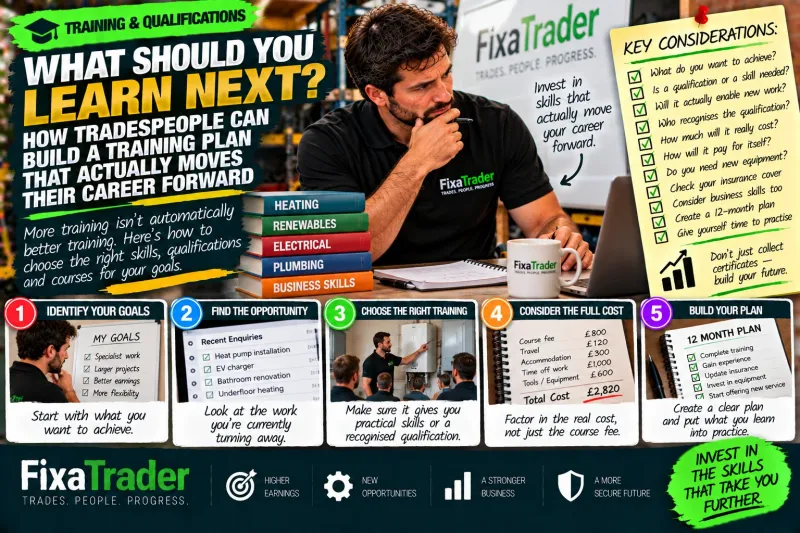
Training doesn't stop once someone enters the industry.
Experienced tradespeople regularly undertake additional training throughout their careers.
Manufacturers may provide training for particular products or systems.
Businesses may train employees on new equipment.
Professionals may develop specialist skills that weren't part of their original qualification.
For example, someone might undertake additional training relating to:
Renewable technologies
Particular heating systems
Specialist access equipment
New installation methods
Testing equipment
Building products
Safety procedures
Manufacturer-specific systems
The industry changes.
Products change.
Regulations change.
Technology changes.
Professional development therefore continues long after someone's initial training is complete.Qualification Doesn't Automatically Mean Experience
Imagine two people hold the same qualification.
One qualified last month.
The other has spent ten years carrying out that type of work every day.
On paper, they may share a credential.
In practice, their experience is very different.
That doesn't make the newly qualified person incompetent.
Everyone starts somewhere.
It simply demonstrates why qualifications and experience answer different questions.
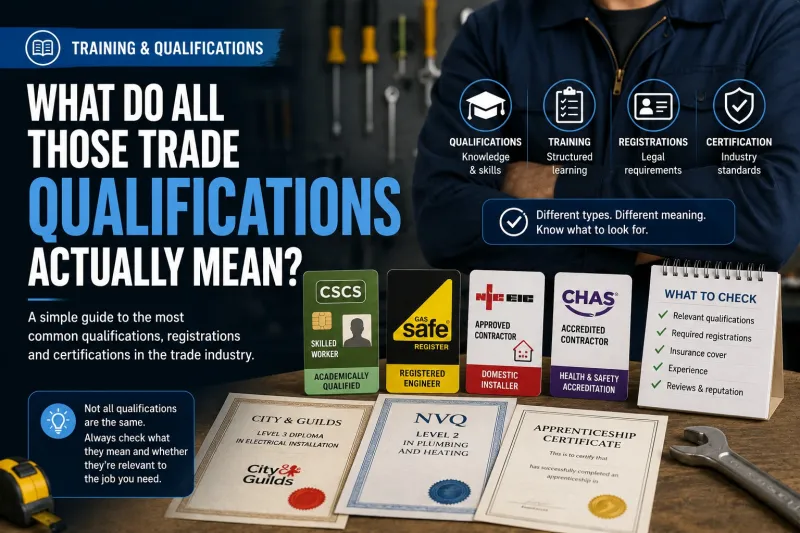
A qualification may demonstrate that someone has met particular learning or assessment requirements.
Experience shows what they've encountered since.
Both can matter.Experience Without Qualifications Isn't Always Enough Either
The opposite assumption can also cause problems.
Someone might say:
“I've been doing this for twenty years. I don't need a certificate.”
Experience can be enormously valuable.
But certain types of work have specific competence, qualification, certification or registration requirements.
Those requirements can't simply be dismissed because somebody has been working for a long time.
The rules also differ between trades.
There isn't one universal qualification that makes someone a “qualified tradesperson” for every type of work.
Anyone entering a trade should therefore understand the requirements that apply specifically to the work they intend to carry out.What About Short Courses?
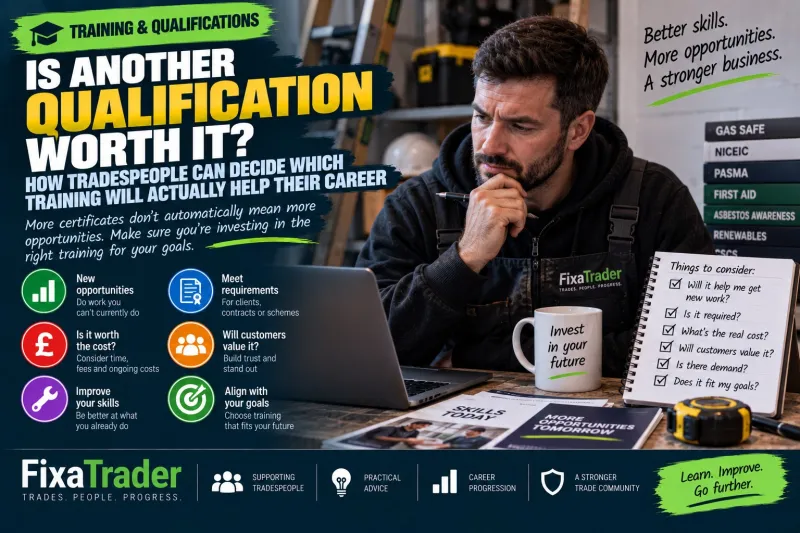
Short courses have a legitimate place in professional training.
They can be useful for:
Refreshing existing knowledge.
Learning a specific product.
Adding a specialist skill.
Understanding updated requirements.
Developing knowledge in an adjacent area.
The problem comes when a short course is presented as though it can replace the depth of learning and experience normally required to become competent in an entire trade.
Ask what the course actually qualifies you to do.
What does it assess?
Is workplace evidence required?
Is it recognised within the industry?
Does completing it satisfy any requirements needed for the work you intend to undertake?
Those questions matter far more than how impressive the certificate looks.How Long Does It Take to Become a Tradesperson?
There isn't one answer.
Different trades have different training structures.
Different qualifications take different lengths of time.
And people develop practical ability at different rates.
More importantly, there's a difference between:
finishing training
and
becoming an experienced professional.
Someone may reach the required qualification standard and still have a great deal to learn.
That's normal.
Experienced tradespeople continue encountering situations they've never seen before.
The goal of initial training isn't to somehow experience every possible job.
It's to build the knowledge, practical skills and judgement needed to continue developing safely and professionally.Choosing the Right Training Route
If you're considering entering a trade, start with the destination rather than the course.
Ask yourself:
What work do I actually want to do?
Then investigate what is normally required to do that work competently and, where applicable, legally.
Look at:
The qualifications recognised within that trade.
Whether workplace assessment is required.
Whether an apprenticeship route exists.
Whether registration with a particular scheme may eventually be necessary.
How much practical experience the training provides.
What employers typically expect.
And what progression looks like after completing the initial qualification.
Only then should you choose the training provider.
Otherwise, it's possible to spend substantial amounts of money completing a course before discovering it doesn't take you where you thought it would.Be Careful With “Fully Qualified” Marketing
Training is a commercial industry too.
Courses need customers.
That means prospective students should read marketing claims carefully.
Statements such as:
“Become a qualified tradesperson in weeks”
deserve further investigation.
Qualified to what level?
Against which standard?
To carry out what work?
What practical assessment is involved?
What experience will you have when you finish?
Will employers recognise the qualification?
Will additional workplace evidence be required?
A legitimate training provider should be able to explain exactly what its course does and doesn't provide.Employers Play a Huge Role
Good training isn't only about the classroom.
The people someone works alongside can have an enormous influence on the professional they eventually become.
An experienced tradesperson can teach things that are difficult to reproduce in a textbook.
How to approach an unfamiliar problem.
How to organise a job.
How to protect a customer's property.
How to recognise when something isn't right.
How to communicate when plans need changing.
How to work efficiently without cutting corners.
How to know when you need advice.
Technical ability matters.
Professional habits matter too.Your First Qualification Shouldn't Be Your Last Learning
One of the biggest misconceptions about skilled work is that training eventually finishes.
It doesn't.
A tradesperson might work for thirty years and still need to learn about:
New products.
New tools.
Updated standards.
Changing regulations.
Different technologies.
New construction methods.
And unfamiliar problems.
The strongest professionals don't necessarily know everything.
They know the limits of their knowledge and are prepared to keep learning.There Isn't One “Correct” Route Into the Trades
An apprentice and an adult career changer can both become excellent tradespeople.
Someone who starts at college and someone who begins within a family business can eventually reach the same professional standard through very different journeys.
What matters is what happens along the way.
Good training.
Relevant qualifications.
Real experience.
Appropriate supervision.
Continued learning.
And enough professional judgement to recognise when a job falls outside your competence.
A certificate can mark an important point in your training.
Becoming a tradesperson is the much longer process of learning how to put that knowledge into practice.
0 Comments
No comments yet — be the first to share your thoughts.