What Do All Those Trade Qualifications Actually Mean?
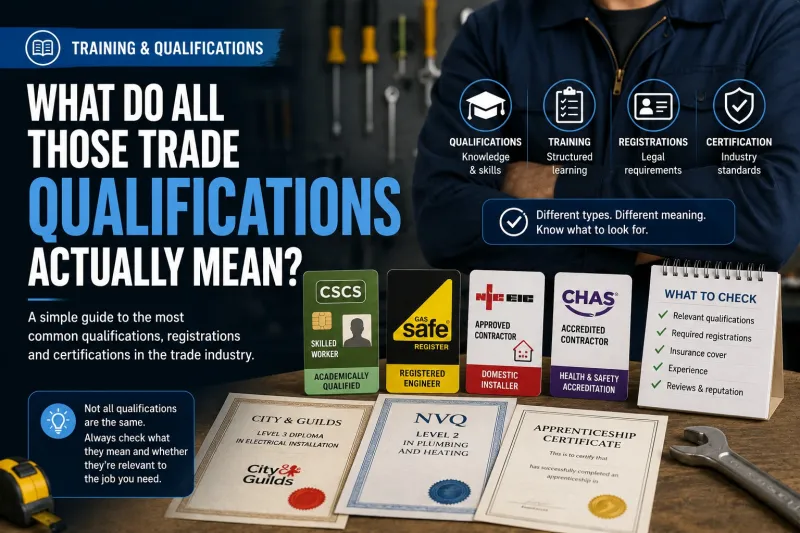
When you're looking for a tradesperson, you'll often see a long list of qualifications, registrations, memberships and certificates. You might see: NVQ Level 2....
When you're looking for a tradesperson, you'll often see a long list of qualifications, registrations, memberships and certificates.
You might see:
NVQ Level 2.
City & Guilds.
Apprenticeship.
CSCS card.
Gas Safe registered.
NICEIC approved.
For someone outside the trade, it can be difficult to understand what any of these actually mean — and whether one is more important than another.
The first thing to understand is that they aren't all qualifications.
Some demonstrate education or training. Others are evidence of occupational competence, while some are registrations or certification schemes that relate to particular types of work.
Understanding the difference can make it much easier to assess a tradesperson.NVQs and SVQs
NVQ stands for National Vocational Qualification.
These are vocational qualifications designed around occupational standards and the skills required to perform a particular job.
Unlike a purely academic qualification, an NVQ can involve demonstrating your competence in a real working environment.
For construction, this can make NVQs particularly relevant because they assess whether someone can actually carry out the tasks associated with their occupation to the required standard.
City & Guilds describes NVQs as being based on national occupational standards and notes that they can be completed while someone is working.
In Scotland, you will generally encounter SVQs — Scottish Vocational Qualifications — which broadly operate in the same way.
The level also matters.
A Level 2 qualification isn't equivalent to a Level 3 qualification, and neither should automatically be interpreted as meaning someone is more experienced simply because the number is higher.
The relevant question is:
What occupation is the qualification actually for?City & Guilds
City & Guilds is an awarding organisation rather than a single qualification.
It offers a very large range of vocational qualifications, apprenticeships and technical programmes across areas including construction, electrical installation, plumbing, refrigeration and other building services.
So if someone says they have a City & Guilds qualification, that doesn't tell you everything by itself.
You would need to know:
The exact qualification
The level
The trade or subject
When it was achieved
Whether it is relevant to the work being undertaken
A City & Guilds qualification in one subject isn't automatically evidence of competence in another.
That's why looking beyond the organisation's name is important.Apprenticeships
An apprenticeship is different again.
It isn't simply a course that someone attends before becoming a tradesperson.
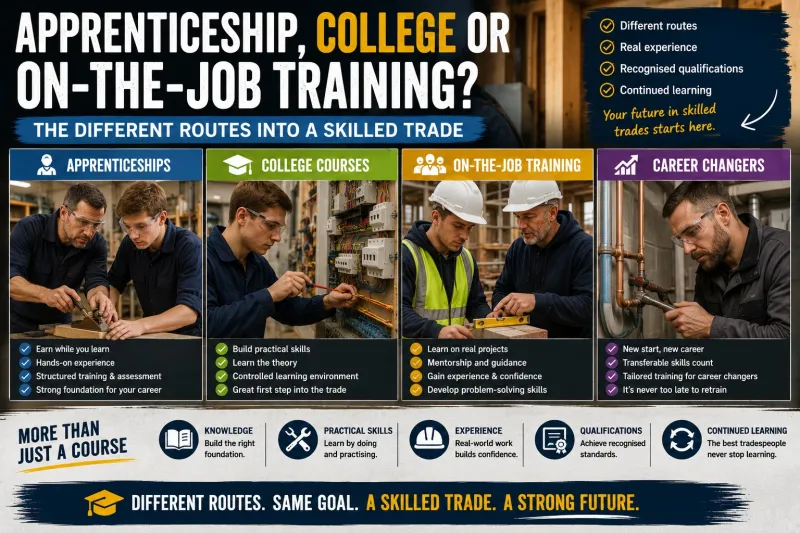
An apprenticeship combines employment, practical experience and structured training.
In England, apprentices are employees and receive a wage while gaining practical experience and completing training. Apprenticeships also include at least 20% of normal working hours dedicated to off-the-job training.
This means an apprenticeship can be an important route into a skilled trade because the person isn't learning entirely in a classroom.
They're developing their skills while working.
For homeowners, however, seeing that someone completed an apprenticeship doesn't tell you everything about their current experience.
Someone who completed an apprenticeship 20 years ago may have developed a substantial amount of additional experience since then.
Conversely, someone who completed one recently may still be relatively early in their career.
Qualification and experience are two different pieces of information.What Is a CSCS Card?
This is one that causes considerable confusion.
A CSCS card isn't itself a qualification.
CSCS describes its cards as providing evidence that people working on construction sites have the appropriate training and qualifications for their role.
For skilled CSCS cards, applicants generally need a nationally recognised construction-related qualification and the required health and safety test or approved alternative.
The card therefore acts more like evidence that certain requirements have been met, rather than being the underlying trade qualification itself.
And having a CSCS card doesn't automatically mean someone is qualified to carry out every type of construction work.
The type of card and the underlying qualification matter.
It's also worth knowing that CSCS says holding a card isn't itself a legal requirement for every construction worker. However, many principal contractors and major housebuilders require appropriate cards for site access.Gas Safe Registration
Gas work is another example where registration and qualification aren't the same thing.
Gas Safe Register is the UK's official registration scheme for businesses and engineers who work with gas.
If you're hiring someone to carry out gas work, checking their Gas Safe registration is particularly important.
But don't simply look for the words "Gas Safe" on a website or vehicle.
The relevant question is whether the individual is registered and authorised for the specific type of gas work they're undertaking.
Registration is therefore something you should verify rather than treating it as simply another qualification printed on a profile.What About NICEIC?
NICEIC is another example of why the distinction matters.
NICEIC operates certification and registration schemes within the electrical sector, including schemes for electrical contractors and domestic installers.
For example, its Approved Contractor Scheme assesses businesses against requirements relating to electrical work, competence, qualifications, experience and other requirements.
NICEIC itself explains that businesses joining its schemes may need to provide evidence of qualifications and experience and pass an assessment.
So seeing NICEIC associated with an electrician isn't simply the same thing as seeing "Level 3 qualification".
It represents something different.Qualifications Don't Tell the Whole Story
This is perhaps the most important point.
A qualification can tell you something about someone's education, training or demonstrated competence.
But it doesn't necessarily tell you:
How much experience they have
How recently they've carried out the work
Whether they're insured
Whether they're registered with the relevant scheme
What previous customers thought of their work
Whether they regularly undertake your particular type of project
That's why qualifications should be viewed as one part of the picture.
A professional with relevant qualifications, appropriate registration where required, suitable insurance, strong previous work and good customer feedback provides considerably more information than a list of certificates alone.What Should Homeowners Actually Look For?
Rather than trying to find the tradesperson with the longest list of certificates, start by asking whether the credentials are relevant to the job you're hiring them to do.
For example:
Is the qualification relevant to the trade?
Is registration required for this particular type of work?
Can the registration be independently verified?
Does the professional have relevant experience?
Can they show previous work?
Do they have appropriate insurance?
Can they provide references or reviews?
And for regulated or safety-critical work, make sure you understand whether there are specific legal or certification requirements that apply.Qualifications, Experience and Reputation Work Together
There isn't necessarily one certificate that tells you whether a tradesperson is good.
Qualifications can demonstrate knowledge and competence.
Experience can demonstrate that those skills have been applied over time.
Registrations and certification schemes can provide additional assurance where they are relevant.
Previous projects show you the kind of work the professional actually undertakes.
And reviews can tell you about the experience of previous customers.
The strongest picture comes from putting all of those pieces together.
So the next time you see a tradesperson advertising a collection of qualifications and memberships, don't just count the logos.
Look at what each one actually means — and whether it's relevant to the work you're asking them to do.
That little bit of research can make choosing the right professional considerably easier.
0 Comments
No comments yet — be the first to share your thoughts.