Should You Take On an Apprentice? 10 Things Tradespeople Need to Consider Before Hiring
You've been running your trade business for several years. The diary is getting busier, customers are recommending you and you're beginning to think about getti...
You've been running your trade business for several years.
The diary is getting busier, customers are recommending you and you're beginning to think about getting some help.
Perhaps you've considered hiring an experienced tradesperson.
But finding someone with the right skills, attitude and availability isn't always straightforward.
Then another possibility comes to mind.
What about taking on an apprentice?
For many established tradespeople, apprenticeships offer an opportunity to train someone in the way their business operates.
An apprentice can gradually develop practical skills, gain recognised qualifications and potentially become a valuable member of the team.
But taking on an apprentice is very different from hiring an experienced worker.
You're not simply paying someone to help complete jobs.
You're accepting responsibility for supporting their development while meeting the legal and practical requirements of an apprenticeship.
The question isn't just whether your business could benefit from another pair of hands. It's whether you're ready to invest the time, money and supervision needed to help someone become a competent tradesperson.
Here are ten things to consider before making that commitment.1. Understand What an Apprenticeship Actually Involves
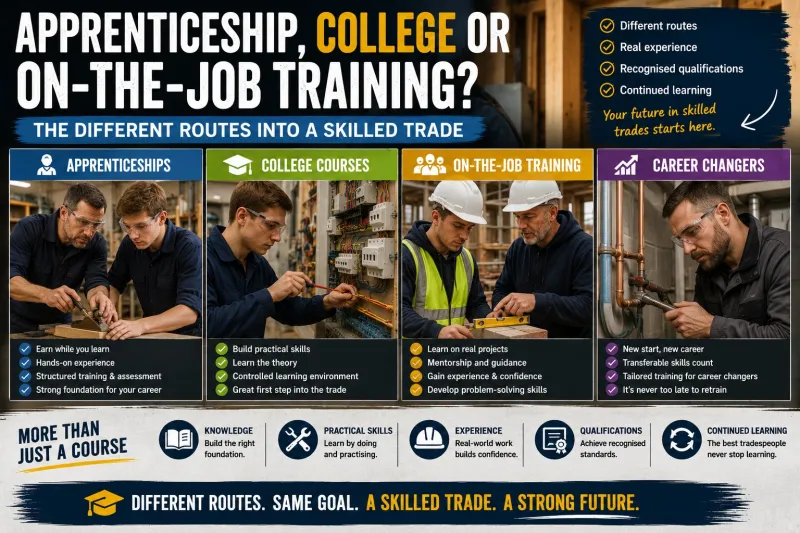
An apprenticeship combines paid employment with structured training.
The apprentice develops practical skills through work while undertaking training towards an approved apprenticeship standard or framework, depending on the UK nation and programme.
In England, apprenticeships are organised around occupational standards that define the knowledge, skills and behaviours required for a particular occupation.
An apprentice isn't simply an inexperienced employee who learns informally while working.
There must be an appropriate training arrangement and a genuine opportunity to develop occupational competence.
Depending on the apprenticeship, training may involve:
Practical experience on site.
Training delivered by an approved provider.
Technical knowledge and theory.
Workplace assessments.
Progress reviews.
A final assessment of occupational competence.
The exact arrangements depend on the apprenticeship and the nation in which it's delivered.
Before recruiting, identify the appropriate apprenticeship route for your trade and understand what the programme requires from you as an employer.2. Make Sure You Have Enough Suitable Work
An apprentice needs opportunities to practise and develop the skills required by their training programme.
That means having more than a busy diary.
You need the right variety of work.
For example, an electrical apprentice may need experience across different installation, inspection and testing activities, depending on their programme.
A plumbing apprentice may need exposure to a suitable range of systems and practical tasks.
If your business only performs a very narrow type of work, you may struggle to provide the full range of required experience.
This doesn't necessarily rule out an apprenticeship.
There may be ways to coordinate appropriate experience with a training provider or other employers.
However, those arrangements need to be established properly.
Ask yourself:
Is there enough work to support the apprentice?
Will the work provide relevant learning opportunities?
Can the apprentice develop progressively?
Are there gaps in the experience your business can offer?
Can those gaps be addressed through suitable arrangements?
A full diary doesn't automatically mean your business can deliver a good apprenticeship. The work needs to support learning as well as revenue.3. Be Realistic About the Time You'll Spend Teaching
One of the biggest commitments involved in taking on an apprentice is supervision.
An apprentice may need help understanding tools, materials, working methods, safety procedures and customer expectations.
Tasks that take an experienced tradesperson twenty minutes may take considerably longer when you're explaining each stage.
That's a normal part of training.
But it affects productivity.
You may need to demonstrate a task, supervise the apprentice carrying it out and check the result.
You may also need to coordinate with the training provider, participate in progress reviews and help address areas where the apprentice needs improvement.
Consider whether you have the patience and time to teach properly.
If you're already working long hours and struggling to keep up with administration, adding training responsibilities could create additional pressure.
A good apprenticeship requires someone who is prepared to teach, not simply someone who needs help carrying materials.4. Calculate the Full Employment Cost
An apprentice's wage is only one part of the cost.
As an employer, you may also need to account for National Insurance contributions, pension obligations where applicable, holiday pay, insurance, equipment and other employment expenses.
Training and assessment arrangements may involve additional costs depending on the funding rules and programme.
You should also consider the indirect cost of supervision.
For example, if an experienced tradesperson spends several hours each week providing instruction, that time has a commercial value.
Potential costs include:
Apprentice wages.
Employer payroll obligations.
Paid holiday.
Tools and personal protective equipment.
Work clothing.
Travel arrangements.
Training-related costs.
Insurance.
Administration and supervision.
Some employers may qualify for government funding or incentives, depending on the apprenticeship, employer circumstances and current scheme rules.
Build a realistic budget based on the total cost of employment and training rather than assuming an apprentice is simply a cheaper employee.5. Understand Apprenticeship Pay Rules
Apprentices are employees and must receive at least the applicable legal minimum wage.
The apprenticeship minimum wage rules depend on age and the stage of the apprenticeship.
In the UK, the apprentice rate can apply to apprentices under 19 and to those aged 19 or over who are in the first year of their apprenticeship.
After the first year, apprentices aged 19 or over are generally entitled to the applicable age-related National Minimum Wage or National Living Wage rate.
Rates change over time.
Employers should check the current figures before making an offer.
You must also understand which training time counts as paid working time.
Required apprenticeship training undertaken during normal working hours is generally paid.
Don't assume you can pay an apprentice only for the hours they spend carrying out productive work on site.
The training provider plays an important role in the apprenticeship.
They help deliver the required training and support the apprentice's progress.
Before committing, discuss the programme in detail.
Find out what training will be delivered away from the workplace and what you are expected to provide.
Useful questions include:
Which apprenticeship standard or programme will the apprentice follow?
How long is the programme expected to last?
How will training be scheduled?
What workplace experience is required?
How will progress be monitored?
What happens if the apprentice falls behind?
What support is available to the employer?
A good working relationship between the employer, apprentice and training provider can make a substantial difference.
The training provider shouldn't be an afterthought. They are part of the arrangement that makes the apprenticeship work.7. Make Sure You Can Supervise Work Safely
Construction and trade environments can expose inexperienced workers to significant hazards.
These may include electricity, working at height, moving machinery, hazardous substances and manual handling.
Apprentices need appropriate instruction, supervision and risk controls.
The level of supervision should reflect the task, the individual's competence and the risks involved.
An apprentice who has completed a particular training module isn't automatically competent to perform every related task independently.
Certain activities may also be subject to specific legal or industry requirements.
For example, gas work must comply with the applicable Gas Safety regulations and competence requirements.
Before assigning work, consider:
What training has the apprentice received?
Has their competence been assessed?
What are the hazards?
What supervision is necessary?
Is the task appropriate for their stage of development?
Never allow commercial pressure to override the need for safe supervision.8. Think About How an Apprentice Fits Into Your Daily Schedule
Training affects how work is organised.
You may need to allow time for demonstrations, questions and progress checks.
The apprentice will also have scheduled training commitments.
This means they won't necessarily be available for every working day.
If your business relies on tight schedules, you need to account for these arrangements.
For example, a job that normally takes one experienced tradesperson a day may not automatically be completed faster because an apprentice is present.
In the early stages, it could take longer.
Over time, productivity may improve as the apprentice develops competence.
Plan for gradual progression rather than expecting an immediate increase in output.9. Recruit for Attitude and Potential, Not Just Experience
An apprenticeship is intended to help someone develop skills.
That means candidates shouldn't be judged solely on what they already know.
Reliability, willingness to learn, communication and an appropriate attitude towards safety can be particularly important.
Consider how the candidate responds to feedback.
Do they ask questions?
Are they interested in the trade?
Do they understand that the work involves practical challenges as well as technical learning?
You should also make recruitment fair and comply with applicable employment and equality law.
Avoid assumptions based on age or background.
Apprenticeships can be suitable for people entering a trade for the first time and for some individuals changing careers.
You're recruiting someone with the potential to become a skilled worker, not expecting them to arrive with all the skills already developed.10. Consider What Happens After the Apprenticeship
An apprenticeship is a long-term investment.
Before recruiting, think about how the role fits your future business plans.
Would you like the apprentice to become a permanent member of your team?
Could they eventually manage certain jobs or take on greater responsibility?
Does your business have enough potential work to support another qualified tradesperson?
Not every apprentice will remain with the same employer after completing their programme.
People's circumstances and career goals change.
However, providing a positive training experience may improve the likelihood of retaining skilled employees.
The best reason to take on an apprentice is to develop future capability, not simply to fill an immediate gap in your schedule.Can a Sole Trader Take On an Apprentice?
Potentially, yes.
You don't necessarily need to operate a large company to employ an apprentice.
A sole trader can be an employer, provided the relevant employment, apprenticeship and training requirements are met.
However, the practical challenges can be significant.
If you work alone, you may be responsible for supervising the apprentice while also managing customers, quotations, accounts and the rest of the business.
You'll also need to understand payroll, employer responsibilities and appropriate insurance arrangements.
A small business may benefit from discussing its circumstances with a training provider before recruiting.
Being self-employed doesn't automatically prevent you from taking on an apprentice, but you must be prepared to operate as an employer.How Long Does a Trade Apprenticeship Take?
The duration depends on the trade, programme and individual circumstances.
In England, apprenticeship programmes must meet applicable minimum duration requirements, but many construction and technical trade apprenticeships take considerably longer.
Some may involve several years of training and practical experience.
The exact programme should be confirmed with the training provider.
It's also important to recognise that completing the apprenticeship isn't the same as becoming experienced in every aspect of the trade.
A newly qualified worker may still benefit from mentoring and further practical development.
Think of the apprenticeship as the foundation of a professional career rather than the point at which learning stops.What If You Can't Provide Every Required Skill?
Some small trade businesses specialise in a limited range of work.
For example, an electrician might focus mainly on domestic maintenance, while the relevant apprenticeship standard requires broader experience.
This can create challenges.
Speak to the training provider about the occupational requirements and whether suitable arrangements can be made to provide missing experience.
Depending on the programme and circumstances, this might involve coordinated work placements or other arrangements.
However, these should be properly agreed and compliant with the apprenticeship requirements.
Don't assume that an apprentice can complete a full occupational programme simply by repeating the same narrow set of tasks throughout their training.What Are the Benefits of Taking On an Apprentice?
When managed well, an apprenticeship can offer several benefits.
Developing future talent
You can help someone learn the trade and potentially build a long-term employee relationship.
Passing on experience
Experienced tradespeople can share practical knowledge that isn't always easy to learn from a textbook.
Building business capacity
As the apprentice develops competence, they may become capable of taking on a wider range of responsibilities.
Creating a consistent working approach
Training someone within your business provides an opportunity to establish expectations around workmanship, communication and customer care.
Supporting the wider trade industry
Apprenticeships help develop the next generation of skilled workers.
However, these benefits depend on the quality of the training and the commitment of everyone involved.
An apprentice is an investment in skills, not a guaranteed shortcut to higher profits.What Are the Biggest Challenges?
It's worth understanding the difficulties before making a commitment.
Time pressure
Teaching and supervision take time away from other tasks.
Financial commitment
Wages and employment costs continue even when the apprentice isn't yet highly productive.
Training coordination
You'll need to work with a provider and support the programme requirements.
Safety responsibilities
Inexperienced workers need appropriate supervision and risk management.
Uncertain retention
The apprentice may eventually choose to work elsewhere.
None of these challenges necessarily makes an apprenticeship a poor decision.
But they should be considered realistically.
A business that understands the commitment is more likely to create a successful training environment.Should You Hire an Apprentice or an Experienced Tradesperson?
The two options serve different purposes.
An experienced tradesperson may be able to contribute more quickly to complex work, depending on their competence and experience.
However, recruiting experienced workers can be expensive and difficult.
An apprentice usually requires more supervision but offers the opportunity to develop skills over time.
Your decision should reflect the business's immediate needs and long-term plans.
If you're struggling to complete technically demanding work right now, an apprentice may not solve that problem.
If you have stable demand, suitable work and time to teach, an apprenticeship may be more appropriate.
Don't recruit an apprentice to solve a staffing problem that actually requires an experienced, competent worker.Five Questions to Ask Before Taking On Your First Apprentice
Before making the decision, ask yourself:
Do I have enough suitable work? The apprentice needs opportunities to develop the required skills.
Can I afford the commitment? Consider wages, supervision and other employment costs.
Do I have time to teach? Proper training requires patience and attention.
Can I provide safe supervision? Tasks must match the apprentice's competence.
Does this fit my business's future? Consider whether you're building long-term capacity.
If you can answer these questions confidently, the next step is to speak with an appropriate apprenticeship training provider about the available programme and employer requirements.The Bottom Line: An Apprentice Is a Long-Term Investment in Your Trade Business
Taking on an apprentice can be one of the most rewarding decisions an established tradesperson makes.
It provides an opportunity to develop future talent, share valuable experience and potentially build a stronger workforce.
But it also brings responsibilities.
You'll need to provide suitable work, support structured training, pay the appropriate wages and supervise tasks safely.
You should expect the apprentice to require time and guidance before they can contribute independently.
And you need to make sure the arrangement fits your business financially and operationally.
If you're ready for that commitment, an apprenticeship can help build something more valuable than extra capacity on today's job.
It can help develop the skilled tradesperson your business—and the wider industry—will need tomorrow.Useful UK Guidance