Autumn Leaves Aren’t Just Messy: 9 Places Around Your Home They Can Cause Problems
A garden covered in autumn leaves doesn't usually feel like a home-maintenance problem. They fall. You sweep them up. More arrive the next day. But once leaves...
A garden covered in autumn leaves doesn't usually feel like a home-maintenance problem.
They fall.
You sweep them up.
More arrive the next day.
But once leaves become wet, compacted and trapped, they can start interfering with the way water and air move around a property.
A handful of leaves isn't the problem.
It's what happens when weeks of debris accumulate in the wrong place.
Blocked drainage can send rainwater somewhere it was never intended to go. Wet leaves can make paths dangerously slippery. Debris can sit against timber and masonry, while hidden accumulations may prevent water from leaving roofs and external areas efficiently.
You don't need to spend every autumn weekend chasing individual leaves around the garden.
Instead, concentrate on the places where accumulation can actually cause trouble.
Here are nine worth checking.1. Gutters
This is the obvious one, but also one of the most important.
Leaves can collect inside gutters alongside moss, twigs and other debris. Once enough material builds up, rainwater may no longer flow freely towards the downpipe.
Instead, you might notice water:
Overflowing the front of the gutter.
Running down the wall.
Escaping from joints.
Collecting behind or beneath the gutter.
Or spilling heavily during prolonged rain.
We've previously covered the warning signs of blocked gutters in more detail, but autumn is when prevention becomes particularly useful.
You don't necessarily need to wait until water is pouring over the edge.
From ground level, watch the gutters during rainfall where visibility allows.
If one section is overflowing while the rest appears to drain normally, there may be a blockage or another defect requiring attention.
Avoid unsafe ladder work. High-level gutter cleaning should be carried out using appropriate equipment and safe access.2. Downpipe Outlets
The gutter can look relatively clear while the outlet leading into the downpipe is blocked.
Leaves travel with flowing water and can collect around the opening.
Once they begin forming a plug, smaller debris gets trapped behind them.
You may then see a gutter filling surprisingly quickly during heavy rain.
After leaves have fallen, pay attention to areas immediately around downpipe outlets.
Also look at what happens at the bottom of the downpipe.
Water needs somewhere suitable to go.
If it discharges into a drain, gully or another drainage arrangement, make sure that area isn't buried beneath leaves too.
Clearing the gutter while leaving the drainage point underneath blocked only moves the problem further down.3. Ground-Level Drains and Gullies
These are extremely easy to overlook.
A drain sits beside the house.
Leaves blow across the garden.
Rain pushes them towards the grate.
Soon the entire surface is covered.
Water then begins pooling around it.
The first sign may be a large puddle during heavy rain.
Where safe and accessible, keep the surface around external drains and gullies clear of loose debris.
You don't need to dismantle drainage systems.
You're simply preventing obvious surface material from covering the route water is supposed to use.
If water continues backing up after accessible debris has been removed, the blockage may be further within the drainage system and require proper investigation.4. Flat Roof Outlets
Flat roofs rely on effective drainage.
Leaves collecting around an outlet can restrict that drainage and allow water to remain on the roof for longer.
This can affect:
Extensions.
Garages.
Porches.
Dormers.
Outbuildings.
And other flat or low-slope roof areas.
The important safety point is that you should not climb onto a roof simply to inspect it.
Look from safe positions where possible.
Perhaps an upstairs window overlooks an extension roof.
You may be able to see whether leaves are accumulating around drainage points without going anywhere near the roof surface.
If significant debris needs removing from an inaccessible roof, use someone with suitable access arrangements.5. Valleys and Roof Junctions
Where two roof slopes meet, debris can sometimes accumulate in the valley between them.
Leaves, moss and twigs may become trapped, particularly where nearby trees overhang the building.
Roof junctions can also collect debris in sheltered areas.
These parts of a roof are responsible for directing significant amounts of rainwater.
Anything interfering with that path deserves attention.
Again, this is primarily something to observe, not an invitation to climb onto the roof.
From the ground or a safe internal vantage point, look for obvious debris and signs that rainwater isn't flowing normally.
If there's a problem, arrange safe inspection.6. Air Bricks and External Vents
Leaves don't only interfere with water.
They can interfere with airflow too.
Properties may have external openings serving purposes such as:
Underfloor ventilation.
Extractor systems.
Air supply.
Or other building services.
If leaves, soil or garden debris build up against low-level vents or air bricks, airflow can become restricted.
Take a walk around the building and look for openings close to ground level.
Make sure they haven't disappeared behind:
Leaves.
Plants.
Stored items.
Mulch.
Or soil.
Don't block intentional ventilation because it appears to be allowing cold air into the property.
Ventilation openings generally exist for a reason.
If you're unsure what a particular vent does, identify its purpose before covering or altering it.7. Paths, Steps and Decking
Wet leaves can be extremely slippery.
This is especially relevant on:
Stone paths.
Paving.
Steps.
Timber decking.
Ramps.
And entrances.
Once leaves begin breaking down, they can form a wet layer over the surface underneath.
The risk increases in shaded areas where surfaces remain damp for longer.
Prioritise the routes people actually use.
Front entrance.
Back door.
Steps.
Side access.
Paths to bins or garages.
You don't need a completely leaf-free garden.
You do want the main walking surfaces to remain reasonably clear and safe.
Autumn maintenance isn't only about preventing damage to the building.
It's also about preventing someone from slipping on the way into it.8. Around External Timber
Wet organic debris can hold moisture against surfaces.
That makes persistent leaf accumulation worth avoiding around external timber such as:
Door frames.
Timber cladding.
Fences.
Decking.
Sheds.
And other wooden elements.
A few leaves touching timber after a windy afternoon aren't a crisis.
The concern is material sitting wet against the same area for prolonged periods.
Clear significant accumulations and take the opportunity to look at the timber itself.
Are coatings failing?
Is paint peeling?
Are there areas remaining noticeably wet?
Is the timber beginning to soften or deteriorate?
Leaves may not be the original cause, but they can help create conditions where existing maintenance problems become worse.9. Around the Base of External Walls
Leaves naturally collect in sheltered edges.
Unfortunately, one of those edges is often where the building meets the ground.
Wind pushes debris against the wall and repeated rainfall turns it into a damp layer.
Keep significant accumulations away from the base of the property, particularly where they begin covering:
Ventilation openings.
Drainage details.
Or other features that need to remain exposed.
Also pay attention to the surrounding ground.
Is water draining away from the building?
Are gullies clear?
Has soil or landscaping built up unusually high against the wall?
Autumn leaves can sometimes hide problems that were already developing underneath them.Trees Close to the House Deserve More Attention
Not every property faces the same autumn maintenance burden.
A house surrounded by mature trees may need much more frequent checks than one on an open development with little nearby vegetation.
Consider:
How close are trees to the roof?
Do branches overhang gutters?
Which direction does the prevailing wind push leaves?
Where do leaves naturally collect?
Which drains receive most of the runoff?
You can often predict the recurring problem areas after living in a property for a few seasons.
Focus your maintenance there.Should You Install Gutter Guards?
Gutter guards are often marketed as a way to eliminate gutter cleaning.
They can help reduce certain types of debris entering the gutter, depending on the system and surrounding environment.
But they don't necessarily create a maintenance-free gutter.
Leaves can collect on top.
Smaller debris may still enter.
Moss can remain a problem.
And the guard itself may eventually need cleaning.
If you're considering one, treat it as a way of managing debris, not a guarantee that you'll never need to look at the gutter again.Don't Sweep Everything Into the Road or Drain
Clearing leaves from your property only to push them directly towards a road gully doesn't solve much.
You're transferring the blockage somewhere else.
Collect leaves appropriately.
Depending on your local arrangements and garden, options may include:
Council garden-waste collection.
A garden-waste bin.
Composting suitable leaves.
Or other permitted green-waste disposal.
Avoid deliberately pushing piles into drains, watercourses or neighbouring property.Autumn Is a Good Time to Look at the Bigger Drainage Picture
While you're checking for leaves, watch what happens to rainwater around the property.
Ask:
Where does roof water go?
Are gutters overflowing?
Do downpipes appear to discharge properly?
Does water pool beside the house?
Are drains slow to clear?
Does one section of paving remain flooded?
Leaves might expose a drainage weakness rather than being the entire cause.
If a drain repeatedly floods despite the surface being clear, there may be a problem elsewhere.Check Again After the Trees Are Actually Bare
Cleaning everything at the beginning of autumn and considering the job finished can be premature.
The tree may still contain most of its leaves.
A better approach is periodic observation during the main leaf-fall period.
Then, once nearby trees are largely bare, carry out another check of the important areas.
That final inspection can catch the debris accumulated after your earlier cleaning.Heavy Rain Is Your Best Free Drainage Test
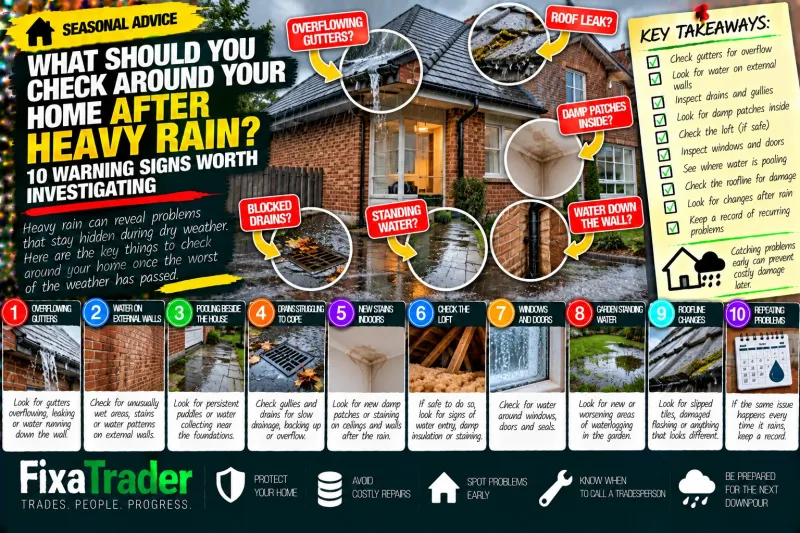
Dry weather can hide drainage problems.
When safe to do so, look outside during sustained rain.
You can often learn more in five minutes than you would from inspecting everything while dry.
Watch:
Gutters.
Downpipes.
Drains.
Flat-roof discharge points you can see safely.
Paved areas.
And places where water collects.
You're looking for water going somewhere unexpected.
Over the gutter.
Down the wall.
Across a doorway.
Pooling beside the building.
Or backing up from a drain.
Don't wait outside during dangerous weather simply to inspect the house, but ordinary rainfall provides useful clues.Know When the Problem Needs More Than a Broom
Leaf removal is basic maintenance.
But sometimes clearing the visible debris reveals another issue.
For example:
A gutter still overflows.
A downpipe remains blocked.
A drain won't clear.
A gutter is sagging.
Roof drainage appears damaged.
Water continues entering the property.
Brickwork remains persistently saturated.
Or timber has already deteriorated.
At that point, the leaves may only have helped expose the problem.
The next step is addressing the defect itself.A 15-Minute Autumn Walkaround Can Prevent a Lot of Trouble
You don't need an elaborate maintenance programme.
Every so often during heavy leaf fall, walk around the property.
Check the areas you can inspect safely:
Gutters from ground level.
Downpipe discharge points.
External drains.
Paths and steps.
Low-level vents.
The base of external walls.
Accessible timber.
Then look upwards from a safe position for obvious accumulation on roofs or around high-level drainage.
Clear what can be cleared safely.
Arrange appropriate help for what cannot.
Autumn leaves are inevitable.
Blocked drainage, slippery entrances and piles of wet debris sitting against the building don't have to be.
You don't need to keep every leaf away from your home—the important thing is keeping them away from the places your property relies on to drain water, move air and keep people safe.
0 Comments
No comments yet — be the first to share your thoughts.