Turning the Heating Back On? 10 Things to Check Before the Cold Weather Arrives
For months, the heating has barely crossed your mind. Then one evening the temperature drops. You turn the thermostat up. The boiler starts. Radiators begin war...
For months, the heating has barely crossed your mind.
Then one evening the temperature drops.
You turn the thermostat up.
The boiler starts.
Radiators begin warming.
And hopefully, that's the end of the story.
But the first few times you use your heating after summer are also a useful opportunity to notice problems while the weather is still relatively mild.
A radiator that doesn't heat properly in September is an inconvenience.
Discovering the same problem during a freezing January evening is considerably less convenient.
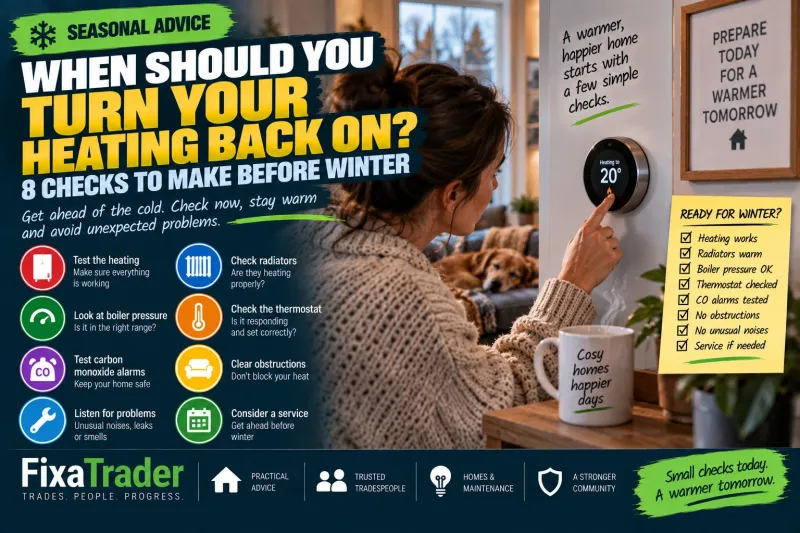
So before winter properly arrives, here are ten things worth checking.1. Turn the Heating On Before You Really Need It
Don't wait for the coldest day of the year to discover whether your heating still works.
Give it a proper test beforehand.
Set the controls so the heating should come on and allow enough time for the system to begin warming up.
You're looking for the basics:
Does the heat source respond?
Do the radiators begin warming?
Does the thermostat appear to control the system?
Are there any obvious warning messages or unusual behaviour?
You don't need to turn the house into a sauna.
You're simply confirming that the system starts and operates as expected.2. Walk Around and Check Every Radiator
Don't assume that because the living-room radiator is hot, everything else is fine.
Walk around the property.
Check each radiator.
You're looking for obvious differences.
One might remain completely cold.
Another may only warm partially.
One room may take considerably longer than the others.
If a radiator isn't behaving normally, note how it isn't heating.
A radiator that's cold at the top can point toward a different issue from one that's warm at the top but cold lower down.
That information can be useful if professional investigation is needed.3. Check the System Pressure Where Applicable
Many sealed heating systems have a pressure gauge or digital pressure reading.
If yours does, check it against the manufacturer's guidance for your particular appliance or system.
Don't assume there's one exact pressure that applies universally.
If the pressure is unusually low—or repeatedly falls after being corrected—that deserves investigation.
Continually topping up a system without establishing why the pressure keeps disappearing isn't a long-term solution.
We've covered this in more detail in our guide to boilers that repeatedly lose pressure, but the important seasonal check is simple:
Know what normal looks like for your system.4. Listen for Anything Unusual
Heating systems aren't necessarily silent.
Pipes can expand.
Water moves.
Boilers and pumps operate.
But you probably know roughly what your home normally sounds like.
Pay attention if you suddenly notice:
Banging.
Persistent gurgling.
Whistling.
Grinding.
Unusual vibration.
Or another sound that wasn't there previously.
A new noise doesn't automatically mean something serious has failed.
But if the system sounds noticeably different, don't ignore it for the entire winter and hope it disappears.5. Look for Small Leaks
Take a quick look around accessible heating components.
Radiator valves are particularly easy to overlook.
You may notice:
A small droplet.
Water staining.
Corrosion.
Dampness around a connection.
Or marks on the floor beneath a valve.
A tiny leak can be easy to dismiss because it isn't flooding the room.
But small leaks can contribute to pressure loss and may worsen over time.
It's much better to notice them during a deliberate check than when they eventually damage flooring or decoration.6. Make Sure Your Thermostat Makes Sense
Sometimes the heating system works perfectly well.
The controls are the problem.
Or more accurately, nobody remembers how the controls work.
Summer can be long enough to forget:
Which schedule is active.
What temperature has been set.
Whether holiday mode is still enabled.
What the different symbols mean.
Or how a smart thermostat was configured.
Check the time and programmed schedule if applicable.
If clocks change later in the season, make sure the controls handle that correctly too.
There's little point heating an empty house at 2pm because last year's schedule no longer matches how you live.7. Check Your Radiator Valves
If your radiators have thermostatic radiator valves (TRVs), make sure they can be adjusted normally.
A valve that's been sitting in one position for months may not behave exactly as expected when heating season returns.
Don't force components that appear seized.
And remember that a numbered TRV isn't usually a simple “power level” for the radiator—it responds to the temperature around it.
Use your heating controls as intended rather than automatically turning everything to maximum.8. Don't Immediately Bleed Every Radiator
“Bleed the radiators” appears on almost every autumn heating checklist.
But don't turn it into an annual ritual performed whether it's needed or not.
Bleeding can be appropriate when air has accumulated in a radiator, often indicated by characteristic cold areas toward the top.
But if all your radiators heat normally, randomly releasing water from them doesn't improve anything.
And on a sealed system, bleeding radiators can affect system pressure.
Identify a reason before reaching for the radiator key.9. Check Your Carbon Monoxide Alarms
If you have fuel-burning appliances, autumn is a sensible time to check that relevant carbon monoxide alarms are present, correctly located according to current guidance and manufacturer instructions, and functioning as intended.
Use the alarm's test function as directed by its manufacturer.
Also check whether the unit has reached its replacement date or end of service life.
Carbon monoxide cannot be reliably detected by smell or sight.
An alarm is therefore safety equipment—not something to leave with a dead battery until it starts chirping at 3am.
If a carbon monoxide alarm activates, follow the alarm manufacturer's safety instructions and appropriate emergency guidance rather than assuming it's a false alarm.10. Check When the Boiler Was Last Serviced
A heating test isn't a substitute for appropriate servicing.
If you have a boiler, check when it was last serviced and whether anything is due.
For gas appliances, relevant gas work must be carried out by an appropriately qualified Gas Safe registered engineer.
Other heating technologies have their own servicing and maintenance requirements, so follow the manufacturer's recommendations for the system you actually have.
Autumn can become a busy period for heating engineers, which is another reason not to leave known issues until temperatures collapse.What If the Heating Has Been Off for Months?
Don't panic if everything doesn't instantly behave exactly as expected within the first few seconds.
Give the system a reasonable opportunity to operate.
Then look at the overall pattern.
Are most radiators warming while one isn't?
Does the heating start and then stop unexpectedly?
Does the pressure change significantly?
Is an error being displayed?
Does one room never reach temperature?
Useful observations are much more valuable than simply telling an engineer:
“The heating doesn't work properly.”Don't Ignore a Problem Because the House Is Still Warm
This is one of the advantages of testing early.
You have time.
If a radiator isn't heating properly today, you're not necessarily sitting in a freezing house.
That gives you an opportunity to arrange investigation without the same urgency that comes during a cold snap.
Problems also have a habit of becoming much more noticeable when a system is suddenly expected to operate for many hours every day.
Deal with known issues while you still have options.Check the Rest of the House While You're at It
Heating efficiency isn't only about the heating system.
If the house struggles to retain warmth, look at obvious sources of unnecessary heat loss too.
Are windows closing properly?
Are external doors sealing reasonably?
Is there an obvious draught you've been ignoring?
Is loft insulation disturbed or missing in accessible areas?
Are curtains blocking radiators?
Have large pieces of furniture been placed directly in front of heat emitters?
Don't block intentional ventilation in an attempt to make the property warmer, but do distinguish necessary ventilation from unintended draughts.If Something Smells Wrong, Pay Attention
A little dust-related smell can sometimes be noticed when heating equipment that hasn't operated for a long time becomes warm again.
But persistent burning smells, visible scorching, smoke, gas smells or other obvious signs of danger shouldn't be dismissed as:
“It's probably because we haven't used it since spring.”
Stop and respond appropriately to the situation.
If you smell gas, follow the emergency guidance for your location. In Great Britain, the National Gas Emergency Service can be contacted on 0800 111 999.Make the First Heating Day a Test, Not an Emergency
The goal of an autumn heating check isn't to diagnose every component yourself.
It's to establish whether the home is behaving normally.
Turn the heating on.
Walk around.
Look.
Listen.
Check the controls.
Notice anything unusual.
If everything works, great.
If something doesn't, you've discovered it while there's still time to deal with it before the heating becomes something you depend on every day.
Winter will arrive whether the system is ready or not.
The best time to discover a heating problem isn't the first freezing night of winter — it's the mild autumn afternoon when you still have time to do something about it.
0 Comments
No comments yet — be the first to share your thoughts.