What Insurance Should a Tradesperson Consider? A Simple Guide to Understanding the Basics
Running a trade business involves risk. Most days, everything goes as planned. You complete the work, pack away your tools and move on to the next job. But occa...
You complete the work, pack away your tools and move on to the next job.
But occasionally, something doesn't go according to plan.
Property can be damaged.
A customer or member of the public could be injured.
Tools can be stolen.
A vehicle can be involved in an accident.
An employee could be injured while working.
Insurance can't prevent these things from happening.
But the right cover can play an important role in protecting a business when something unexpected does happen.
The difficulty is that there isn't one single insurance policy that automatically covers every tradesperson against every possible risk.
The cover you may need depends on the work you do, how your business operates, whether you employ people and what equipment or vehicles you rely on.
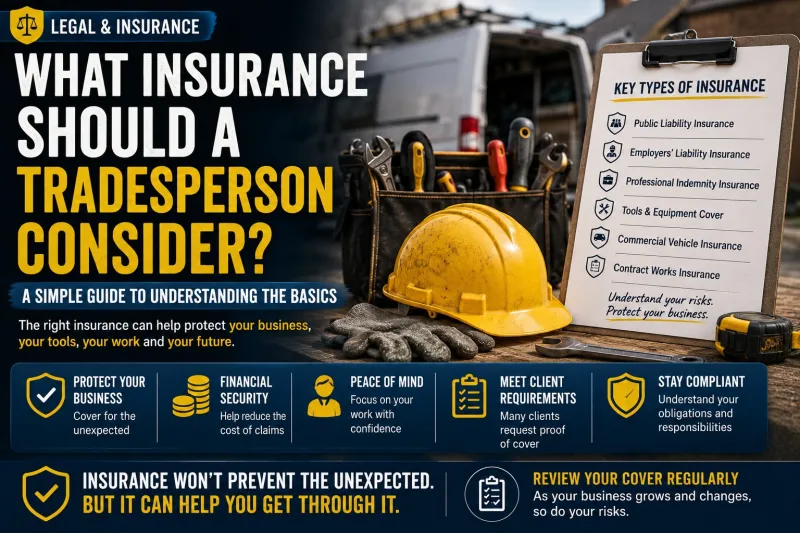
Here is a straightforward look at some of the main types of insurance tradespeople may want to understand.1. Public Liability Insurance
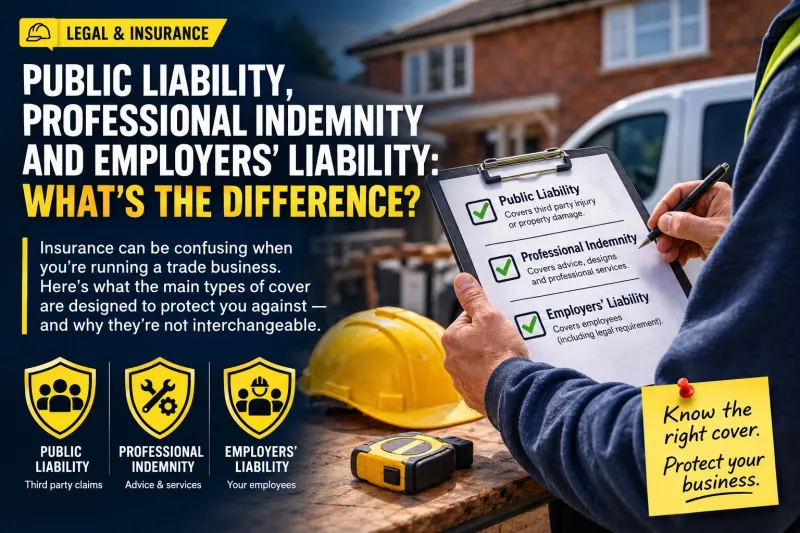
Public liability insurance is one of the types of cover most commonly associated with trade businesses.
It can provide protection in certain circumstances where your work or business activities cause injury to another person or damage to their property.
For example, imagine you're carrying equipment into a customer's property and accidental damage occurs.
Or someone is injured as a result of your business activities.
The exact circumstances in which a policy responds will depend on its terms, conditions and exclusions.
That's an important point.
Having insurance doesn't mean every possible situation is automatically covered.
You need to understand what the policy actually includes.
Some customers, commercial clients or contractors may also require evidence of public liability cover before allowing work to begin.
When comparing policies, consider the type of work you carry out and the level of cover being offered rather than simply choosing the cheapest available option.2. Employers' Liability Insurance
If you employ people, employers' liability insurance is another important area to understand.
In the UK, employers are generally required to have employers' liability insurance when they employ staff, although exemptions can apply in certain circumstances.
The purpose is broadly to provide cover for certain claims involving employees who become injured or ill as a result of their work.
Exactly who counts as an employee for insurance purposes and whether an exemption applies can depend on the circumstances.
If you're unsure about your obligations, don't guess.
Speak to an insurer, insurance adviser or another appropriately qualified professional who can advise based on how your business operates.
As a business grows and begins bringing other people into the work, insurance requirements can become more complicated.
It's worth reviewing them before assuming an existing policy automatically covers everyone working with you.3. Professional Indemnity Insurance
Professional indemnity insurance may be relevant where your business provides professional advice, designs, specifications or other services that customers rely upon.
This can be particularly important for some trades and specialist businesses where the work extends beyond physically carrying out an installation or repair.
For example, if your role involves advising a client, producing designs or making professional recommendations that influence a project, you may want to understand whether professional indemnity cover is relevant to your business.
Again, the details matter.
Don't assume that because two businesses work in a similar industry, they automatically need identical cover.
The services you actually provide are what matter.4. Tools and Equipment Cover
For many tradespeople, tools aren't simply possessions.
They're how you earn a living.
If essential equipment is stolen or damaged, the cost isn't necessarily limited to replacing it.
You may also lose income if you can't complete scheduled work.
That's why tools and equipment cover can be worth considering.
When comparing policies, look carefully at questions such as:
Where are your tools covered?
Are they covered while in a vehicle?
Are there conditions around overnight storage?
Is there a maximum value per item?
Are certain types of equipment excluded?
Does the policy cover accidental damage as well as theft?
A policy may sound comprehensive until you look at the circumstances in which a claim could be excluded.
Knowing how and where you normally store your equipment can help you assess whether a particular policy is actually suitable.5. Commercial Vehicle Insurance
If you use a van or other vehicle for your business, make sure you understand whether your insurance reflects how the vehicle is actually used.
Business use can involve different requirements from purely personal use.
The cover required may depend on the vehicle, who drives it and how it is used as part of the business.
If you're carrying tools or materials, don't automatically assume the vehicle policy also provides cover for everything inside it.
Tools and stock may be subject to separate limits, conditions or entirely separate insurance arrangements.
Always check the policy rather than relying on assumptions.6. Contract Works and Ongoing Projects
For larger projects, construction or renovation work, there can be additional risks associated with the work itself.
Materials may be damaged.
Partially completed work could be affected by an unexpected event.
Equipment and supplies may be exposed on site.
Depending on the type of projects you undertake, you may need to understand whether specialist cover is appropriate.
This is particularly important if you're taking responsibility for a larger site or contract.
Don't wait until something goes wrong to discover who was responsible for insuring part of the project.
Before starting significant work, understand what your contract says and where your responsibilities begin and end.7. Don't Assume Every Subcontractor Is Covered by Your Policy
Working with subcontractors can make insurance more complicated.
Who is responsible for what?
Are they genuinely operating independently?
What insurance do they hold themselves?
Does your own policy extend to the work they carry out?
The answer isn't always obvious.
Before bringing other people onto a project, make sure you understand the insurance arrangements rather than assuming everyone is automatically covered under one policy.
You may also need to consider checking that subcontractors hold appropriate insurance for the work they are carrying out.
The details will depend on the working arrangement and the policies involved.8. The Cheapest Policy Isn't Always the Best Value
This should sound familiar to anyone who regularly quotes for work themselves.
Customers often compare the number at the bottom of a quote without comparing everything included.
Insurance works in a similar way.
A cheaper premium can be attractive.
But what has been excluded?
What are the excesses?
Are the limits appropriate?
Does the policy actually cover the type of work you do?
Are there important conditions you need to meet?
The right policy isn't necessarily the most expensive one either.
The goal is to find cover that is appropriate for the real risks your business faces.9. Review Your Cover as Your Business Changes
The insurance that suited your business when you first started may not still be appropriate a few years later.
Your business might grow.
You might employ people.
Buy more expensive equipment.
Take on larger contracts.
Add new services.
Purchase additional vehicles.
Move into specialist work.
These changes can affect the risks your business faces.
Reviewing insurance shouldn't necessarily be something you only think about when renewal arrives.
If the way your business operates changes significantly, it may be worth checking whether your existing arrangements still reflect reality.10. Read the Details Before You Need to Make a Claim
Nobody enjoys reading policy documents.
But understanding the basics before something goes wrong is far better than discovering an important condition afterwards.
Pay particular attention to:
What is covered
What isn't covered
Policy limits
Excesses
Conditions you must meet
Security requirements
Geographical limits
Types of work excluded from cover
If something isn't clear, ask.
Insurance terminology can be complicated, and it's reasonable to want an explanation before committing to a policy.Insurance Is About Understanding Your Risks
The aim isn't to buy every possible type of insurance.
And there is no universal policy that is automatically right for every plumber, electrician, builder, decorator or other tradesperson.
The first step is understanding how your business operates.
What could realistically go wrong?
What would the financial impact be?
Which risks could your business absorb?
Which ones could cause serious problems?
Once you understand that, you're in a better position to ask the right questions about insurance.Protecting the Business You've Built
For a tradesperson, a business can take years to build.
Your reputation.
Your customer base.
Your equipment.
Your vehicles.
Your ability to keep earning.
Insurance is one part of protecting that.
But it only works as intended when the cover is appropriate for the work you actually do.
Don't simply renew a policy every year without checking it.
Don't choose purely on the lowest premium.
And don't assume something is covered because it sounds like it should be.
The best time to understand your insurance is before you ever need to use it.
Know what your business is protected against — and just as importantly, know where the gaps might be.
This article provides general information only and is not legal or insurance advice. Insurance requirements and policy cover depend on individual circumstances and specific policy terms. If you're unsure what cover is appropriate for your business, seek advice from an authorised insurer, broker or suitably qualified professional.
0 Comments
No comments yet — be the first to share your thoughts.