The Customer Has Cancelled the Job: What Should Tradespeople Do Next?
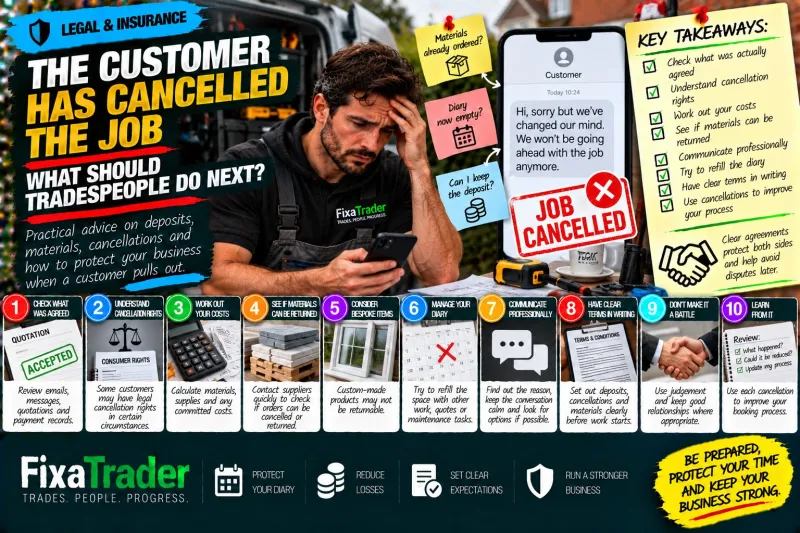
The materials have been ordered. You've blocked three days out of the diary. Another customer has already been told you're unavailable. Then the message arrives...
Another customer has already been told you're unavailable.
Then the message arrives:
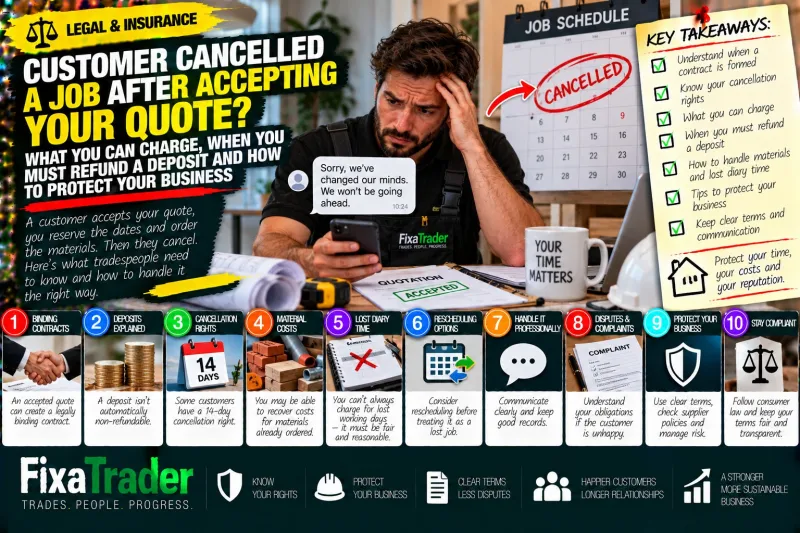
“Sorry, we've changed our mind. We won't be going ahead anymore.”
Sometimes there's plenty of notice.
Sometimes it's the evening before you're supposed to start.
For a tradesperson, a cancellation isn't necessarily just a job you didn't win. Once work has been agreed, you may already have committed time and money to delivering it.
But that doesn't mean every cancelled job should immediately become a dispute.
The best response usually starts much earlier — with clear terms, good records and an understanding of exactly what has been agreed.1. First, Establish What Has Actually Been Agreed
There's an important difference between:
“Thanks for the quote, I'll think about it.”
and:
“Yes, please go ahead. Monday the 19th works for us.”
Before deciding how to handle a cancellation, look at the actual communication.
Was the quotation accepted?
Was a start date agreed?
Was a deposit paid?
Were materials ordered?
Was anything bespoke or made specifically for the customer?
Has any work already started?
Was the agreement made at the customer's home, over the phone, online or at your business premises?
The circumstances matter.
Don't rely entirely on what you remember from a telephone conversation three weeks ago.
Emails, messages, accepted quotations, invoices and payment records can provide a much clearer picture.2. Don't Assume a Deposit Is Automatically Yours
One of the first questions after a cancellation is often:
“Can I keep the deposit?”
There isn't a sensible universal answer.
Calling a payment a non-refundable deposit doesn't necessarily mean a business can automatically keep the entire amount regardless of what has happened.
Consumer contracts and cancellation charges need to be fair, and the circumstances surrounding the agreement can affect the customer's rights.
For example, there is a major difference between retaining money to reflect genuine costs or losses and using a disproportionately large payment as a punishment for cancelling.
So don't create a policy that simply says:
“All deposits are non-refundable under all circumstances.”
and assume those words settle every possible situation.
Your terms should be reasonable, clear and appropriate to the work you undertake.
For specific disputes or significant sums, professional legal advice may be appropriate.3. Understand That Some Customers May Have Cancellation Rights
Tradespeople who contract with consumers need to be particularly careful when agreements are made away from their own business premises or at a distance.
UK consumer law can provide cancellation rights in certain circumstances, including a 14-day cancellation period for many distance and off-premises contracts, although the exact rules and exceptions depend on how the contract was formed and what is being supplied.
This becomes particularly relevant when a customer accepts work:
Online.
By telephone.
By email.
Or during a visit to their home.
There are also specific considerations where the customer wants work to begin during a cancellation period, as well as circumstances involving urgent repairs and bespoke goods.
The important lesson isn't to try to memorise every legal exception.
It's to make sure your booking process reflects the type of contracts your business actually enters into.
If you're routinely agreeing substantial domestic work in customers' homes, proper terms and cancellation information are worth getting right.4. Find Out Why the Customer Is Cancelling
You don't need to interrogate them.
A simple question can be useful:
“No problem. Before I update everything, can I ask whether the project has been cancelled completely or whether you're looking to postpone it?”
You may discover that:
Their finances have changed.
Another part of the project has been delayed.
They're waiting for planning or another approval.
A family situation has arisen.
They misunderstood the quotation.
They've chosen someone else.
Or they simply no longer want the work.
That distinction matters.
A customer postponing a £6,000 project for six weeks may still be a valuable future customer.
Treating them as though they've deliberately wasted your time could turn a temporary delay into a permanently lost relationship.5. Work Out What You've Already Spent
Once the position is clear, calculate the actual impact.
Perhaps you've already:
Ordered materials.
Paid a supplier.
Collected products.
Paid delivery charges.
Booked plant or equipment.
Paid subcontractors.
Spent time on preparatory work.
Or commissioned bespoke items.
Separate genuine committed costs from frustration about losing the job.
That's important.
A cancellation might be annoying, but annoyance isn't itself a business expense.
Knowing your actual position makes it much easier to have a reasonable conversation with the customer.6. Check Whether Materials Can Be Returned
If you've ordered standard materials, contact the supplier quickly.
Can the order be cancelled?
Can unopened goods be returned?
Will there be a restocking charge?
Has delivery already taken place?
Could the materials realistically be used on another job?
The answers can significantly change your loss.
Imagine you've purchased £800 of standard materials and the supplier accepts them back for a £50 collection or restocking fee.
Your position is very different from having £800 of bespoke products manufactured specifically for that customer's property.
Keeping good supplier records helps demonstrate what actually happened if the customer later questions a charge.7. Bespoke Items Need Particular Attention
Custom-made products can create one of the biggest risks when a customer cancels.
That might include certain:
Windows.
Doors.
Worktops.
Joinery.
Fabricated metalwork.
Made-to-measure components.
Or specially ordered finishes.
A product manufactured specifically for one property may have little or no value elsewhere.
This is why businesses supplying bespoke goods should think about cancellation before ordering them.
Make clear:
When the order becomes committed.
What is being manufactured.
What payment is required.
What happens if the customer later cancels.
And whether changes can be made once production begins.
A vague conversation followed by a large bespoke order leaves everyone exposed.8. An Empty Diary Is a Real Business Problem
Materials aren't the only consequence.
Suppose you've reserved four days for a bathroom installation.
The customer cancels the night before.
You might technically have spent very little on materials.
But finding another four-day project starting tomorrow could be impossible.
That lost capacity matters to a business.
This is one reason cancellation terms exist.
However, it doesn't mean every empty day automatically becomes chargeable at your full expected job value.
Consumer-facing cancellation charges should be approached carefully and fairly, taking account of the actual circumstances and applicable law.
From a business perspective, the bigger lesson is to reduce your exposure through sensible booking processes rather than relying on arguments after the cancellation happens.9. Try to Refill the Space
Once a job disappears, act quickly.
Look through:
Customers waiting for smaller jobs.
Quotes where someone wanted an earlier date.
Maintenance work you've postponed.
Existing customers waiting for additional work.
Administrative tasks.
Quotations and site visits.
Training.
Vehicle or workshop maintenance.
Content and portfolio updates.
A cancellation may still hurt revenue, but recovering even part of the time reduces the loss.
This is also where maintaining a healthy pipeline helps.
If your diary contains only confirmed jobs and no active enquiries behind them, a cancellation creates a much bigger hole.10. Put Cancellation Terms in Writing Before Problems Happen
The worst time to invent a cancellation policy is after someone has cancelled.
Your terms should explain the process clearly enough that both sides understand what they're agreeing to.
Depending on your business and the type of work, that may include information covering:
Deposits.
Cancellation.
Changes to booked dates.
Ordered materials.
Bespoke products.
Access.
Customer-supplied items.
Additional work.
Payment stages.
And delays.
The terms need to suit your actual business rather than being copied blindly from another tradesperson's website.
A sole trader completing £150 repairs has very different commercial risks from a contractor undertaking £40,000 renovations.
For important contractual documents, having appropriate professional advice when creating them can be money well spent.Don't Hide Important Terms in Tiny Print
A technically comprehensive document isn't necessarily a good one.
If a condition could significantly affect the customer, make it clear.
For example, if accepting a quotation and paying the deposit means you're immediately ordering a custom-made product, the customer should understand that.
Good terms aren't designed to catch people out.
They're designed to prevent two people walking away from the same agreement with completely different expectations.Keep a Clear Trail of Changes
Jobs evolve.
The customer originally books for May.
They move it to June.
Then July.
The specification changes.
Materials are added.
A deposit is transferred.
Eventually, they cancel.
Without records, it becomes difficult to establish what happened.
You don't need a complicated legal system.
For many businesses, consistent use of written quotations, emails, messages, invoices and variation records already provides a much better trail.
After an important telephone conversation, you can also confirm the outcome in writing.
For example:
“Just confirming our call today: we've moved the start date to 14 July and everything else remains as quoted.”
That's useful for both parties.Don't Turn Every Cancellation Into a Battle
There will be situations where pursuing a relatively small loss makes little commercial sense.
Perhaps a regular customer gives reasonable notice.
Perhaps you've been able to refill the dates immediately.
Perhaps the materials can all be returned.
Perhaps someone has cancelled because of genuinely difficult circumstances.
That doesn't mean ignoring your terms.
It means using judgement.
The objective should be protecting the business fairly — not extracting the maximum possible amount from every cancelled booking.
A professional response can preserve a relationship even when the original project doesn't happen.But Don't Be Afraid to Protect Your Business Either
The opposite mistake is absorbing every cancellation without question.
If you repeatedly:
Order materials without sufficient commitment.
Reserve weeks of your diary without clear terms.
Allow customers to move dates indefinitely.
Or accept substantial projects on nothing more than a verbal “yeah, let's do it,”
your business is carrying nearly all the risk.
Professionalism works both ways.
Customers deserve fair treatment and clear information.
Tradespeople deserve clarity about the commitments being made to them.Use Every Cancellation to Improve the Process
When a cancellation costs you money, review what happened.
Could the risk have been reduced?
Did you order too early?
Was the deposit structure appropriate?
Were your cancellation terms clear?
Did the customer actually confirm the booking?
Could materials have been ordered later?
Did you reserve too much diary space without sufficient commitment?
Was the project dependent on something else happening first?
Not every cancellation can be prevented.
But repeated problems often reveal weaknesses in the booking process.
Fixing those weaknesses is more valuable than simply becoming stricter with every future customer.Clear Agreements Protect Both Sides
Most customers aren't planning to cancel when they book a tradesperson.
And most tradespeople aren't trying to trap customers into paying for work they no longer want.
Problems usually arise when circumstances change and nobody is quite sure what was agreed.
That's why the best protection isn't an aggressive cancellation policy.
It's a professional process.
Clear quotation.
Clear acceptance.
Clear terms.
Clear payment arrangements.
Clear communication when circumstances change.
And good records throughout.
If a customer eventually cancels, you'll be in a much better position to work out what's reasonable, what costs have genuinely been incurred and what should happen next.
A cancelled job doesn't always have to become a dispute — but the time to decide how cancellations work is before one lands in your diary.
0 Comments
No comments yet — be the first to share your thoughts.