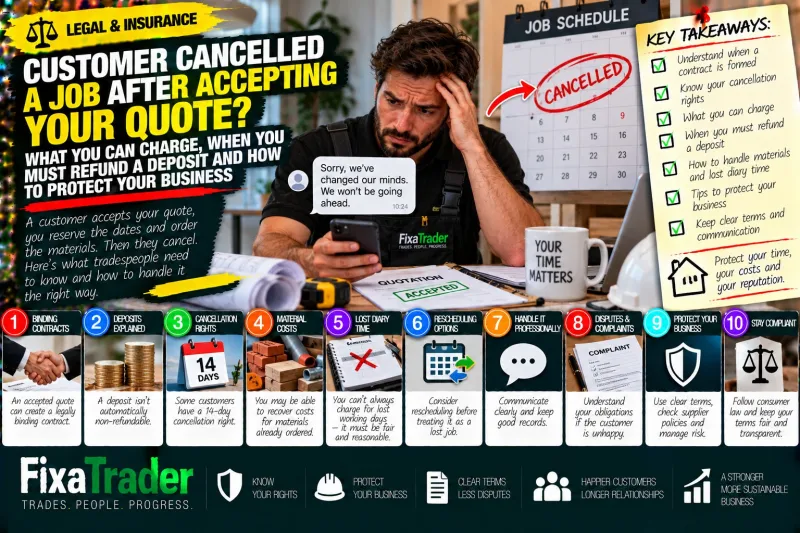
What Happens When a Customer Cancels a Job? A Guide to Deposits, Cancellation Fees and Your Rights as a Tradesperson
You've quoted for a job. The customer has accepted. You've blocked out three days in your diary, turned down other enquiries and perhaps ordered materials speci...
You've blocked out three days in your diary, turned down other enquiries and perhaps ordered materials specifically for their property.
Then, two days before you're due to start, the customer sends a message.
"Sorry, we've changed our minds. We won't be going ahead."
For the customer, it might seem like a straightforward cancellation.
For you, it could mean lost working days, unrecoverable material costs and disruption to other bookings.
But can you charge a cancellation fee?
Can you keep the deposit?
And what happens if the customer argues that no work has actually been completed?
The answer depends on the agreement, how and where the contract was formed, the circumstances of the cancellation and the consumer protection rules that apply.
For UK tradespeople, understanding those distinctions is important.
A cancelled booking doesn't automatically mean you can keep every payment received. But it doesn't necessarily mean you must absorb every loss either.
Here's what you need to know.1. An Accepted Quotation Can Create a Binding Contract
One of the biggest misunderstandings in the trades industry is that a contract only exists when something has been signed.
That isn't necessarily true.
A legally binding agreement can arise through emails, messages, verbal discussions or other conduct, provided the legal requirements for forming a contract are met.
For example, you might send a quotation describing the work and price.
The customer replies confirming they want to proceed.
You agree the start date.
Depending on the circumstances, that exchange may establish a contract even without a formal signature.
However, not every quotation or informal conversation creates a binding agreement.
The wording, outstanding conditions and intentions of the parties matter.
The practical lesson: Make sure customers understand when they are accepting a quotation and what that acceptance means.
A clear written confirmation is far easier to rely on than an uncertain telephone conversation.2. A Deposit Isn't Automatically Non-Refundable
Many tradespeople request deposits before starting work.
That may be perfectly reasonable, particularly where materials must be purchased or significant diary time reserved.
But describing a payment as a non-refundable deposit doesn't automatically make it lawful to retain the entire amount.
Consumer contract terms must be fair.
Under the Consumer Rights Act 2015, terms requiring customers to pay disproportionately high compensation when they cancel may be considered unfair.
The Competition and Markets Authority (CMA) advises that businesses should generally retain only an amount that reflects their legitimate losses, rather than treating cancellation payments as an opportunity to make a profit.
For example, if a customer pays a £1,000 deposit and cancels before you've incurred any meaningful costs, keeping the entire amount may be difficult to justify.
But if you've purchased non-returnable materials and incurred other reasonable losses, retaining an appropriate amount may be justified, subject to the contract and applicable law.
A deposit should protect legitimate business interests, not operate as an automatic penalty.3. Understand the Customer's Cancellation Rights
Some customers have statutory rights to cancel certain contracts within 14 days.
These rights commonly arise under the Consumer Contracts (Information, Cancellation and Additional Charges) Regulations 2013.
Whether they apply depends on how and where the contract was formed.
For example:
Distance contracts: Certain contracts concluded entirely through distance communication, such as online or telephone arrangements.
Off-premises contracts: Certain contracts made away from your business premises, including some agreements concluded in a customer's home.
On-premises contracts: These generally do not carry the same automatic 14-day cancellation right.
The rules contain exceptions and detailed requirements.
A quotation discussed during a home visit isn't automatically an off-premises contract in every circumstance; the actual contract formation process matters.
Similarly, not every agreement made using a phone or email qualifies as a regulated distance contract.
If statutory cancellation rights apply, you may also have obligations to provide specific information about those rights.
Failure to provide the required information can extend the cancellation period.
Don't assume that an accepted quotation always removes the customer's legal right to cancel.4. What If the Customer Wants Work to Start Within 14 Days?
This is particularly relevant for urgent repairs and short-notice bookings.
A customer might accept a quotation on Monday and ask you to begin work on Wednesday.
If the contract is subject to statutory cancellation rights, starting during the cancellation period requires particular care.
The customer may need to make an express request for the service to begin before the cancellation period expires.
Where the legal requirements are satisfied, a customer who subsequently cancels may be required to pay a proportionate amount for services already supplied.
Different rules can apply where a service has been fully performed, and the necessary acknowledgements and information have been provided.
The details matter.
A statement such as "Deposits are non-refundable once work starts" isn't a reliable substitute for complying with the regulations.
For businesses regularly arranging work in customers' homes, reviewing the applicable cancellation requirements before drafting standard terms is worthwhile.5. Can You Charge for Materials You've Already Ordered?
Materials are one of the most common reasons cancellation becomes expensive.
Perhaps you've ordered:
Bespoke windows.
A made-to-measure kitchen component.
Specialist flooring.
Custom-fabricated metalwork.
Materials that cannot be returned without substantial charges.
If the customer cancels, you may be left with products that cannot easily be used elsewhere.
Whether you can recover those costs depends on the contract, the applicable cancellation rules and the actual loss incurred.
There are also specific statutory exceptions concerning certain goods made to a consumer's specifications or clearly personalised.
However, those exceptions shouldn't automatically be applied to every contract involving bespoke materials or installation services.
Keep evidence of orders, supplier terms, cancellation charges and any refunds or credits received.
If materials can reasonably be returned or reused, that may affect the amount of loss you can justify.6. Can You Charge for Lost Working Days?
This is where disputes often become more complicated.
A customer cancels a three-day job.
You can't find replacement work at short notice.
Can you charge for all three days?
Not automatically.
Any contractual cancellation charge must be fair and proportionate.
A business may have a legitimate claim for losses caused by a breach of contract, but the amount recoverable depends on the circumstances.
You generally need to consider whether the loss was caused by the cancellation and what reasonable steps could have been taken to reduce it.
For example, if you successfully fill the cancelled dates with another paying job, that may reduce your actual loss.
A cancellation clause demanding the full contract price regardless of when the customer cancels or what costs you've avoided may be vulnerable to challenge.
The aim should be recovering reasonable losses, not charging customers as though the cancelled work had been completed.7. Why Clear Cancellation Terms Matter
Many disagreements arise because cancellation was never discussed.
The tradesperson assumes the deposit protects their booking.
The customer assumes they can change their mind without financial consequences.
Neither fully understands the other's expectations.
Clear terms can reduce that uncertainty.
Before the customer commits, explain:
When the booking becomes confirmed.
Whether a deposit is required.
What the deposit is intended to cover.
How the customer can cancel.
What reasonable charges may apply.
How materials and work already completed will be handled.
Any statutory cancellation rights that apply.
These terms should be communicated before the contract is formed.
They should also be written clearly rather than hidden in lengthy, confusing documents.
Remember that putting a term in writing doesn't automatically make it enforceable.
It must still comply with consumer law.8. What Should You Do When a Customer Cancels?
The first response shouldn't automatically be a demand for payment.
Start by establishing the situation.
A practical approach is to:
Confirm the cancellation in writing. Record the date and what the customer has requested.
Review the agreement. Check the accepted quotation, terms and any statutory cancellation rights.
Identify work already completed. Include relevant planning or preparatory services where recoverable.
Check material orders. Establish what can be cancelled, returned or reused.
Calculate reasonable losses. Consider costs incurred, savings and opportunities to reduce the loss.
Explain your position. Provide an understandable breakdown of any amount you propose to retain or charge.
Keep records. Save relevant messages, invoices, supplier correspondence and payment details.
Sometimes the cancellation can be resolved without disagreement.
The customer may accept a reasonable deduction once they understand the costs involved.
In other cases, the contract or statutory rights may require a full refund.9. Consider Rescheduling Before Treating It as a Lost Job
Not every cancellation means the customer no longer wants the work.
Perhaps their circumstances have changed.
A delivery has been delayed.
They need more time to arrange finance.
Or another part of the renovation isn't ready.
Before discussing cancellation charges, it may be worth asking whether they want to postpone.
A revised date could preserve the customer relationship and reduce the financial impact.
However, rescheduling should be mutually agreed.
You shouldn't assume a customer has accepted new dates or additional charges simply because you suggested them.
If a revised arrangement is reached, confirm it in writing.
Sometimes flexibility protects the business more effectively than immediately escalating a dispute.10. Don't Let One Cancellation Damage Your Reputation
Losing a booking is frustrating, especially when you've already invested time and money.
But how you respond matters.
Aggressive messages, threats or demands for charges you cannot justify can turn a manageable disagreement into a much bigger problem.
A professional approach doesn't mean surrendering legitimate rights.
It means explaining your position clearly, providing evidence and allowing the customer to understand the calculation.
If a dispute cannot be resolved directly, consider appropriate dispute-resolution options or independent legal advice.
For smaller sums, the cost and time involved in pursuing a claim should also form part of your commercial decision.
Protecting your reputation and protecting your finances don't have to be competing priorities.What About Customers Who Cancel Because They're Unhappy With Your Work?
Not every cancellation is simply a change of mind.
A customer may want to end the contract because they believe the work is defective, delayed or not being carried out as agreed.
That situation is different.
Under the Consumer Rights Act 2015, services supplied to consumers must generally be performed with reasonable care and skill.
Other legal rights and remedies may apply depending on the circumstances.
A business shouldn't automatically impose its ordinary cancellation charges when the customer is exercising a valid legal remedy for a breach.
Equally, an allegation of poor workmanship doesn't automatically establish that the customer is entitled to every remedy they demand.
The facts, evidence and contractual obligations matter.
Where there is a genuine dispute about performance, seek advice rather than relying solely on a standard cancellation clause.Should You Ask for Larger Deposits on Bigger Jobs?
A larger project may involve greater upfront expenditure.
But that doesn't mean a larger non-refundable deposit is always appropriate.
Consider the actual commercial risk.
If you're purchasing expensive bespoke materials, a clearly explained advance payment may be reasonable.
For longer projects, staged payments linked to agreed milestones may sometimes provide a better balance.
The structure should reflect the work and remain fair to the consumer.
Avoid requesting large upfront payments without a clear explanation of what they cover.
Customers may reasonably want reassurance about how their money will be used and what happens if the project doesn't proceed.How Can You Reduce the Financial Impact of Cancellations?
You won't eliminate every cancellation.
But you can make the business less vulnerable.
Consider introducing a consistent booking process, documenting acceptance and explaining cancellation terms before customers commit.
Avoid ordering expensive materials until the necessary arrangements are confirmed.
Check supplier return policies before placing specialist orders.
Keep a list of customers who may be interested in earlier appointments if space becomes available.
And consider whether your cash reserves are sufficient to withstand occasional lost bookings.
None of these measures guarantees that every cancelled job will be financially neutral.
But they can reduce avoidable disruption.The Difference Between Protecting Your Business and Penalising Customers
Cancellation terms exist for a legitimate reason.
Tradespeople commit time, resources and money when accepting work.
Those commitments can create genuine losses when a customer cancels.
But consumer law also protects customers from unfair terms and excessive charges.
A fair approach recognises both sides.
The customer should understand their obligations before agreeing to the work.
The tradesperson should be able to explain any reasonable loss.
And any statutory cancellation rights must be respected.
The strongest position is usually one supported by clear communication, appropriate terms and accurate records.
A cancelled job can cost your business money, but the amount you're entitled to recover should be based on the agreement, applicable law and the circumstances — not simply the frustration of losing the booking.Sources and Further Reading
This article provides general information about UK consumer contract principles, with particular relevance to England, Wales and Northern Ireland. Scottish contract law and the application of particular remedies may differ. It is not legal advice; businesses should seek professional guidance when drafting terms or handling significant disputes.
0 Comments
No comments yet — be the first to share your thoughts.