Public Liability, Professional Indemnity and Employers' Liability: What's the Difference?
Insurance probably isn't the most exciting part of running a trade business. You'd rather be on the job, finishing projects, speaking to customers or planning t...
Insurance probably isn't the most exciting part of running a trade business.
You'd rather be on the job, finishing projects, speaking to customers or planning the next week's work.
But one of the realities of working professionally is that things don't always go according to plan.
Someone could be injured while you're working.
Property could be accidentally damaged.
A customer could claim that professional advice or work has caused them a financial loss.
Or you could have employees working for you who need to be covered appropriately.
This is where understanding the different types of business insurance becomes important.
The terminology can be confusing, particularly because public liability, professional indemnity and employers' liability cover very different risks.Public Liability Insurance
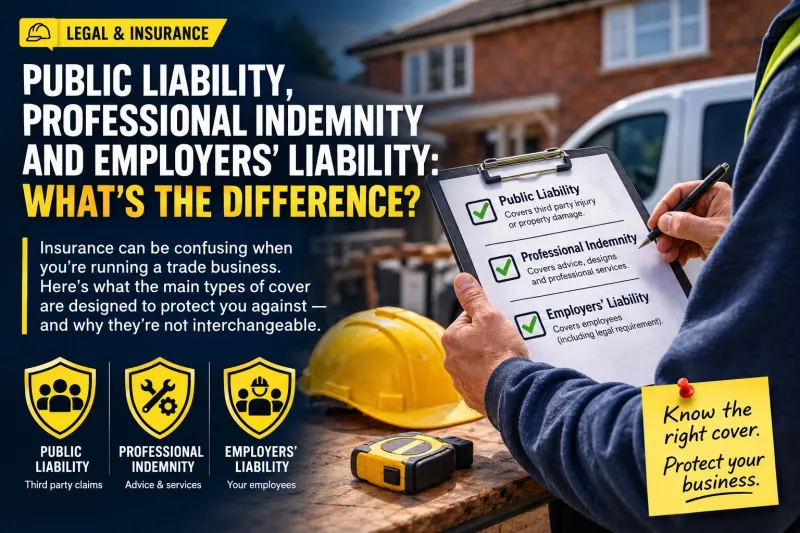
Public liability insurance is designed around claims from members of the public arising from your business activities.
For a tradesperson, that could potentially involve accidentally damaging a customer's property while carrying out work, or someone being injured in connection with your work.
Imagine a decorator accidentally damages an expensive floor while moving equipment.
Or a landscaper's work causes damage to a customer's property.
Or a member of the public is injured because of something connected to work being carried out.
These are the kinds of situations where public liability insurance can become relevant.
It's particularly important for tradespeople because you're regularly working in other people's homes, gardens, businesses and properties.
The exact cover, exclusions and limits will depend on the policy, so it's important to understand what your particular insurance actually covers rather than assuming every policy is identical.Professional Indemnity Insurance
Professional indemnity insurance is different.
It's generally associated with claims arising from professional advice, designs, specifications or services where a customer alleges that an error or omission has caused them a financial loss.
This can be particularly relevant to professionals whose work involves advice, design, calculations, consultancy or other professional services.
For example, a professional could provide advice or a design that a client later alleges was incorrect and caused them financial loss.
That isn't necessarily the same type of risk as accidentally breaking something while physically carrying out work.
This distinction is important because having public liability insurance doesn't automatically mean you have professional indemnity cover.
The two policies are designed around different risks.Employers' Liability Insurance
Employers' liability is concerned with another situation entirely: having employees.
If you employ people in your business, employers' liability insurance can provide cover for certain claims relating to injury or illness suffered by employees as a result of their employment.
For businesses that employ staff, this isn't simply another optional policy to consider. There are legal requirements around employers' liability insurance in the UK, including minimum levels of cover.
The rules can depend on the circumstances of the business and who is working for it, so anyone employing people should make sure they understand the requirements that apply to their particular situation.
And it's important not to assume that calling someone a "subcontractor" automatically means they are treated as self-employed for every purpose.
The actual working relationship matters.Why One Policy Doesn't Automatically Replace Another
It's easy to look at several insurance products and think:
"Surely I just need one good policy?"
Unfortunately, it's not quite that simple.
Different policies exist because businesses face different types of risk.
A plumber accidentally damaging a customer's flooring is a different situation from an engineer being accused of providing incorrect professional advice.
And both are different again from an employee being injured while carrying out their work.
That's why insurance should be considered in the context of what your business actually does.What About Tools and Equipment?
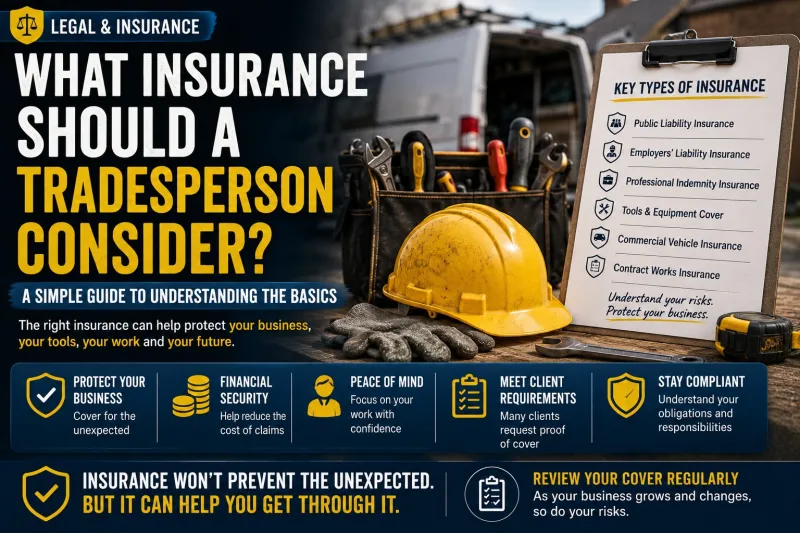
There are other types of business insurance that may be relevant depending on your circumstances.
For example, tradespeople may want to consider cover for tools, equipment, vehicles, stock or business premises.
A tradesperson who relies on thousands of pounds worth of equipment faces a very different financial risk if those tools are stolen from a vehicle overnight compared with someone whose work requires relatively little equipment.
Again, the important thing is understanding what is actually covered.
A policy described as "tools insurance" may have specific conditions around where equipment is stored, how vehicles are secured and what circumstances are covered.
Don't assume that the headline description tells you everything.The Level of Cover Matters Too
Another mistake is focusing only on whether a tradesperson has insurance.
The amount of cover and the terms of the policy matter as well.
A business might have public liability insurance, but the level of cover could be different from another business.
Some customers, commercial clients or contractors may also require particular levels of cover before allowing a business to work for them.
If you're taking on larger projects, it's worth checking whether the contractual requirements of the work place any specific insurance obligations on you.Insurance Doesn't Mean You Can Stop Being Careful
Insurance is there to help manage financial risk.
It isn't a replacement for proper training, safe working practices or professional standards.
A tradesperson should still make sure they're appropriately qualified for the work they're undertaking, follow relevant safety requirements and take reasonable steps to protect customers, employees and property.
The best approach is to think of insurance as one layer of protection within a professionally run business.What Should a Tradesperson Check?
If you're reviewing your business insurance, start with the basics.
Ask yourself:
Does my policy cover the actual work I carry out?
Are the limits appropriate for the size of my business and the jobs I undertake?
Do I have the right type of cover for the services I provide?
Are there exclusions that could affect my normal work?
If I employ people, am I meeting the relevant employers' liability requirements?
Are my tools, equipment and vehicles adequately covered?
Do particular customers or contracts require specific levels of insurance?
And perhaps most importantly:
Have my circumstances changed since I originally took out the policy?
A business can evolve surprisingly quickly.
A tradesperson who started out working alone on small domestic jobs might eventually take on larger contracts, employ staff, use subcontractors, operate commercial vehicles or begin offering additional services.
The insurance that made sense at the beginning may not necessarily be appropriate several years later.Insurance Is Part of Being Prepared
Nobody starts a trade business expecting something to go wrong.
That's exactly why insurance exists.
The goal isn't to spend every day worrying about hypothetical problems.
It's to make sure that if something does go wrong, your business isn't completely exposed to a financial risk it cannot absorb.
Public liability, professional indemnity and employers' liability aren't interchangeable products.
They exist because different businesses face different risks.
Understanding those differences is a small but important part of running a professional trade business.
And when you're building a reputation around doing good work, communicating properly and looking after your customers, having the right protection behind the business is another part of that professional picture.
0 Comments
No comments yet — be the first to share your thoughts.