How to Tell If Your Roof Needs Repair or Replacement: 9 Signs to Look For
Your roof is one of the most important parts of your home. It protects everything underneath it from rain, wind, snow and the elements. But because most of it i...
Your roof is one of the most important parts of your home.
It protects everything underneath it from rain, wind, snow and the elements.
But because most of it is out of sight, it's also something many homeowners don't think about until there is a problem.
A small leak appears on the ceiling.
A tile falls into the garden.
Water starts getting into the loft.
Suddenly, the condition of the roof becomes very important.
The good news is that roof problems don't always mean you need a completely new roof.
In many cases, a relatively small repair can address the issue.
The challenge is knowing when something is minor and when it may indicate a larger problem.
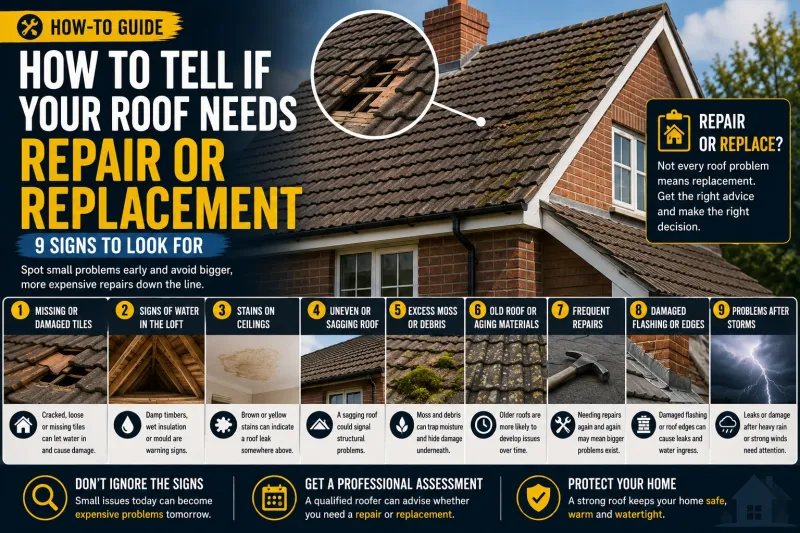
Here are nine signs worth looking out for.1. You Can See Missing or Damaged Tiles
One of the easiest warning signs to spot is a missing, cracked or visibly damaged roof tile.
You don't need to climb onto the roof to check.
From ground level, you may be able to identify obvious gaps or tiles that look different from the surrounding roof.
After periods of strong wind, it's particularly worth taking a look.
A single damaged tile doesn't automatically mean the roof needs replacing.
Depending on the type of roof and the extent of the damage, it may simply need repair.
But leaving damaged areas unattended can allow water to enter and potentially cause further problems.
If you're unsure about the condition of the roof, have it assessed rather than attempting to inspect it yourself.2. There Are Signs of Water in the Loft
The loft can provide useful clues about what's happening above it.
Look for signs such as:
Damp timber
Water stains
Damp insulation
Mould
A musty smell
Visible water marks
Wet areas after rainfall
Remember that water doesn't necessarily appear directly below the point where it enters.
It can travel along roof structures before becoming visible.
That means a damp patch in one location doesn't automatically identify the source.
If you notice recurring moisture after rainfall, it's worth finding out where it is coming from rather than simply treating the visible area.3. There Are Stains on Your Ceilings
A brown or yellow stain on a ceiling is something worth investigating.
Sometimes the cause can be relatively straightforward.
It could be related to a roof issue, plumbing problem, condensation or another source of moisture.
The important thing is that the stain shouldn't simply be painted over without understanding why it appeared.
If it returns after being painted, becomes larger or appears alongside other signs of damp, the underlying cause may still be active.
A professional assessment can help establish where the moisture is coming from.4. Your Roof Looks Uneven or Sagging
A roof should generally have a consistent appearance.
If you notice areas that appear to dip, sag or have changed shape, that is something worth taking seriously.
There can be different reasons for changes in the roof structure, and the significance depends on the construction and circumstances.
A visibly sagging roof isn't something to diagnose from ground level.
It's a reason to get appropriate professional advice.
The important point is not to assume that an unusual appearance is simply part of an older roof.
If the shape of the roof has noticeably changed, have it assessed.5. The Roof Has a Lot of Moss or Debris
Moss on a roof isn't automatically a sign that the entire roof needs replacing.
Some roofs naturally accumulate moss, particularly in shaded or damp environments.
However, significant moss growth can make it more difficult to see the condition of the roof surface.
Debris can also accumulate in areas where water needs to drain.
Rather than focusing purely on how the roof looks, consider whether there are other signs of deterioration underneath the moss or debris.
If you're concerned, a professional can assess the condition of the roof and advise whether cleaning or further work is appropriate.
Avoid attempting to remove large amounts of roof moss yourself if doing so would require unsafe access.6. Your Roof Is Getting Older
Age alone doesn't mean a roof needs replacing.
Different roofing materials have very different expected lifespans, and the condition of the roof matters just as much as its age.
A well-maintained older roof may continue performing effectively.
Meanwhile, a relatively newer roof can still develop problems.
Instead of asking only:
“How old is my roof?”
also consider:
“What condition is it in?”
If you don't know when the roof was installed or haven't had it checked for a long time, an inspection can give you a much clearer picture.7. You Keep Having Small Repairs
One isolated repair isn't necessarily concerning.
But if you're repeatedly paying to fix different parts of the same roof, it may be worth stepping back and looking at the bigger picture.
For example, you might have:
Replaced several tiles
Repaired flashing
Fixed recurring leaks
Addressed damaged roof edges
Dealt with repeated water ingress
At some point, the question may become whether continuing individual repairs makes sense compared with assessing the roof as a whole.
That doesn't automatically mean replacement is the right answer.
But repeated problems can be a reason to ask for a more comprehensive assessment.8. Your Flashing or Roof Edges Look Damaged
Some of the most vulnerable parts of a roof aren't the large areas of tiles themselves.
Pay attention to areas around:
Chimneys
Roof valleys
Extensions
Skylights
Junctions between different roof sections
Roof edges
These areas can involve additional materials and junctions where water needs to be directed away correctly.
Visible damage, deterioration or signs of water around these areas can indicate that something needs attention.
Again, the solution could be relatively minor.
A problem with flashing doesn't automatically mean the entire roof has reached the end of its life.9. Problems Appear After Heavy Rain or Strong Winds
Weather can reveal problems that aren't obvious during normal conditions.
After particularly heavy rain or strong winds, look for signs such as:
New ceiling stains
Water in the loft
Missing tiles
Loose roof components
Overflowing gutters
Damaged flashing
New damp patches
You don't need to climb onto the roof after a storm.
A simple visual check from a safe position can sometimes reveal that something has changed.
If you notice a problem, arrange an appropriate inspection rather than trying to investigate a roof yourself in unsafe conditions.Repair or Replace?
This is the question many homeowners really want answered.
Unfortunately, there isn't one universal rule.
A roof with a single damaged tile may only need a straightforward repair.
A roof with widespread deterioration, repeated failures or significant structural problems may require more extensive work.
The decision can depend on:
The roofing material
The age of the roof
The extent of the damage
The condition of the underlying structure
Previous repairs
Water damage
The expected remaining life of the existing roof
This is why getting an assessment can be more useful than trying to decide based purely on photographs or age.
A professional should be able to explain what they've found and why they recommend a particular course of action.Don't Let One Quote Decide the Diagnosis
If you're told that your roof needs significant work, it can be sensible to understand exactly why.
Ask questions such as:
What has been found?
Which parts of the roof are affected?
Can the existing problem be repaired?
What happens if I only carry out the immediate repair?
Is there evidence of wider deterioration?
What work is actually included in the quotation?
You don't need to challenge a professional simply for recommending work.
You're asking questions because you want to understand the decision.
A good tradesperson should be able to explain the problem without relying on technical language that leaves you none the wiser.Don't Try to Inspect the Roof Yourself
There is an important distinction between looking at your roof and climbing onto it.
A visual check from the ground can be useful.
Climbing onto a roof is a completely different matter.
Roofs can be slippery, fragile and difficult to access safely.
Even a seemingly simple inspection can involve significant risk.
If you need a closer assessment, use an appropriately qualified professional with suitable equipment and experience.
Your roof isn't worth risking a serious injury to inspect yourself.What About Roof Leaks?
If you have an active leak, don't wait simply because the visible amount of water seems small.
Water entering the property can affect ceilings, insulation, timber, electrical components and other parts of the building depending on where it travels.
If water is close to electrical equipment or fittings, treat the situation particularly seriously and avoid putting yourself at risk.
Where safe to do so, contain water inside the property and arrange appropriate professional assistance to identify and address the source.
The visible leak may only be part of the problem.A Roof Doesn't Have to Look Terrible to Need Attention
One of the biggest misconceptions about roof maintenance is that you'll obviously know when something is wrong.
That's not always the case.
A roof can look perfectly acceptable from the ground while having a small defect that allows water in.
Equally, a roof can look old or weathered while still performing adequately.
Appearance is useful information.
It isn't the whole diagnosis.
That's why regular visual checks and occasional professional assessments can be valuable, particularly for older properties or roofs that have experienced repeated problems.When Should You Get Your Roof Checked?
There isn't necessarily one specific month when every homeowner needs a roof inspection.
But there are some situations where getting one makes particular sense.
Consider an assessment if:
You've noticed a leak
Tiles appear damaged or missing
The roof has visibly changed shape
You're experiencing recurring damp
You've had multiple roof repairs
The roof is approaching the expected lifespan of its materials
You've recently experienced severe weather
You're buying or selling a property
You simply don't know the condition of an older roof
The purpose isn't to create unnecessary work.
It's to understand the condition of something that's difficult for most homeowners to assess themselves.Repair Early or Wait?
Waiting can sometimes seem like the sensible option when a problem isn't causing much disruption.
But with roofs, the visible problem isn't always the full problem.
A small defect that allows water into the building can potentially lead to additional damage if it remains unresolved.
That doesn't mean every minor roof issue needs an emergency call-out.
It means recurring or worsening problems shouldn't simply be ignored because they're currently manageable.
If you're unsure, get an assessment and find out what you're actually dealing with.The Goal Is to Know What You're Paying For
A roof repair or replacement can represent a significant expense.
That's why understanding the condition of your roof before committing to major work is important.
Ask for a clear explanation.
Find out what has been identified.
Understand what the proposed work will address.
And make sure you know whether the quotation is for a specific repair or a broader replacement.
You don't need to become a roofing expert.
You just need enough information to make an informed decision.Look Up Before You Look Out
Your roof is easy to forget because you rarely see it.
But a few minutes spent looking at the property from ground level can sometimes reveal changes worth investigating.
Missing tiles.
New damp.
Water stains.
Sagging.
Recurring repairs.
Damaged roof edges.
Problems after heavy weather.
None of these automatically means you need a new roof.
But they are reasons to pay attention.
A roof problem is usually easier to deal with when you know about it early.
Don't wait for the first bucket on the floor to tell you that your roof needs attention.
0 Comments
No comments yet — be the first to share your thoughts.