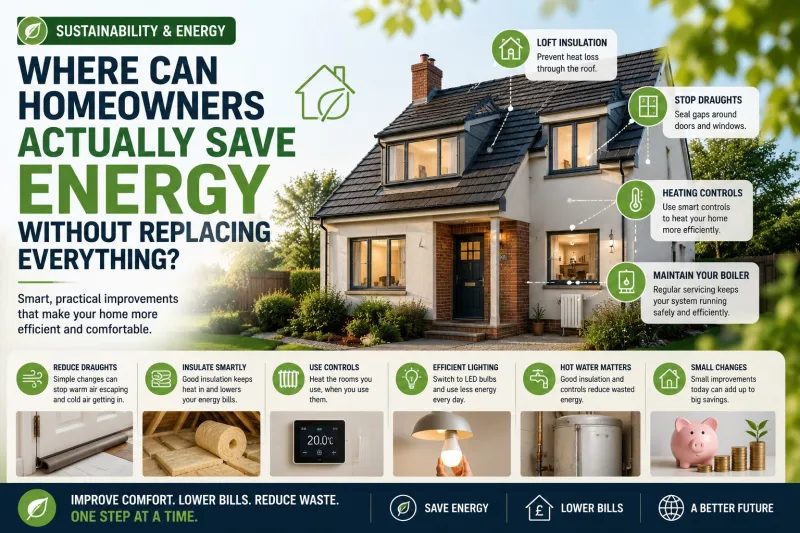
Where Can Homeowners Actually Save Energy Without Replacing Everything?
Improving the energy efficiency of your home can sound expensive. When people talk about making a property more efficient, the conversation often jumps straight...
Improving the energy efficiency of your home can sound expensive.
When people talk about making a property more efficient, the conversation often jumps straight to solar panels, heat pumps, new windows or major insulation projects.
Those can all have a place.
But they aren't the only options.
For many homeowners, there are smaller improvements that can make the home more comfortable, reduce unnecessary energy use and potentially lower running costs without turning the entire property upside down.
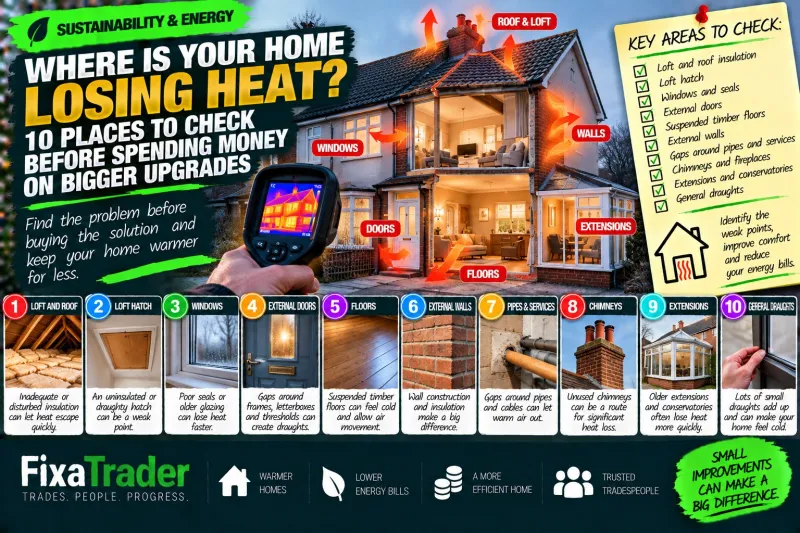
The important thing is understanding where your home is actually losing energy before spending money on improvements.Start With the Biggest Sources of Energy Use
Before buying anything, it helps to understand where energy is going.
For many homes, heating and hot water represent a significant proportion of household energy consumption.
That means improving the efficiency of the heating system, reducing heat loss and making the home easier to heat can often be more meaningful than focusing on small electrical appliances.
Every property is different, though.
The age and construction of the building, existing insulation, heating system, windows and ventilation all influence where improvements are likely to have the greatest effect.1. Reduce Draughts
Draughts are one of the simplest problems to identify.
Gaps around doors, windows and other openings can allow heated air to escape and cold air to enter.
Appropriate draught-proofing can make a room feel more comfortable without requiring major building work.
However, ventilation still matters.
A home shouldn't simply be sealed up without considering how fresh air is supplied and how moisture is removed.
Particularly in kitchens, bathrooms and other areas where humidity is produced, adequate ventilation remains important.2. Look at Loft Insulation
Heat rises, which makes the roof space an important area to consider.
If loft insulation is missing, damaged or inadequate, upgrading it can be one of the more straightforward ways of reducing heat loss from a property.
It's also an area where professional advice can be useful.
Insulation needs to be installed appropriately, and roof spaces still need to be considered in terms of ventilation, moisture and access.
The goal isn't simply to add as much material as possible.
It's to improve thermal performance while keeping the building healthy.3. Check Your Heating Controls
You don't necessarily need a completely new heating system to improve the way your home uses energy.
Heating controls can make a significant difference to how a system operates.
Depending on the property and existing installation, this could involve programmable controls, thermostatic radiator valves or other ways of controlling when and where heating is used.
The right approach depends on the heating system already installed.
Rather than replacing equipment simply because something newer exists, it can be worth understanding whether the current system is being controlled effectively first.4. Don't Ignore Your Boiler
If your home uses a boiler, its condition and efficiency matter.
A poorly maintained system may not operate as effectively as it should, while faults can become more expensive when they're allowed to develop.
Regular servicing and appropriate maintenance can help keep the system operating properly.
For gas appliances, any work that requires a registered gas professional should be carried out by someone appropriately qualified and registered for the work.
And if a boiler is approaching the end of its useful life, that's when it can make sense to start considering the longer-term options rather than waiting for an emergency breakdown.5. Improve Windows and Doors Where It Makes Sense
Replacing every window in a home isn't necessarily the first step towards better energy efficiency.
But poorly performing windows and doors can contribute to heat loss and uncomfortable rooms.
Sometimes relatively simple improvements, such as repairing damaged seals or addressing draughts, may be appropriate.
In other cases, replacement may make more sense, particularly where existing windows are old, damaged or performing poorly.
The important point is to consider the condition of what you already have rather than assuming that replacement is automatically the best answer.6. Insulate the Right Areas
Loft insulation isn't the only form of insulation worth considering.
Depending on the property, homeowners may also look at cavity wall insulation, solid wall insulation, floor insulation or pipe and hot water cylinder insulation.
But insulation isn't a one-size-fits-all decision.
The construction of the building matters.
A solution that works well for one property may not be appropriate for another, particularly in older buildings with different construction methods.
This is one area where professional assessment can be particularly valuable.7. Think About Hot Water
Energy isn't only used to heat rooms.
Hot water can also account for a significant amount of household energy use.
Simple measures such as appropriate hot water controls, insulation around relevant components and avoiding unnecessary heating can help reduce waste.
If you're considering replacing a cylinder, boiler or hot water system, it's worth looking at the entire setup rather than treating each component independently.
A heating professional can help determine what makes sense for the property and household.8. Make Lighting More Efficient
Lighting is one of the easier areas to address.
Modern LED lighting generally uses considerably less electricity than older incandescent lighting and can last significantly longer.
If you're still using older bulbs throughout your home, gradually replacing them as they need changing can be a simple improvement.
It isn't going to transform the energy performance of an entire house by itself.
But energy efficiency is often about adding up multiple sensible improvements rather than looking for one magic solution.9. Consider Renewable Energy Carefully
Solar panels and other renewable technologies can be worthwhile for some properties.
But they shouldn't automatically be the first recommendation for every homeowner.
Roof orientation, shading, available space, electricity usage and the property's wider energy setup all matter.
The same applies to technologies such as heat pumps.
The question shouldn't simply be:
"What's the newest technology?"
It should be:
"What's appropriate for this property?"
A professional assessment can help establish whether a particular technology is likely to make sense before a homeowner commits to a major investment.10. Don't Forget Comfort
Energy efficiency isn't purely about reducing a number on a bill.
A well-performing home should also be comfortable.
Cold rooms, draughts, condensation and inconsistent temperatures can all be signs that something about the building or heating system could be improved.
Sometimes the most useful improvement isn't the one with the biggest headline efficiency figure.
It's the one that makes the home easier to heat and more comfortable to live in.Don't Start With the Most Expensive Improvement
One of the biggest mistakes homeowners can make is assuming that energy efficiency requires a major project.
It doesn't always.
A home might benefit from better draught-proofing.
Another might need insulation.
Another might have an inefficient heating system.
Another might have a ventilation problem that needs addressing before additional insulation is considered.
There is no universal order that works for every property.
The sensible approach is to understand the building first and then prioritise the improvements that are most likely to make a meaningful difference.Think About the Whole Home
Energy efficiency works best when the different parts of the property are considered together.
Improving insulation changes how quickly heat leaves the building.
Heating controls determine when that heat is supplied.
Ventilation affects indoor air quality and moisture.
Windows and doors influence heat loss.
The heating system determines how heat is generated.
Changing one part of the system can therefore affect how the other parts perform.
That's why professional advice can be valuable for larger improvements.Small Improvements Can Still Add Up
Not every homeowner has the budget for a major retrofit.
That doesn't mean there's nothing worth doing.
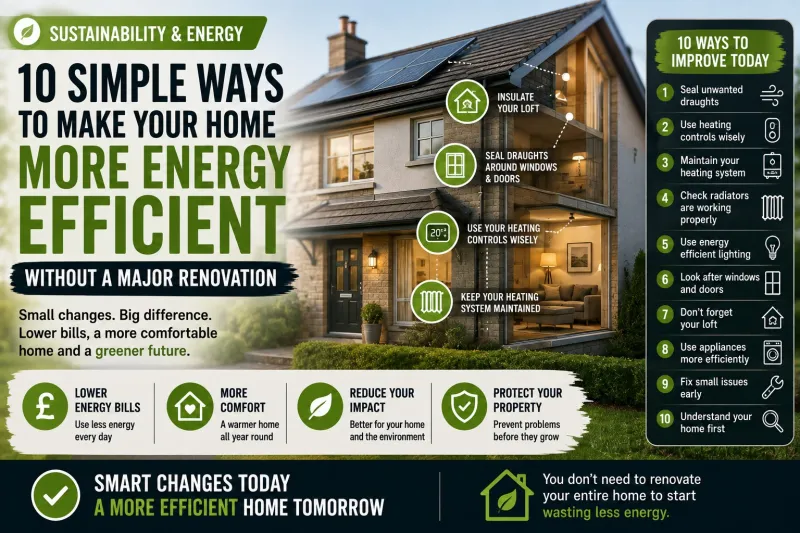
Reducing draughts, improving insulation where appropriate, maintaining heating equipment, using effective heating controls and replacing inefficient lighting can all form part of a gradual approach.
You don't have to do everything at once.
In fact, understanding your home's biggest weaknesses before spending money can help prevent you from spending thousands on an improvement that wasn't actually the highest priority.The best energy-efficiency project isn't necessarily the biggest one.
It's the one that addresses a genuine weakness in your home and makes sense for the building, your household and your budget.
Sometimes that means a major upgrade.
Sometimes it means fixing something small that has been overlooked for years.
Either way, making your home more efficient starts with understanding where the energy is actually going.
0 Comments
No comments yet — be the first to share your thoughts.