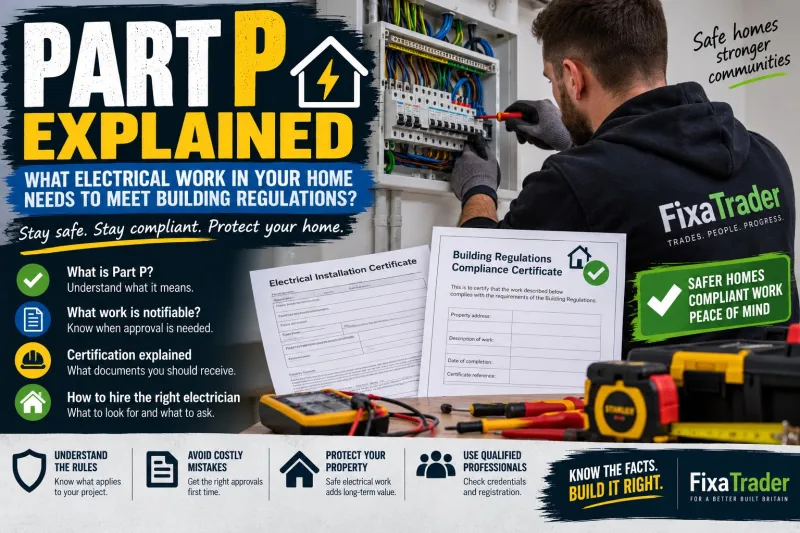
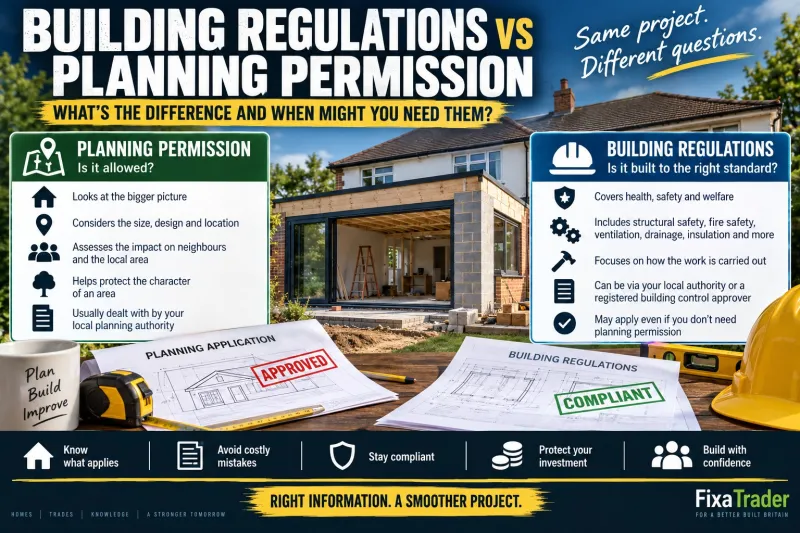
Part P Explained: What Electrical Work in Your Home Needs to Meet Building Regulations?
You need some electrical work carried out at home. Perhaps you're installing a new circuit. Replacing a consumer unit. Adding electrics to an extension. Or maki...
You need some electrical work carried out at home.
Perhaps you're installing a new circuit.
Replacing a consumer unit.
Adding electrics to an extension.
Or making changes during a kitchen renovation.
You find an electrician, agree on the work and get it completed.
But there's another question homeowners don't always think about until afterwards:
What paperwork should I receive?
This is where Part P of the Building Regulations often enters the conversation.
Part P applies to electrical safety in dwellings in England and is intended to help ensure that electrical installation work is carried out safely.
But there is plenty of confusion around what it actually means.
Does every electrical job need Building Regulations approval?
Does an electrician have to be “Part P registered”?
What's the difference between an electrical certificate and a Building Regulations compliance certificate?
And what does notifiable electrical work actually mean?
Let's break it down.What Is Part P?
Part P is one part of the Building Regulations in England.
Its fundamental requirement is that electrical installations are designed and installed in a way that provides reasonable protection against fire and injury.
It applies to electrical installation work in and around dwellings, subject to the scope of the regulations.
This is important because people sometimes talk about “Part P” as though it is a qualification held by an electrician.
It isn't.
Part P is a part of the Building Regulations.
Competent person schemes and electrical qualifications are related subjects, but they aren't the same thing as Part P itself.Does All Electrical Work Need to Comply?
Electrical installation work that falls within the scope of Part P needs to comply with its requirements.
But that doesn't mean every electrical job requires a separate Building Regulations notification.
That's where the distinction between notifiable and non-notifiable work becomes important.
Some types of electrical work must be notified to building control.
Other work may not require notification but still needs to be carried out safely and comply with the applicable requirements.
In other words:
“Non-notifiable” does not mean “no standards apply.”
What Is Notifiable Electrical Work?
Under the current rules in England, certain electrical installation work in dwellings is notifiable under the Building Regulations.
This includes:
Installing a new electrical circuit
Replacing a consumer unit
Certain additions or alterations to existing circuits within a special location
Bathrooms and other locations containing a bath or shower can fall within the rules around special locations, depending on exactly where the electrical work is being carried out.
The details matter.
If you're unsure whether the work you're planning is notifiable, ask the electrician before the job begins.What About Smaller Electrical Jobs?
Many smaller alterations and replacements aren't generally notifiable in the same way.
That doesn't mean they can simply be carried out without regard for electrical safety.
Electrical installations still need to be safe.
The type of certification appropriate to the work can also depend on what has actually been done.
This is one reason homeowners shouldn't judge electrical work solely by whether it needs to be notified to building control.
Notification is an administrative and compliance requirement for particular categories of work.
Competence and electrical safety matter on every job.Who Can Notify the Work?
There are different ways notifiable electrical work can be dealt with under the Building Regulations.
One common route is using an electrician registered with an authorised competent person scheme for the relevant work.
Registered installers can self-certify qualifying work as compliant with the Building Regulations rather than requiring the homeowner to make a separate building control application for that work.
Afterwards, the relevant Building Regulations compliance documentation can be issued.
Alternatively, notifiable work can be dealt with through building control using the appropriate procedure.
The important thing for the homeowner is to establish how compliance will be handled before the work starts.Does an Electrician Have to Be “Part P Registered”?
This phrase is commonly used, but it can be misleading.
There isn't a profession called a “Part P electrician”.
What people usually mean is that an electrician is registered with a competent person scheme that allows them to self-certify relevant electrical work under the Building Regulations.
That distinction matters.
An electrician's qualifications demonstrate one thing.
Competent person scheme registration demonstrates another.
And Building Regulations set the requirements that relevant work must satisfy.
They are connected, but they aren't interchangeable.What Is a Competent Person Scheme?
Competent person schemes allow appropriately registered businesses to self-certify certain types of building work as complying with the Building Regulations.
Electrical installation is one area where these schemes are commonly encountered.
For homeowners, using an appropriately registered electrician for relevant notifiable work can simplify the compliance process because the installer can deal with notification through their scheme.
But don't simply rely on a logo displayed on a van or website.
If scheme membership is important for your project, you can check the business through the relevant official register.What Certificates Might You Receive?
This is another area where terminology can become confusing.
Depending on the electrical work carried out, you may receive electrical certification relating to the installation itself.
For example, relevant work may result in an Electrical Installation Certificate or, for appropriate minor work, a Minor Electrical Installation Works Certificate.
Where work is notifiable and self-certified through a competent person scheme, there may also be a Building Regulations compliance certificate associated with the notification.
These documents serve different purposes.
The electrical certificate relates to the electrical installation and the work carried out.
The Building Regulations documentation demonstrates that the relevant notifiable work has been dealt with through the appropriate compliance route.
Don't assume they're simply two names for the same certificate.Why Should Homeowners Keep the Paperwork?
Because today's electrical work can become tomorrow's property question.
Imagine having a new consumer unit installed.
Five years later, you decide to sell the house.
Your conveyancer asks for documentation relating to electrical work carried out at the property.
Trying to reconstruct what happened years later is much harder than keeping the paperwork when the work is completed.
Store electrical certificates alongside other important property documents such as:
Building Regulations certificates.
Planning documents.
Window installation certificates.
Boiler documentation.
Guarantees.
Warranties.
And records of substantial building work.
You may not need them regularly.
But when you do need them, you'll be glad you kept them.What If You're Having an Extension Built?
This is where our previous article about planning permission and Building Regulations becomes particularly relevant.
Suppose you're building an extension.
The overall project may already be going through building control.
Electrical work within that extension still needs to satisfy the applicable electrical safety requirements.
How certification and notification are dealt with should therefore be established as part of the wider project.
Don't assume:
“The extension has Building Regulations approval, so somebody else must be dealing with the electrical paperwork.”
Find out who is actually responsible.
Your builder?
Your electrician?
The building control body?
Make that clear before the project reaches completion.What About DIY Electrical Work?
Being legally permitted to undertake a particular task and being competent to undertake it safely are not the same question.
Electrical work can create risks including electric shock and fire.
Some work is also subject to Building Regulations notification requirements.
Watching somebody complete an electrical job online doesn't demonstrate that you can safely assess the existing installation, select the correct equipment, install it properly, test it and verify that the finished work is safe.
For anything beyond straightforward tasks within your competence, using an appropriately qualified professional is the sensible approach.
And for notifiable work, make sure the Building Regulations requirements are understood before starting.What Should You Ask an Electrician Before Hiring Them?
For substantial electrical work, you don't need to interrogate somebody with twenty technical questions.
A few straightforward ones can establish a lot:
Are you appropriately qualified for this work?
Is this job notifiable under the Building Regulations?
If it is, how will it be notified?
Are you registered with a competent person scheme for this work?
What electrical certificate will I receive?
Will I also receive Building Regulations compliance documentation where applicable?
A professional electrician should be able to explain the process.Don't Choose an Electrician Based on a Badge Alone
Qualifications, registrations and scheme memberships are useful trust signals.
But they should form part of a wider picture.
You can also look at:
Relevant experience.
Previous work.
Reviews.
Insurance.
Professional communication.
The clarity of the quotation.
Whether the business can explain what is being installed.
And whether the necessary testing and certification are included.
Compliance is important.
So is the quality of the person actually doing the work.England, Wales, Scotland and Northern Ireland Aren't Identical
One particularly important point for a UK-wide platform like FixaTrader is that building standards and regulatory systems aren't identical across all four nations.
Part P, as described in this article, relates specifically to England.
Wales has its own Building Regulations framework, while Scotland and Northern Ireland operate under their respective building standards and regulations.
So homeowners shouldn't assume that an article describing the English notification system applies unchanged everywhere in the UK.
Always check the rules applicable to the location of the property.Check Before the Work Starts
The worst time to discover that electrical work should have been notified is years after it was completed.
If you're arranging significant electrical work, establish the compliance process at the beginning.
What work is being carried out?
Is it notifiable?
Who will deal with the notification?
What testing will be completed?
What certificates will you receive?
Then keep those documents.
It doesn't need to make hiring an electrician complicated.
It simply needs to be part of the conversation.
Part P isn't a badge that makes somebody an electrician.
It's part of the Building Regulations designed to help ensure electrical work in homes is carried out safely — and for certain work, that means following the correct notification and certification process too.
0 Comments
No comments yet — be the first to share your thoughts.