Gas Safe Registered: What Does It Actually Mean and What Should Homeowners Check?
You need somebody to work on your boiler. A company advertises itself as: “Gas Safe registered.” That sounds like exactly what you need. And it's certainly some...
And it's certainly something you should be looking for when gas work requires a registered engineer.
But there's an important detail homeowners don't always realise:
Gas Safe registration isn't simply a generic badge that means somebody can work on every type of gas appliance.
Engineers can be qualified for different categories of work.
The business matters.
The individual engineer matters.
And the work they're actually qualified to carry out matters too.
Here's what homeowners should understand.1. What Is the Gas Safe Register?
The Gas Safe Register is the official registration scheme for gas businesses and engineers legally permitted to undertake relevant gas work in the UK, Isle of Man and Guernsey.
It replaced CORGI as the gas registration body in Great Britain in 2009.
For homeowners, the basic principle is straightforward:
Gas work that legally requires a Gas Safe registered engineer should not be handed to somebody who isn't appropriately registered and qualified for that work.
You can check businesses and engineers through the official register:
But it's ultimately an individual engineer who arrives at your property and carries out the work.
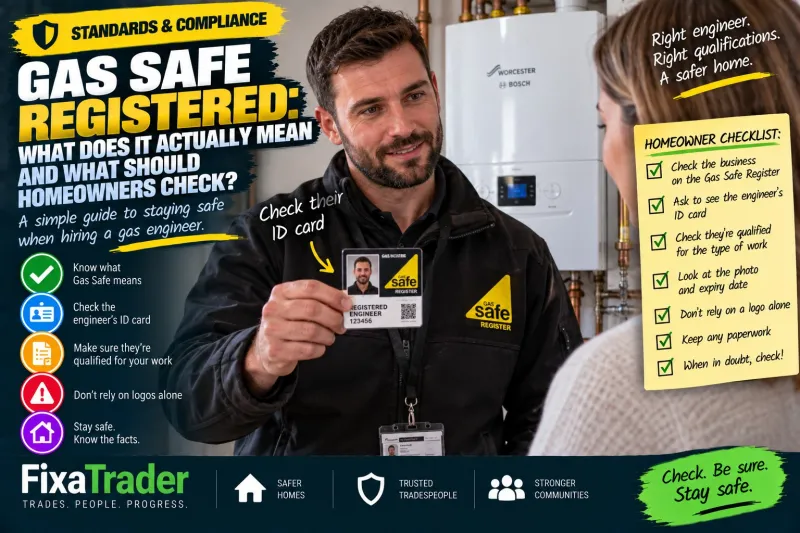
Gas Safe provides engineers with an ID card showing their registration information and the categories of gas work they're qualified to perform.
That distinction is useful because:
A registered company doesn't mean every person associated with that company can personally undertake every form of gas work.
The engineer carrying out the work needs the appropriate competence for the work involved.3. Ask to See the Gas Safe ID Card
A legitimate engineer should be able to show their Gas Safe ID card.
Don't feel awkward asking.
Checking professional credentials isn't an accusation.
It's a sensible precaution when somebody is about to work on a safety-critical system inside your home.
The front of the card contains identifying information.
The reverse shows the types of gas work the engineer is qualified to undertake.
That second part is particularly important.4. Check What They're Qualified to Work On
This is where “Gas Safe registered” can sometimes be misunderstood.
An engineer may be registered for particular categories without being qualified for every gas appliance or type of installation.
For example, qualifications can differ depending on the work involved.
So if somebody is attending to work on a particular appliance or system, don't only ask:
“Are you Gas Safe registered?”
The more useful question is:
“Are you registered for this type of work?”
The engineer's card and the official register can help you verify that.5. Check the Photograph and Expiry Date
If you're checking an engineer's ID card, actually check it.
Does the photograph match the person standing in front of you?
Is the card still valid?
Does the information correspond with the engineer or business you expected?
It's easy to ask to see identification and then barely look at it because you feel uncomfortable keeping somebody waiting.
Take the few seconds required.
That's what the identification is there for.6. Don't Rely Only on a Logo
A Gas Safe logo on:
A website.
Van.
Social-media profile.
Advertisement.
Business card.
Or workwear
isn't the same thing as independently checking registration.
Logos can potentially be misused.
A business could also have information online that is outdated.
The official register exists so that homeowners don't have to rely entirely on what somebody claims about themselves.
If you're unsure, check.7. What If Someone Says They're “Gas Qualified”?
Be careful with vague terminology.
Phrases such as:
“Gas qualified.”
“Heating specialist.”
“Boiler expert.”
or
“Fully trained.”
don't replace the legal registration requirements applicable to gas work.
Someone may have extensive knowledge of heating systems while still not being permitted to undertake particular gas work.
Likewise, some heating work may not itself involve carrying out gas work.
The important question is what work is actually being performed and whether the person carrying it out holds the appropriate registration and competence where required.8. What About Apprentices or Trainees?
Seeing another person working alongside a registered engineer doesn't automatically mean something improper is happening.
The gas industry, like other skilled trades, needs people to learn under appropriate arrangements.
The relevant issue is whether the work is being undertaken within the proper supervision and competency framework.
If you're concerned about who is carrying out gas work in your property, ask the registered business or engineer.
You don't need to guess.9. Does Gas Safe Registration Mean the Work Is Guaranteed to Be Perfect?
No professional registration should be interpreted as a guarantee that nothing can ever go wrong.
Gas Safe registration demonstrates that the business is registered and that engineers have relevant recorded competencies for the categories shown.
It doesn't mean every registered engineer has identical experience, pricing, customer service or workmanship.
You should still make normal hiring checks where appropriate:
Look at reputation.
Discuss the work.
Understand the quote.
Ask relevant questions.
Keep paperwork.
And make sure you're comfortable with who you're hiring.
Registration is a crucial safety and legal check.
It isn't the only consideration when choosing a business.10. What Paperwork Should You Receive?
That depends on the work carried out.
Different jobs can involve different records, certificates or notifications.
For certain new heat-producing appliances, Building Regulations requirements may also be relevant, and appropriately registered installers can in some circumstances notify qualifying work through competent person arrangements.
Don't assume every visit should produce the same certificate.
Ask the engineer:
“What paperwork should I receive for this work?”
For installations, keep relevant documentation somewhere safe.
It can become useful when servicing equipment, making warranty claims or eventually selling the property.What About Landlords?
Landlords have additional gas-safety responsibilities.
In relevant rented properties, landlords are generally required to arrange annual gas safety checks on applicable gas appliances and flues and meet associated record requirements.
Those checks must be carried out by an appropriately qualified Gas Safe registered engineer.
Landlords should use current official guidance rather than assuming an ordinary boiler service automatically satisfies every legal responsibility.
Homeowners sometimes worry that asking to see credentials will offend a genuine tradesperson.
It shouldn't.
Professional registration exists partly so customers can verify that somebody is appropriately qualified to undertake regulated work.
The check can take very little time.
Before gas work begins:
Check the business.
Check the engineer.
Look at the ID card.
Check the categories of work.
Make sure the person you're expecting is the person who has arrived.
Then keep any relevant documentation after the work is completed.
Because when the work involves gas, relying on somebody simply saying “don't worry, I'm qualified” isn't necessary when the registration can be independently checked.
A Gas Safe badge is a useful sign—but the strongest check is verifying the person, the registration and the work they're actually qualified to carry out.
0 Comments
No comments yet — be the first to share your thoughts.