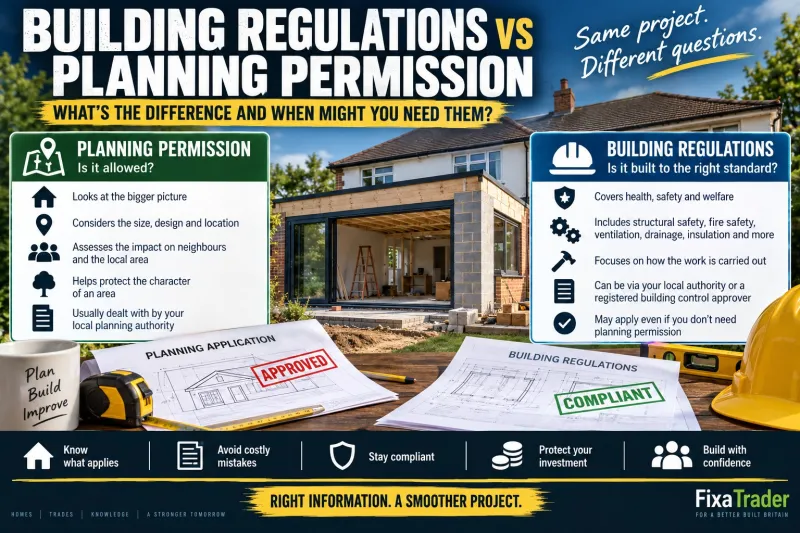
Building Regulations vs Planning Permission: What’s the Difference and When Might You Need Them?
You're planning some work on your home. Perhaps you're removing a wall. Building an extension. Converting the loft. Replacing windows. Changing the heating. Or...
They're sometimes used interchangeably in everyday conversation, but they deal with different things.
And understanding that difference matters.
A project that doesn't require planning permission could still need to comply with Building Regulations.
Another project may involve both.
Some relatively straightforward work may require neither a planning application nor a separate Building Regulations application, although other requirements can still apply.
So what is the difference?Planning Permission Is Mainly About What You Can Build
The planning system is concerned with the development and use of land and buildings.
For a homeowner, that can include questions such as:
How large is the proposed development?
Where will it be positioned?
How will it affect the appearance of the property?
Could it affect neighbouring properties?
Is the building listed?
Is the property within a conservation area?
Will the use of the property change?
In simple terms, planning is largely concerned with whether a particular development is acceptable in that location.
For many household projects, the relevant authority will be your local planning authority.Building Regulations Are Mainly About How Work Is Carried Out
Building Regulations have a different purpose.
They establish minimum requirements covering areas such as the health, safety, accessibility and energy performance of buildings.
Depending on the work, that can involve matters such as:
Structural safety
Fire safety
Ventilation
Drainage
Electrical safety
Energy efficiency
Access
Sanitation
Glazing
Insulation
So while planning might consider whether an extension is acceptable in principle, Building Regulations can affect how that extension must actually be designed and constructed.
That's why obtaining planning permission doesn't automatically mean you've satisfied Building Regulations.
They are separate systems.You Might Need Both
Imagine you're building a substantial extension.
The development may require planning permission because of its size, design or circumstances.
If permission is granted, that answers the planning question.
But the actual construction may still need to satisfy applicable Building Regulations.
That could involve the foundations.
Structure.
Insulation.
Drainage.
Ventilation.
Fire safety.
Electrical work.
And other technical requirements.
Planning approval is not Building Regulations approval.
For projects involving both systems, each needs to be dealt with appropriately.You Might Need Building Regulations Without Planning Permission
This is where homeowners can easily become confused.
Some work can be carried out without making a conventional planning application because it falls within permitted development rights, subject to the relevant conditions and limitations.
That doesn't automatically remove Building Regulations requirements.
Similarly, certain internal alterations may have little or nothing to do with planning permission but still involve Building Regulations.
Removing or altering a load-bearing wall is a good example.
From the street, the house may look exactly the same afterwards.
But structurally, the work could be significant.
Whether planning permission is needed and whether Building Regulations apply are two separate questions.And Some Work May Not Need Either Application
Not every home improvement requires formal approval.
Routine decorating, replacing ordinary fittings or carrying out many minor repairs generally isn't treated in the same way as constructing an extension or making significant structural alterations.
But don't rely on a broad statement such as:
“You don't need permission for that.”
Which permission?
Planning?
Building Regulations?
Listed building consent?
Something else?
And does that answer actually apply to your particular property and project?
The details matter.What Is Permitted Development?
Permitted development rights allow certain types of development to take place without a conventional planning application, provided the work meets the relevant rules.
This can potentially cover certain household extensions and alterations, among other development.
But permitted development isn't simply a blanket rule saying homeowners can build whatever they want up to a particular size.
Rights are subject to conditions and limitations.
They can also be affected by the property, location, previous development and local restrictions.
Flats and maisonettes don't have the same permitted development rights as houses, for example.
Some rights may also be restricted in designated areas or removed through specific planning controls.
Before relying on permitted development, check that your actual proposal qualifies.What About Listed Buildings?
Listed buildings require particular care.
Work affecting the character of a listed building may require listed building consent, including work that might otherwise appear to be an internal alteration.
That is separate again from ordinary planning permission and Building Regulations.
Carrying out unauthorised work to a listed building can have serious consequences.
If you own a listed property, don't assume that because something is inside the building or can't be seen from the road, approval isn't relevant.
Check first.Who Deals With Building Regulations?
Building control oversees compliance with Building Regulations.
Depending on the circumstances, this may involve a local authority building control service or a registered building control approver.
The appropriate process depends on the project.
For homeowners, the important point is to establish before work begins what route is being used and who is responsible for dealing with it.
Don't simply assume the builder is handling everything unless that has actually been agreed.Some Trades Can Self-Certify Certain Work
For some types of work, appropriately registered installers may be able to self-certify that their work complies with relevant Building Regulations through a competent person scheme.
This can apply to certain categories of installation where the contractor belongs to an authorised scheme covering that work.
The homeowner may then receive documentation relating to the completed installation without making a separate Building Regulations application themselves for that particular work.
But registration isn't universal.
And being competent at a trade doesn't automatically mean someone belongs to every relevant self-certification scheme.
If certification matters for the work you're arranging, ask how it will be handled.Why Does the Paperwork Matter?
It's easy to think of compliance documents as something that gets filed away and forgotten.
They can become much more important later.
Imagine selling the property several years after completing major work.
Questions may arise about whether alterations had the necessary approvals or certification.
Missing documentation can create additional enquiries and potentially complicate a sale.
More importantly, the approval process exists for reasons beyond paperwork.
For Building Regulations in particular, the underlying requirements relate to how buildings perform and how work is carried out.
A certificate isn't a substitute for good workmanship.
But neither should compliance be treated as an optional administrative extra.Don't Assume Your Tradesperson Is Responsible for Everything
This is an important conversation to have before a project starts.
Depending on the project, responsibility for applications and notifications might sit with:
The homeowner.
The builder.
An architect.
A designer.
An engineer.
A specialist contractor.
Or another professional involved in the work.
The mistake is leaving it ambiguous.
If you believe the builder is submitting something and the builder believes you're doing it, the problem may not become apparent until work is already underway.
For larger projects, put responsibilities in writing.Questions Worth Asking Before Work Starts
You don't need to become an expert in planning law or Building Regulations.
But you should understand the approval route for your project.
Useful questions include:
Does this work require planning permission?
Could it fall within permitted development instead?
Do Building Regulations apply?
Are there any other consents relevant to this property?
Who is making the application or notification?
Who will arrange inspections where required?
Will I receive certification when the work is complete?
Which documents should I keep afterwards?
If nobody involved can confidently answer those questions on a substantial project, it's worth finding out before construction begins.Check With the Proper Authority
Friends, neighbours and online forums can be useful for understanding how other people approached similar projects.
But:
“My neighbour didn't need planning permission”
doesn't establish that you don't.
Their extension may be different.
Their property may be different.
Planning restrictions may have changed.
Their previous development history may be different.
Or they may simply have been wrong.
For planning matters, your local planning authority and the government's official Planning Portal are useful starting points.
For Building Regulations, official government guidance and the relevant building control body can help establish what applies.The Difference in One Simple Example
Suppose you want to build an extension.
Planning asks:
Are you allowed to build this extension here in this form?
Building Regulations ask:
Does the way this extension is designed and constructed meet the applicable technical requirements?
Those are different questions.
And that's why satisfying one doesn't automatically satisfy the other.Check Before You Build
Approval questions are much easier to deal with before work begins than after it has been completed.
Before starting a significant home-improvement project, establish:
What you're building.
Which rules potentially apply.
What permissions or notifications are required.
Who is responsible for obtaining them.
And what documentation you should receive when the project is finished.
Don't rely solely on assumptions because a project looks small or because somebody else carried out similar work.
Planning permission and Building Regulations aren't two names for the same thing.
One can determine whether development is acceptable. The other helps determine the standards to which applicable building work must be carried out — and your project may need to deal with both.
0 Comments
No comments yet — be the first to share your thoughts.